Factory-direct from Lahore · Nationwide delivery in 2–4 days
+92 319 4262451
WhatsApp
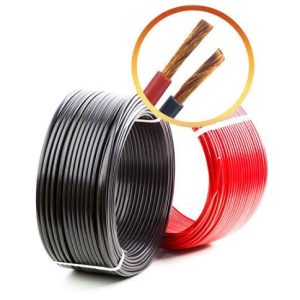
One 0.75 mm² class 5 core, 24 strands of 0.20 mm, PVC insulated and rated 1000 V DC. 6 A and 26.0 Ω/km. DC runs as a pair — one core positive, one negative — and the 62 mV/A/m figure already counts both legs, which is why volt drop, not heat, decides this size on almost every job. It is the bottom of our DC ladder: sensor and meter runs, indicator circuits and the short leads on a small panel or a portable kit. Drawn on the Pilone line in Lahore.
Prices track the daily copper rate. Bulk and coil pricing on request.
Check the coil before you pay for it
Every coil leaves our factory with a QR code printed on the packaging. Scan it and the factory record for that batch opens: brand, cable size, batch number, year of manufacture and conductor. Compare the batch number on screen with the one printed on your coil — if the two do not match, it did not come from us.
| Property | Value |
|---|---|
| Conductor | Plain annealed copper, class 5 flexible stranded |
| Nominal area | 0.75 mm² × 1 core |
| Strand construction | 24 / 0.20 mm (typical) |
| Max conductor resistance at 20°C | 26.0 Ω/km |
| Current capacity (single conductor, DC reference) | 6 A |
| Voltage drop | 62 mV/A/m |
| Voltage rating | 1000 V DC |
| Insulation / sheath | PVC / PVC, 70°C conductor rating |
| Conductor copper weight | ≈ 6.7 kg/km |
| Reference standards | IEC 60228 (conductors), IEC 60227 (PVC cables) |
Short positive and negative tails on a small panel, a portable folding kit, or a 12 V light board — where the run is a couple of metres, not a rooftop.
Shunt and display wiring, temperature sensors, low-side switching. Currents in the milliamp-to-2 A range where copper cost matters more than capacity.
Battery-sense and remote-display leads inside an enclosure, and other DC control runs that never carry the array current.
Work the length first. Volt drop is current × metres × 62 mV/A/m ÷ 1000, and solar work is usually designed to 3% on the DC side. A 2 A sensor or small-panel lead on a 24 V system has a 0.72 V budget: 0.72 × 1000 ÷ (2 × 62) = 5.8 m of route. Load the same cable to its full 6 A on 24 V and the budget is gone at 1.9 m. On a 12 V battery circuit at 6 A it is under a metre. That is the honest shape of this size: fine for short, low-current DC, wrong for a panel-to-inverter home run, which is why installers step to 4mm DC cable or 6mm DC cable for the array itself.
“Excellent quality copper cables. Fast delivery across Pakistan. Highly recommended for electrical projects.”
“Best cable manufacturer in Lahore. 99.9% pure copper as promised. Very satisfied with the product quality.”
“Good quality cables at competitive prices. Delivery was quick to Karachi. Will order again.”