
Factory-direct from Lahore · Nationwide delivery in 2–4 days
+92 319 4262451
WhatsApp
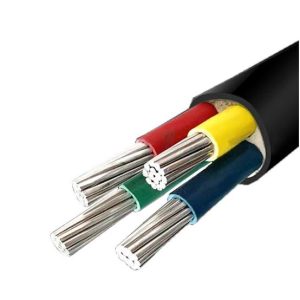
The trade code is 7/.052 — four aluminium conductors of seven 0.052″ strands each, PVC insulated and sheathed to 450/750 V. Three loaded conductors carry 43 A on BS 7671 reference method C, about 30 kVA on a 400 V three-phase supply. Four cores because a three-phase meter feeds three phases plus a neutral, all in one sheath. Drawn on the Pilone line in Lahore.
Prices track the daily aluminium and copper rates. Bulk and coil pricing on request.
Check the coil before you pay for it
Every coil leaves our factory with a QR code printed on the packaging. Scan it and the factory record for that batch opens: brand, cable size, batch number, year of manufacture and conductor. Compare the batch number on screen with the one printed on your coil — if the two do not match, it did not come from us.
| Property | Value |
|---|---|
| Conductor | Plain aluminium, class 2 stranded |
| Nominal area | 10 mm² × 4 cores |
| Strand construction | 7 / 0.052″ per core |
| Max conductor resistance at 20°C | 3.08 Ω/km |
| Current capacity (method C, 3 loaded) | 43 A |
| Voltage rating | 450/750 V |
| Insulation / sheath | PVC / PVC, 70°C conductor rating |
| Conductor aluminium weight | ≈ 108 kg/km (4 × 27.0 kg/km) |
| Reference standards | IEC 60228 (conductors), IEC 60227 (PVC cables) |
Heat sets the 43 A limit. Distance sets the second one. On a balanced three-phase circuit the drop is 1.732 × current × length × resistance ÷ 1000, using the 3.08 Ω/km from the table above.
A 30 A three-phase load 30 m from the board: 1.732 × 30 × 30 × 3.08 ÷ 1000 = 4.8 V. On 400 V that is 1.2%, comfortably inside the 5% BS 7671 allows on a power circuit, which is 20 V here. Run the sum backwards and 30 A spends the full 20 V at 20 × 1000 ÷ (1.732 × 30 × 3.08) = 125 m; at this cable's full 43 A it lands at 87 m.
Three-phase runs travel further than most people expect, and the reason is in the arithmetic: the budget is 5% of 400 V rather than 5% of 220 V, and the sum uses 1.732 instead of the 2 that a single-phase line-and-neutral pair needs. The same 10 mm² conductor in the 2 core version is out of volts in under half the distance. One caution: 3.08 Ω/km is the IEC 60228 figure at 20 °C, and a conductor near its 70 °C rating has more resistance, so keep margin. Check your own run in the voltage drop calculator.
Three phases plus a neutral from a three-phase meter to the main board — 43 A, about 30 kVA at 400 V.
Small commercial three-phase connections whose sanctioned load sits inside 30 kVA.
Panel to a three-phase motor or pump drawing under 43 A, on a fixed clipped run.
Core count follows the supply, not the load. A three-phase meter delivers three phases and a neutral, so the cable that leaves it has four cores; that is the whole reason this SKU exists next to the two-core. The buyer is usually an electrician commissioning a three-phase connection for a shop, a small workshop or a tubewell, ordering 20 to 40 metres of it by the coil. Aluminium suits the job because the run is fixed, clipped, and terminated only at its two ends.
If the meter is single-phase, you want line and neutral only — that is 10mm 2 core aluminium cable at 48 A. If the three-phase load is above 30 kVA, step up to 16mm 4 core aluminium cable at 59 A. This is insulated power cable, not bare overhead conductor: we do not make ACSR. Copper in the same four-core build carries more current in a smaller cable — copper vs aluminium cable sets the two against each other.
“Excellent quality copper cables. Fast delivery across Pakistan. Highly recommended for electrical projects.”
“Best cable manufacturer in Lahore. 99.9% pure copper as promised. Very satisfied with the product quality.”
“Good quality cables at competitive prices. Delivery was quick to Karachi. Will order again.”