
Factory-direct from Lahore · Nationwide delivery in 2–4 days
+92 319 4262451
WhatsApp
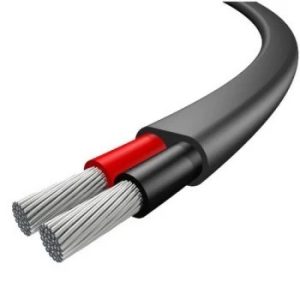
The trade calls it 7/.052 — two aluminium conductors of seven 0.052″ strands each, PVC insulated and sheathed to 450/750 V. It carries 48 A on BS 7671 reference method C, about 10.5 kW on a 220 V single-phase supply, which is why it is the usual size for the drop from a single-phase meter to a house main board. Drawn on the Pilone line in Lahore.
Prices track the daily aluminium and copper rates. Bulk and coil pricing on request.
Check the coil before you pay for it
Every coil leaves our factory with a QR code printed on the packaging. Scan it and the factory record for that batch opens: brand, cable size, batch number, year of manufacture and conductor. Compare the batch number on screen with the one printed on your coil — if the two do not match, it did not come from us.
| Property | Value |
|---|---|
| Conductor | Plain aluminium, class 2 stranded |
| Nominal area | 10 mm² × 2 cores |
| Strand construction | 7 / 0.052″ per core |
| Max conductor resistance at 20°C | 3.08 Ω/km |
| Current capacity (method C, 2 loaded) | 48 A |
| Voltage rating | 450/750 V |
| Insulation / sheath | PVC / PVC, 70°C conductor rating |
| Conductor aluminium weight | ≈ 54.0 kg/km (2 × 27.0 kg/km) |
| Reference standards | IEC 60228 (conductors), IEC 60227 (PVC cables) |
Heat sets the 48 A limit. Length sets the other one, and on a service drop the length is usually what bites first. On a 2-core single-phase run the current goes out on the line and comes back on the neutral, so it sees twice the run length: drop = 2 × current × length × resistance ÷ 1000, with the 3.08 Ω/km from the table above.
Take a 40 A main breaker and 20 m from the meter box to the main board. 2 × 40 × 20 × 3.08 ÷ 1000 = 4.9 V. That is 2.2% of 220 V, well inside the 5% BS 7671 allows on a power circuit — 11 V on this supply. Turn the sum around and the same 40 A spends the whole 11 V at 11 × 1000 ÷ (2 × 40 × 3.08) = 45 m. Load this cable to its full 48 A and the budget runs out at 37 m. Past those distances the run length picks the size, not the load.
One note on that arithmetic, because most listings skip it: 3.08 Ω/km is the IEC 60228 maximum at 20 °C. A conductor working near its 70 °C rating has more resistance than that, so 4.9 V is the optimistic end of the answer and you should leave margin. Put your own current and length through the voltage drop calculator before you buy the coil.
The run from a single-phase WAPDA or K-Electric meter to the house main board — line and neutral in one sheath, 48 A clipped direct.
48 A is roughly 10.5 kW at 220 V. A 40 A main breaker sits inside that with room left for summer derating.
Main board to an outbuilding, a shop front or a boundary-wall meter box, where the run is fixed and clipped.
The buyer for this size is usually an electrician doing a domestic connection: a new single-phase meter, a 30 to 40 A main breaker, and 15 to 30 metres from the meter box to the main board. Aluminium earns its place on that run because the cable is fixed, terminated twice, and paid for by the metre. What it is not for is the wiring behind the board — socket and light circuits belong in copper, where a small conductor has to survive being bent into a switch box and clamped under a tiny screw. Note also that this is insulated power cable: we do not make ACSR or bare overhead conductor.
For three phases plus a neutral the same conductor comes in four cores as 10mm 4 core aluminium cable. For more current on one phase, 16mm 2 core aluminium cable carries 66 A on the same method. Copper at the same nominal size carries more in a smaller cable — copper vs aluminium cable puts the two side by side.
“Excellent quality copper cables. Fast delivery across Pakistan. Highly recommended for electrical projects.”
“Best cable manufacturer in Lahore. 99.9% pure copper as promised. Very satisfied with the product quality.”
“Good quality cables at competitive prices. Delivery was quick to Karachi. Will order again.”