
Factory-direct from Lahore · Nationwide delivery in 2–4 days
+92 319 4262451
WhatsApp
A server room is the one building load with no diversity in it. The racks pull what they pull at three in the morning as hard as at noon, and the cable never gets a cool hour. That is what changes the sizing, and it is what this page works through.
Size every circuit on 100% of its rated load, then derate it for the bundle it runs in.
A 5 kW rack on a single-phase 220 V feed draws 5000 ÷ 220 = 22.7 A and holds it, so it belongs on a 32 A breaker. 4 mm² copper is rated 36 A clipped direct at 30 °C, but a dozen circuits bunched in one under-floor basket pull that below the breaker rating — 6 mm² at 46 A is the size that still clears it. Where a rack has an A feed and a B feed, each one has to carry the whole rack alone, so both are sized for the full 22.7 A.
Start from the rack's rated feed, not from what the servers currently idle at. Divide by 220 V for a single-phase feed, take the breaker at 125% of that current, and read the base cable size off the same row. The 125% is what makes a rack different from a house circuit: the load is continuous, so the protective device is not sized on the bare figure.
| Rack feed | Current at 220 V | Breaker | Base size | Base capacity |
|---|---|---|---|---|
| 2 kW | 9.1 A | 16 A | 2.5 mm² | 27 A |
| 3 kW | 13.6 A | 20 A | 2.5 mm² | 27 A |
| 5 kW | 22.7 A | 32 A | 4 mm² | 36 A |
| 7 kW | 31.8 A | 40 A | 6 mm² | 46 A |
| 10 kW | 45.5 A | 63 A | 10 mm² | 63 A |
The 10 kW row is the one people get wrong. The base read-off is 10 mm² at 63 A — exactly the breaker, with no margin left to spend on grouping. Under a floor with other circuits it will not hold, so the size we would actually run is 16 mm² at 85 A. That is a judgement on top of the table, not a reading of it. A three-phase PDU feed changes the arithmetic to line current at 400 V — that ladder lives on 3-phase cable size.
The rack is rated 5 kW, the feeds run 25 m from the panel, and both of them share a floor basket with ten other circuits in a room held warm by the racks themselves.
So the feed is 6mm 2 core cable, twice, on separate routes. Split A and B into different baskets and each group gets smaller, which is worth more than a size of copper. Check your own run in the voltage drop calculator.
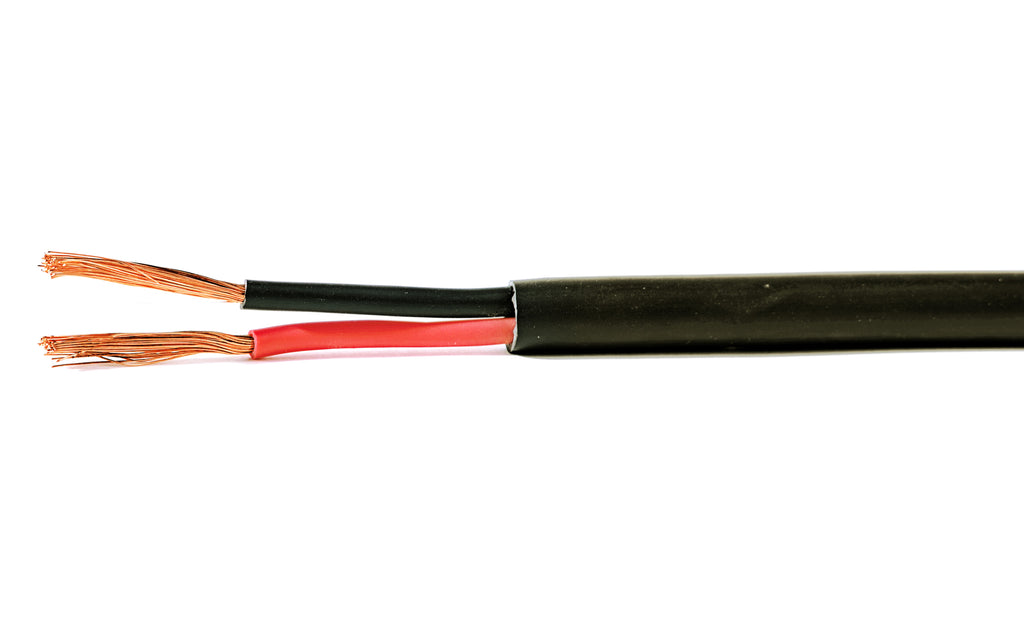
Class 5 stranded copper, 300/500 V, for tails that bend into a rack or a PDU and get re-dressed when the row changes.
Class 2 stranded copper, 450/750 V, for the fixed runs between panels, UPS output boards and floor baskets.
Where a feed leaves the room — out to a generator, across a yard, under a slab — the mechanical protection matters more than the flex, and that run goes in 16mm armoured cable or the size the load calls for. What to check before burying it is on underground cable.
Two honest limits, stated before you order rather than after. First, "data center cable" means two different things: the Cat6 and fibre between switches and servers, which we do not make, and the power cable behind it, which we do. Second, our line is PVC insulated copper and aluminium at a 70 °C conductor rating, 450/750 V fixed and 300/500 V flexible. If your specification calls for low-smoke or fire-survival cable on the critical circuits, that is a separate certified product class — read our position on fire resistant cable and tell us the requirement before you buy, not after.
Size, cores, construction and metres per line — or the load schedule and we will read the sizes off it with you.
Cable is priced off the day's copper rate, so the quote is dated. No dealer margin between the line that drew it and you.
Collect from the Lahore factory, or we dispatch by courier or transport — Punjab in 1–2 days, rest of Pakistan in 2–4.
Send the load schedule or the cable lines from your BOQ. You get the day's factory price against each one, with dispatch by courier or transport.