Factory-direct from Lahore · Nationwide delivery in 2–4 days
+92 319 4262451
WhatsApp
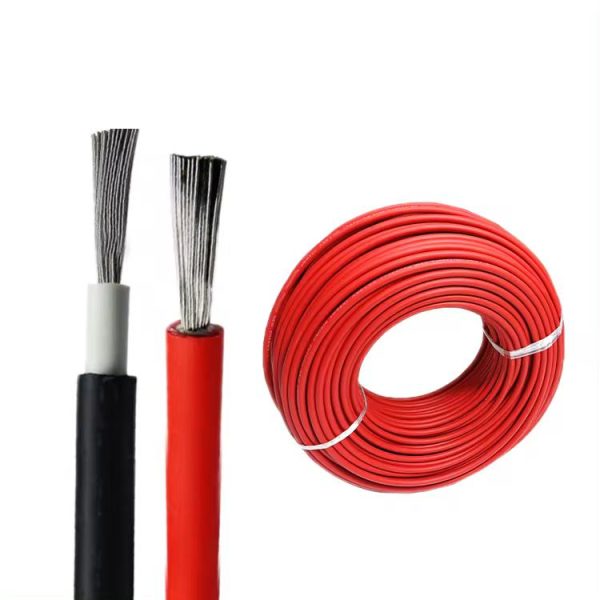
A solar job buys three cables, not one: single-core DC up on the roof, multi-core for the inverter's AC output, and earth cable on the array frames. All three drawn in Lahore, quoted at the day's copper rate.
On a typical 5 kW rooftop job: 6 mm² single-core DC for the panel strings and home run, 4 mm² for the inverter’s AC output, and 6 mm² earth to the array frame — with bigger arrays moving up the same ladder.
6 mm² carries 46 A on the BS 7671 method C reference against 36 A for 4 mm², and it drops 7.3 mV per amp per metre where 4 mm² drops 11 mV — a third less loss on what is usually the longest cable in the job, which is why rooftop DC runs settle there. The AC side is set by arithmetic: a 5 kW single-phase inverter puts out 5000 ÷ 220 = 22.7 A, and 4 mm² carries that with margin at 36 A. Earth to the array frame matches the DC conductor at 6 mm², and all three — single-core DC, multi-core AC and earth cable — are drawn in Lahore and quoted line by line at the day's copper rate.
Solar is the one job where the current changes character halfway through. Between the panels and the inverter it is direct, one conductor per polarity, so the cable is single-core and a string is two separate cables, not a twin. Past the inverter it is ordinary 220 V single-phase or 400 V three-phase, wanting the same multi-core cable as a house submain. Bonding is a third purchase again.
The trade's SWG codes only name half of that. 7/.036 and 7/.052 — roughly 4 mm² and 10 mm² — are the class 2 standard coils that run the AC side, and an installer can order those by code. The DC single-core has no SWG name: it is class 5 fine strand, ordered in mm² and in two colours. Send the DC lines in mm² and nothing gets substituted.
| Where it runs | Family | Sizes we draw | Why that cable |
|---|---|---|---|
| Panel string and DC home run to the inverter | single-core DC cable | 0.75 – 35 mm² | DC needs one cable per polarity, so the conductor is single-core and bought in two colours |
| Inverter AC output to the AC distribution board | standard or flexible multi-core | 0.75 – 25 mm² | Live, neutral and earth in one sheath; sized to the inverter's rated output current, not the panel wattage |
| Array frames, rails and inverter chassis | earth cable | 6 – 35 mm² | Bonds the metalwork so a fault has a low-resistance path back instead of a person |
The AC side is where quotes go wrong, because it gets sized off the system's kW instead of the inverter's output current. Take that 22.7 A over a 15 m run to the AC board: on 4 mm² the drop is 11 × 22.7 × 15 ÷ 1000 = 3.75 V, inside the 6.6 V that 3% of 220 V allows. On 2.5 mm² the same run drops 18 × 22.7 × 15 ÷ 1000 = 6.13 V — almost the whole budget, before the submain from the meter has taken its share. To see one system worked end to end, panels to meter, read cable size for a 5kW solar system. Installers also ask which is the best DC cable for solar, and the honest answer is a size and a construction rather than a name: the size comes off the run, the construction off how hot the roof gets. The DC range page carries the ladder, the PVC and XLPE builds and the rate per size.
Cable is priced on the metal inside it, so the number a bulk buyer wants is kilograms of conductor per hundred metres. Order 200 m of 6 mm² and 100 m of 16 mm² on one job and you buy 200 × 0.0533 = 10.7 kg on the first line and 100 × 0.1422 = 14.2 kg on the second — half the metres, more metal. That is why a mixed order is quoted line by line, never as one job price.
| Size | Class 5 strands | Copper per 100 m | R at 20°C | Where it goes on a solar job |
|---|---|---|---|---|
| 4 mm² | 56/0.30 | 3.56 kg | 4.95 Ω/km | Short strings, small inverter AC output |
| 6 mm² | 84/0.30 | 5.33 kg | 3.30 Ω/km | The rooftop workhorse — strings and home runs |
| 10 mm² | 80/0.40 | 8.89 kg | 1.91 Ω/km | Longer home runs, combiner to inverter |
| 16 mm² | 126/0.40 | 14.22 kg | 1.21 Ω/km | Higher-output arrays, long roof-to-inverter runs |
| 25 mm² | 196/0.40 | 22.23 kg | 0.78 Ω/km | Main DC run on commercial arrays |
| 35 mm² | 276/0.40 | 31.12 kg | 0.554 Ω/km | The largest DC size we run |
One habit follows from that: settle the unit before you compare suppliers — the cable price per meter page explains how to normalise a per-coil figure you already hold. Rates sit with the size rather than with the job, so the 4mm solar cable price in Pakistan and the 16mm solar cable price in Pakistan each live on their own size pages, per metre and per coil, moving with that day's copper.
Buy by the coil and underweight copper costs you a whole job, not one circuit. Three checks catch it on the spot, all read off the table above. Read your own metres off the quote first — we cut to the length ordered and write those metres beside the rate — then scale these figures to it. The worked case here is 100 m of 6 mm² single-core.
Where our sheet stops is worth stating too. The conductor is plain annealed class 5, not tinned. IEC 60228 and IEC 60227 say where our resistance, stranding and construction figures come from — provenance, not a certificate; we publish no test reports or third-party marks. Temperature stops at the conductor rating, 70°C PVC and 90°C XLPE, with no service-life figure beyond it.
WhatsApp each size with the metres against it — DC, AC out and earth — plus your city. A system size on its own cannot be priced; metres per size can.
Cable tracks the daily copper rate, so we quote that day's factory price for each size, per metre and per coil, with no dealer margin on top.
Collect from the Lahore factory, or we dispatch — courier for single coils, transport for bulk. Punjab in 1–2 days, rest of Pakistan in 2–4 days.
Repeat orders run the same loop, because copper moves and last month's number is not this month's. Send the same list back and you get the current figure against it.
Send the sizes and the metres against each one. You get the day's factory price per line, per metre and per coil, with collection from Lahore or delivery nationwide.