Factory-direct from Lahore · Nationwide delivery in 2–4 days
+92 319 4262451
WhatsApp
6 mm² bonds the frames, rails and inverter body on a 3–5 kW array; 10 mm² from 10 kW up. The earth core inside the AC cable is a separate conductor and follows its own phase.
A protective conductor is not sized from the kilowatts. It is sized against the conductor it protects, which is why an array on 6 mm² DC strings earths in 6 mm² and an array on 10 mm² home runs earths in 10 mm². Everything metal on the installation — frames, rails, combiner enclosure, inverter body — ties back to the same earthing system as the house, not to a rod of its own.
A rooftop array puts a few hundred volts of direct current on a metal structure people walk past. The aluminium frames, the rails they sit on, the enclosure holding the DC isolator and the inverter body all have to be bonded, so that a conductor chafing through onto metal has a path back and the protection can act instead of leaving the frame live. The fifth conductor, the earth core inside the AC cable, is already bought with that cable and is sized with it.
The size for a solar earthing run comes from the conductor it protects, not from the system rating: on a rooftop array wired in 6 mm² DC, the frames, rails, combiner enclosure and inverter body bond in 6 mm², and on an array wired in 10 mm² they bond in 10 mm². The earth core inside the AC cable from the inverter to the distribution board follows its own phase conductor — 6 mm² on a 5 kW single-phase run, 10 mm² on a 20 kW three-phase one. The conductor from the installation's main earth terminal down to the earth electrode is a different item again, sized against the main incomer rather than the array. All of it is a safety circuit rather than a load circuit, and the correct size depends on the fault current and disconnection time of your installation, so have a licensed electrician confirm the earthing design before anything is energised.
| What is bonded | 3 kW | 5 kW | 10 kW | 20 kW |
|---|---|---|---|---|
| Panel frames, rails, mounting structure | 6 mm² | 6 mm² | 10 mm² | 10 mm² |
| DC isolator and combiner enclosures | 6 mm² | 6 mm² | 10 mm² | 10 mm² |
| Inverter body | 6 mm² | 6 mm² | 10 mm² | 10 mm² |
| Earth core inside the AC cable | 4 mm² | 6 mm² | 16 mm² 1-phase, 4 mm² 3-phase | 10 mm² 3-phase |
The one row that catches people is the last. A 10 kW inverter on a single-phase connection runs 16 mm² three-core to the board, so its earth core is 16 mm²; the same inverter on three phases runs 4 mm² four-core and its earth core is 4 mm². Three sizes apart, and neither number came from the array. A 7 kW array is wired in 6 mm² DC, so it earths in 6 mm², and its single-phase AC run is 10 mm² three-core, which makes that earth core 10 mm². A 15 kW three-phase run is 6 mm² four-core, so its earth core is 6 mm². The full AC sizing sits on the net metering cable page.
One line covers almost every case on a domestic or small commercial installation: the protective conductor matches the conductor it protects, up to 16 mm². Above that it may be smaller, because a fault on a heavy conductor is cleared fast enough that the earth does not need the same section.
| Conductor being protected | Protective conductor | Strands (class 2) |
|---|---|---|
| 6 mm² | 6 mm² | 7/1.04 |
| 10 mm² | 10 mm² | 7/1.35 |
| 16 mm² | 16 mm² | 7/1.70 |
| 25 mm² | 16 mm² | 7/1.70 |
| 35 mm² | 16 mm² | 7/1.70 |
Apply that to the conductor in front of you and every row of the previous table falls out of it. It is also why nobody can give a single answer to "what earth wire for solar" without first asking what the array is wired in. The same rule, applied across the whole house rather than the roof, is on the earth cable range page.
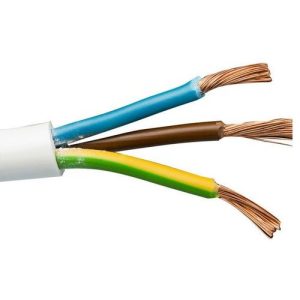
Solar earthing is often quoted as "bare copper", and it is worth being exact about what that means and what we actually make. Pilone earth cable is PVC-insulated green and yellow copper, class 2 stranded, 6 to 35 mm². We do not draw bare conductor or earth tape. Where a bare conductor is specified — usually the buried length between the earth pit and the main earth terminal, where installers want copper in direct contact with soil — that comes from an earthing supplier, not from us, and we would rather say so than sell you the wrong item.
Everything above ground on a solar installation is insulated conductor anyway: the bond from a panel frame across to the next rail, the run down to the inverter, the earth core in the AC cable. Insulated is what belongs there. The green-and-yellow sleeve is not decoration — it is how the next person on the roof knows not to cut it. Our conductor is plain annealed copper, not tinned; tinning earns its place in humid coastal service, and where a specification calls for it, buy the tinned item from whoever makes it.
The earth is the run most quotes underestimate, because it is the only one that goes the long way round. It follows the array perimeter rather than the shortest line, then makes the same descent as the DC cable, then crosses the plot to the pit.
Green and yellow PVC over class 2 stranded copper, drawn in Lahore, in the three sizes almost every rooftop job uses. Most of those roofs run 6mm solar cable on the DC side, and the earth that protects it matches it.
Larger installations take 25mm earth cable and 35mm protective conductor on the main incomer; the whole range is on the earth cable page, and the DC side of the same installation is on the DC and solar cable page. Because the earth is sized from the array conductor and never the other way round, the array's own copper is quoted on its own size page: the 4mm solar cable price in pakistan, the 6mm solar cable price in pakistan and the 16mm solar cable price in pakistan each sit with the spec and the coil units, not here. Cable is priced off the day's copper rate, so send the size and the metres for the current figure — and ask whether the number quoted is per metre or per coil before comparing it with anyone else's.
We draw the copper in Lahore and sell it at the day's rate — no dealer margin. Send the size, the metres and your city: Punjab in 1–2 days, rest of Pakistan in 2–4.