Factory-direct from Lahore · Nationwide delivery in 2–4 days
+92 319 4262451
WhatsApp
Six links, and only the first three are solar cable: strings and home run in single-core DC, then the inverter to the AC board in multi-core copper on its own MCB, the AC board to the utility meter sized from your sanctioned load, and one earth tying the metal together.
On a 5 kW single-phase reference system that is 6 mm² on the DC side, 6 mm² three-core on a 32 A MCB from the inverter to the board, and 6 mm² for the earth — with the run on to the meter set by the sanctioned load on your connection rather than by the array. The whole chain has one boundary worth knowing: going on net metering changes the alternating-current links and nothing on the roof.
Solar to grid wiring is the same six runs in the same order on every grid-tied system, whether the array is 3 kW or 20 kW. What changes between systems is the size in the fourth column, not the shape of the chain. Sizes below are for a 5 kW single-phase system, worked end to end in the 5kW system guide.
A grid-tied solar system in Pakistan is six cable links in one line: panel to panel and string to roof edge in single-core DC, roof edge down to the inverter in single-core DC, inverter to the AC distribution board in multi-core copper on its own MCB, AC board to the utility meter sized from the sanctioned load on the connection rather than from the inverter, and one insulated earth conductor bonding the frames, enclosures and inverter body. On a 5 kW inverter, a 220 V single-phase connection and one panel string, that comes to 6 mm² on the DC side, 6 mm² three-core on a 32 A MCB to the board, and 6 mm² for the earth. Going on net metering changes only the alternating-current links.
| Link | What it carries | Cable | 5 kW size | Isolation here |
|---|---|---|---|---|
| 1. Panel to panel, within the string | String current, DC | Factory MC4 leads, single core | 6 mm² | None — a series link |
| 2. String to the roof edge | String current, DC | Single core, one red one black | 6 mm² | String fuses where several strings combine |
| 3. Roof edge down to the inverter | String or combined current, DC | Single core, per pair | 6 mm² | DC isolator at the inverter |
| 4. Inverter to the AC distribution board | 22.7 A, 220 V AC | Multi-core copper, 3 core | 6 mm² | 32 A MCB, AC isolator |
| 5. AC board to the utility meter | House import plus array export | Multi-core copper, meter tails | From sanctioned load | Main breaker |
| 6. Frames, enclosures, inverter body to earth | Fault current only | Single core, insulated | 6 mm² | — |
Links 1 to 3 are the solar cable most people mean when they say "solar wire": single-core, one conductor for the positive and one for the negative, sized from string current and route length rather than from kilowatts. Links 4 and 5 are ordinary building cable doing an ordinary job. Link 6 is the one that gets left off quotes.
Net metering does not touch the roof. It is an arrangement past the inverter: an export path, a bidirectional meter and an agreement. Links 1 to 3 are sized exactly as they would be on an off-grid or hybrid system, from string design current, string voltage and route length. If somebody quotes you a heavier DC cable "because it is on net metering", the reason is not electrical.
Link 5 is not sized from the inverter. The run from the AC board to the meter carries everything the house imports as well as anything the array exports, so the figure that sets it is the sanctioned load on your connection — usually larger than the inverter. On a 15 kW sanctioned single-phase load that is 15000 ÷ 220 = 68 A, which after the 1.25 continuous-duty margin is 85 A and takes 25 mm² at 112 A — three sizes above the cable the same system runs from the inverter. Where the existing tails already suit that load, net metering does not change them; the meter is swapped, not the cable feeding it. The full table by sanctioned load is on the net metering cable size page, and the utility-specific detail on WAPDA meter cable and K-Electric meter cable.
One more boundary, stated plainly: we make cable. The net-metering application, the NEPRA licence, the agreement and the meter itself sit between you, your installer and your distribution company. This page covers the copper.
The chain is also a sequence, and it matters more here than on an ordinary circuit, because two ends of it stay live independently: the utility side is energised whenever the grid is up, and the panel strings are energised whenever there is daylight, whatever the inverter is doing.
Open the AC isolator or the inverter's own MCB before anything else, so the inverter stops exporting into a circuit somebody is about to work on.
Only once the inverter has stopped drawing does the DC isolator open off load. Opening it under load is how a DC arc gets drawn, and a DC arc does not self-extinguish the way an AC one does.
DC on, then AC. The inverter needs the array present before it will synchronise and start exporting.
Same six links, with one added or one removed.
A grid-tied 5 kW system is one purchase from three ranges. For the metres each link takes, the system guides carry a full bill of materials against a stated roof layout — 5kW, 10kW and 20kW.
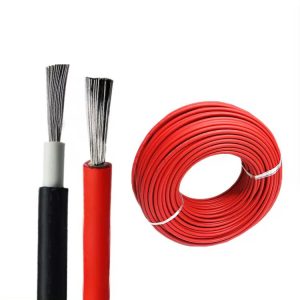
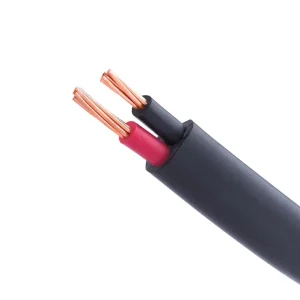
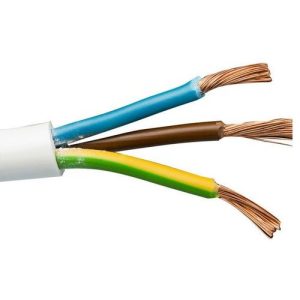
Larger arrays step the DC side up to 10mm DC cable and, on a long home run, to the size behind the 16mm dc cable price; the AC side sits on the standard cable range and the earthing sizes on the earth cable range. Links 1 to 3 are what people are actually pricing when they ask for the 6mm dc wire price in pakistan. The small end of the same ladder — 1mm dc wire, 1.5mm dc wire and 2.5mm dc wire — goes on panel tails, controller leads and 12 V lighting rather than on any link in this chain, and sells as 1mm dc cable, 1.5mm dc cable and 2.5 mm dc cable. Cable is priced off the day's copper rate, so send the metres for the current figure — and check whether a quoted number is per metre or per coil before comparing it with anyone else's.
We draw the copper in Lahore and sell it at the day's rate — no dealer margin, and one message covers all three ranges. Send the inverter rating, the roof-to-inverter route and whether your connection is single or three-phase: Punjab in 1–2 days, rest of Pakistan in 2–4.