
Factory-direct from Lahore · Nationwide delivery in 2–4 days
+92 319 4262451
WhatsApp
6 mm² per DC string, 6 mm² four-core on the AC side to a 32 A MCB per phase, 10 mm² for the array earth.
A 15 kW inverter on a 400 V three-phase connection puts out 15000 ÷ (1.732 × 400) = 21.7 A per phase, which is a 32 A MCB. On the roof, thirty panels usually run as three strings of ten, each at about 17.5 A of design current, and 6 mm² holds a 3% voltage drop out to an 86 m route on a 370 V string. The one place a 15 kW array differs from a 10 kW one: three strings cannot share a 6 mm² home run. 52.5 A of combined design current is over its 46 A rating, so a combined run starts at 10 mm².
A 15 kW array does the same three electrical jobs as a small one: single-core DC outdoors from the panels down to the inverter, multi-core AC from the inverter into the building, and an earth for the frames. What is different at 15 kW is the number of strings. Thirty panels do not make a bigger string; they make a third one, and every extra string is another pair of conductors down the same route, or another 17.5 A on a shared one.
A 15 kW rooftop array in Pakistan needs 6 mm² single-core DC per string, 10 mm² or larger where all three strings are combined into one home run, 6 mm² four-core copper on a 32 A MCB per phase from a three-phase inverter to the AC board, and 10 mm² for bonding the array frames and the inverter body. Those sizes hold for thirty panels wired as three series strings of ten, 17.5 A of design current per string, a 400 V three-phase supply, DC routes of 86 m or less per string, and cable clipped direct at 30°C ambient.
| Run | Current | Cable | Capacity | Protection |
|---|---|---|---|---|
| Each panel string, DC | 17.5 A design | 6 mm² single core | 46 A | DC isolator |
| Two strings combined, DC | 35 A design | 6 mm² to a 43 m route, else 10 mm² | 46 A / 63 A | DC isolator, string fuses |
| Three strings combined, DC | 52.5 A design | 10 mm² to a 48 m route, else 16 mm² | 63 A / 85 A | DC isolator, string fuses |
| Inverter to AC board, 3-phase 400 V | 21.7 A/phase | 6 mm² 4 core | 41 A | 32 A MCB |
| Array frames and inverter earth | — | 10 mm² | — | — |
Two numbers off the back of your own panels drive this: the short-circuit current, Isc, and the voltage at maximum power, Vmp. The worked example below uses a plate reading Isc 14 A and Vmp 37 V, thirty panels in three series strings of ten, and a 30 m route from the roof edge down to the inverter.
That is the 15 kW-specific catch. On a 5 kW or 10 kW roof the combining decision is about distance; here it becomes a capacity decision first. The millivolt figure already covers the trip out and the trip back, so the 30 m in those sums is the route, measured one way, and the cable you buy is twice it per pair. Thirty panels is the count at 500 W each; twenty-six 585 W panels come to the same 15 kW, and the string layout, not the panel count, is what moves the cable.
The 370 V string is what buys the distance. Read the left column for a string on its own MPPT input and the right column for a home run carrying all three.
| Size | Capacity | Voltage drop | Route, one string (17.5 A) | Route, three combined (52.5 A) |
|---|---|---|---|---|
| 2.5 mm² | 27 A | 18 mV/A/m | 35 m | not enough capacity |
| 4 mm² | 36 A | 11 mV/A/m | 57 m | not enough capacity |
| 6 mm² | 46 A | 7.3 mV/A/m | 86 m | not enough capacity |
| 10 mm² | 63 A | 4.4 mV/A/m | 144 m | 48 m |
| 16 mm² | 85 A | 2.8 mV/A/m | 226 m | 75 m |
| 25 mm² | 112 A | 1.75 mV/A/m | 362 m | 120 m |
Three rows say "not enough capacity" rather than a distance, and that is the useful half of this table: at 52.5 A the combined run is settled on heat, not on length. There is a middle arrangement worth pricing too — two strings combined on one MPPT input and the third on its own. That pair carries 35 A, which 6 mm² holds to a 43 m route, so a 15 kW roof can often be wired entirely in 6 mm². Full spec and today's rate sit on the 6mm DC solar cable, 10mm DC cable and 16mm DC cable pages.
A 15 kW inverter in Pakistan is normally a three-phase machine on a 400 V connection, because the single-phase alternative is unattractive: 15000 ÷ 220 = 68.2 A, which after the 1.25 continuous-duty margin is 85.2 A, a 100 A main and 25 mm² cable. Three phases split the same output: 15000 ÷ (1.732 × 400) = 21.7 A per phase, times 1.25 is 27.1 A, so a 32 A MCB. 6 mm² four-core carries 41 A with three conductors loaded, nine amps clear of that breaker.
Read those nine amps honestly. They survive a run clipped on a wall between the inverter and a board beside it, which is how most of these are installed. They do not survive being bunched in conduit with other circuits in a plant room at 45°C, where a correction factor of 0.75 takes 41 A down to 31 A — under its own breaker. If that describes your run, go to 10 mm² four-core. Voltage drop is not the deciding factor either way: over a 15 m route at 21.7 A on 6 mm² it is 7.3 × 21.7 × 15 ÷ 1000 = 2.38 V, 0.59% of 400 V. The millivolt figures tabulated here are two-conductor values, and a balanced three-phase run drops about 13% less than that (√3 ÷ 2 = 0.87), so using them is the conservative way round.
Four-core cable carries three phases and a neutral, off the standard cable range; the earth runs as a separate conductor. Bond the array frames and the inverter body back to the house earth electrode with 10 mm² — every frame, not just the first, because a clamp on anodised aluminium is not a reliable electrical joint. The solar earthing cable guide covers the sizes and the terminations, and the run from the AC board on to the utility meter is sized from your sanctioned load in the net metering cable size guide.
At 15 kW the quantity is the number that moves the quote. Three strings send three pairs of conductors down the same long route, and the frame bonding alone crosses the whole array twice. Here is the count for one stated layout, to adjust against your own roof.
| Run | Route | Cable to buy | Size |
|---|---|---|---|
| String 1 to roof edge, DC | 10 m | 20 m (10 red, 10 black) | 6 mm² |
| String 2 to roof edge, DC | 7 m | 14 m (7 red, 7 black) | 6 mm² |
| String 3 to roof edge, DC | 4 m | 8 m (4 red, 4 black) | 6 mm² |
| Roof edge to inverter, DC, three strings | 30 m | 180 m (3 pairs) | 6 mm² |
| Inverter to AC board, three-phase | 15 m | 15 m of 4 core | 6 mm² |
| Frames, inverter, earth pit | 46 m | 46 m single core | 10 mm² |
Totals for that layout: 222 m of 6 mm² DC split evenly red and black, 15 m of 6 mm² four-core, and 46 m of 10 mm² earth. With 15% for slack, order 128 m of each DC colour. Two things to check before comparing quotes: coil lengths in this market are not standard, and price lists routinely print a coil price where a per-metre price belongs. Ask for the metres, and ask which unit the number is in. Send us the route lengths and the string layout, and we will quote the metres.
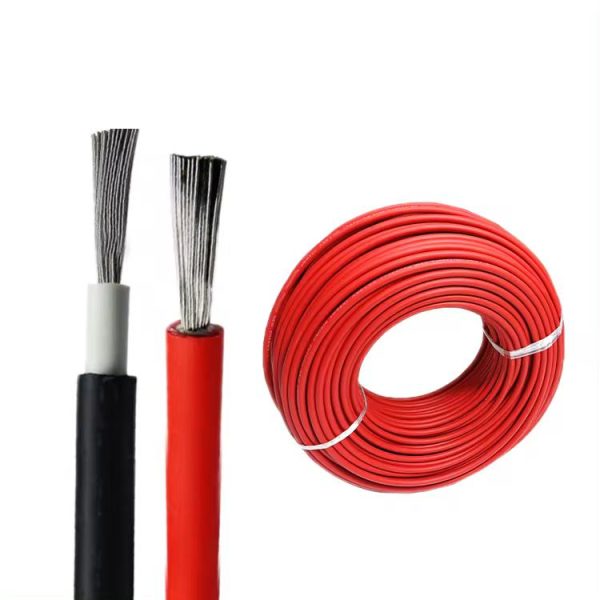
The size for one home run carrying all three strings on a long route: 85 A of capacity against 52.5 A of combined design current, and 75 m of allowable route at 3%. Single-core stranded copper drawn on the Pilone line in Lahore — plain annealed class 5, 126 strands of 0.40 mm, not tinned. A 100 m length holds about 14.2 kg of conductor at 142.2 kg/km, which is the fastest check on whether you were sold full copper: put the coil on a scale.
Prices track the daily copper rate. Send the metres and your city on WhatsApp for the exact figure.
The strings themselves take 6mm solar cable, a shorter combined run takes 10mm DC cable, the three-phase AC run takes 6mm four-core off the standard cable range, and the earth takes 10mm earth cable. All DC and solar cable sizes.
We draw the copper in Lahore and sell it at the day's rate — no dealer margin. Send the route lengths, the string layout and whether the strings are combined: Punjab in 1–2 days, rest of Pakistan in 2–4.