
Factory-direct from Lahore · Nationwide delivery in 2–4 days
+92 319 4262451
WhatsApp
6 mm² per DC string, 10 mm² earth. The AC side depends on whether your supply is single-phase or three-phase.
On a 400 V three-phase supply a 10 kW inverter puts out 14.4 A per phase — 10000 ÷ (1.732 × 400) — so the AC run is 4 mm² four-core on a 20 A MCB. On 220 V single-phase the same inverter puts out 45.5 A, which is a 63 A MCB and 16 mm². Check the inverter nameplate first: that one line changes the AC cable by four sizes.
A 10 kW array has the same three electrical jobs as a small one: single-core DC outdoors from the panels to the inverter, multi-core AC from the inverter into the house, and an earth for the frames. What is different at 10 kW is that the AC side is no longer a foregone conclusion. Plenty of 10 kW homes in Pakistan run a single-phase 220 V connection; plenty run 400 V three-phase. The inverter follows the connection, and the cable follows the inverter.
A 10 kW rooftop array in Pakistan needs 6 mm² single-core DC per string, stepping to 10 mm² where two strings are combined into a home run longer than 43 m; 4 mm² four-core copper on a 20 A MCB where the inverter is three-phase, or 16 mm² on a 63 A MCB where it is single-phase; and 10 mm² for the array frame bonding and the inverter earth. Those sizes hold for two strings of ten panels at 17.5 A of design current each, routes of 86 m or less on the DC side, and cable clipped direct at 30°C ambient.
| Run | Current | Cable | Capacity | Protection |
|---|---|---|---|---|
| Each panel string, DC | 17.5 A design | 6 mm² single core | 46 A | DC isolator |
| Both strings combined, DC | 35 A design | 6 mm² to 43 m route, else 10 mm² | 46 A / 63 A | DC isolator, string fuses |
| Inverter to AC board, 3-phase 400 V | 14.4 A/phase | 4 mm² 4 core | 32 A | 20 A MCB |
| Inverter to AC board, 1-phase 220 V | 45.5 A | 16 mm², 2 core plus a separate earth core | 85 A | 63 A MCB |
| Array frames and inverter earth | — | 10 mm² | — | — |
Two numbers off the back of your own panels drive this: the short-circuit current, Isc, and the voltage at maximum power, Vmp. The worked example below uses a plate reading Isc 14 A and Vmp 37 V, twenty panels split into two series strings of ten, and a 30 m route from the roof edge down to the inverter.
This is the counter-intuitive part of a big array: 4 mm² also passes at 30 m, because the 370 V string can afford 11.1 V of drop. We still put 6 mm² on a 10 kW roof, and the reason is in the paralleled column of the next table — combine two strings and 6 mm² still works where 4 mm² does not. The millivolt figure covers the trip out and the trip back, so the 30 m in that sum is the route, one way, and the cable you buy is twice it per pair.
The 370 V string is what buys the distance here. Compare these numbers with a 5 kW array on 185 V strings and every figure doubles — the bigger system is easier on cable, not harder.
| Size | Capacity | Voltage drop | Route, one string (17.5 A) | Route, two combined (35 A) |
|---|---|---|---|---|
| 2.5 mm² | 27 A | 18 mV/A/m | 35 m | not enough capacity |
| 4 mm² | 36 A | 11 mV/A/m | 57 m | 28 m |
| 6 mm² | 46 A | 7.3 mV/A/m | 86 m | 43 m |
| 10 mm² | 63 A | 4.4 mV/A/m | 144 m | 72 m |
| 16 mm² | 85 A | 2.8 mV/A/m | 226 m | 113 m |
2.5 mm² is struck out of the combined column on capacity, not on distance: 27 A of rating against 35 A of design current fails before voltage drop is even considered. Full spec and today's rate sit on the 6mm solar cable and 10mm DC cable pages.
Three-phase, 400 V. The inverter splits its output across three phases: 10000 ÷ (1.732 × 400) = 14.4 A per phase. With the 1.25 continuous-duty margin that is 18 A, so a 20 A MCB. 4 mm² four-core copper carries 32 A with three loaded conductors, 12 A clear of the breaker. Over a 15 m route at 14.4 A the drop works out at 11 × 14.4 × 15 ÷ 1000 = 2.38 V, about 0.6% of 400 V. The tabulated millivolt figures are the two-conductor values, and a three-phase run drops about 13% less than that (√3 ÷ 2 = 0.87), so using them here is the conservative way round.
Single-phase, 220 V. The whole output goes down two conductors: 10000 ÷ 220 = 45.5 A, times 1.25 is 56.9 A, so a 63 A MCB. Here is where quotes go wrong. 10 mm² carries exactly 63 A on two loaded conductors — the same number as the breaker, with nothing left after the cable enters conduit or the ambient passes 30°C. 16 mm² at 85 A is the size to run, and its drop over 15 m is 2.8 × 45.5 × 15 ÷ 1000 = 1.91 V, under 1%. Voltage drop was never the problem on that run; breaker margin was.
Bond the array frames and the inverter body back to the house earth electrode with 10 mm² — every frame, not just the first, because a clamp on anodised aluminium is not a reliable electrical joint. The solar earthing cable guide covers the terminations. If the system is going on net metering, the run from the AC board on to the utility meter is sized separately: see the net metering cable size guide.
At 10 kW the quantity matters more than the size. Two strings send two pairs of conductors down the same long route, and the earth bonding alone crosses the whole array. Here is the count for one stated layout, to adjust against your own roof.
| Run | Route | Cable to buy | Size |
|---|---|---|---|
| String 1 to roof edge, DC | 8 m | 16 m (8 red, 8 black) | 6 mm² |
| String 2 to roof edge, DC | 6 m | 12 m (6 red, 6 black) | 6 mm² |
| Roof edge to inverter, DC, both strings | 30 m | 120 m (2 pairs) | 6 mm² |
| Inverter to AC board, three-phase | 12 m | 12 m of 4 core | 4 mm² |
| Frames, inverter, earth pit | 38 m | 38 m single core | 10 mm² |
Totals for that layout: 148 m of 6 mm² DC split evenly red and black, 12 m of 4 mm² four-core, and 38 m of 10 mm² earth. With 15% for slack, order 85 m of each DC colour. Two things to check before comparing quotes: coil lengths in this market are not standard, and price lists routinely print a coil price where a per-metre price belongs. Ask for the metres and ask which unit the number is in. Send us the route lengths on WhatsApp and we will quote the metres.
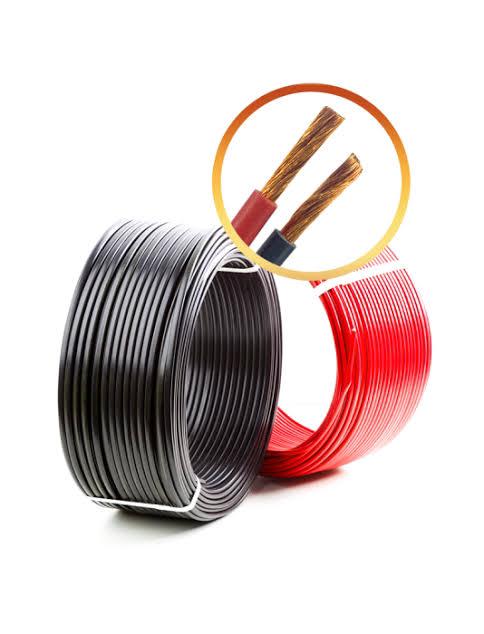
The size for a combined home run at 35 A and for the array earth on a system this big. Single-core stranded copper, plain annealed class 5, 80 strands of 0.40 mm — not tinned. A 100 m length holds about 8.89 kg of conductor at 88.9 kg/km, which is the fastest check on whether you were sold full copper: put the coil on a scale.
Prices track the daily copper rate. Send the metres and your city on WhatsApp for the exact figure.
The strings themselves take 6mm solar cable; a three-phase AC run takes 4mm 4 core and a single-phase one takes 16mm, 2 core plus a separate earth core, both off the standard cable range; and the earth takes 10mm earth cable. All DC and solar cable sizes.
We draw the copper in Lahore and sell it at the day's rate — no dealer margin. Send the route lengths and whether the inverter is single or three-phase: Punjab in 1–2 days, rest of Pakistan in 2–4.