
Factory-direct from Lahore · Nationwide delivery in 2–4 days
+92 319 4262451
WhatsApp
Size it off the bank voltage, not the watts. A 1 kW inverter takes 25 mm² on a 12 V bank, 10 mm² on 24 V and 4 mm² on 48 V — and on 12 V the lead has to stay under about two metres.
The same inverter, the same load, four times the current at the bottom of the range: 1000 ÷ 12 = 83 A against 1000 ÷ 48 = 21 A. Current is what a cable is sized against, which is why this short run is the thickest copper in most houses and why halving the bank voltage costs you two cable sizes and three quarters of your run length. The fuse and the isolator are part of the same decision as the cable.
Power is volts times amps. Hold the power still and drop the voltage, and the current has to rise to make up the difference. A 1 kW load fed from the 220 V mains draws 1000 ÷ 220 = 4.5 A and runs happily on 1.5 mm². Pull that same 1 kW out of a 12 V battery bank and the conductor carries 83 A. Nothing about the load changed. The voltage did, and the copper follows the current.
An inverter-to-battery lead is sized from the direct current it carries, which is the inverter's rated output divided by the bank voltage, plus the 1.25 continuous-duty margin any load that runs for hours deserves. On the three bank voltages sold in Pakistan that gives 104 A of design current for a 1 kW inverter on 12 V, 52 A on 24 V and 26 A on 48 V, which take 25 mm², 10 mm² and 4 mm² copper respectively at 30°C clipped direct. Because 3% of a 12 V bank is only 0.36 V, that 25 mm² lead is out of voltage-drop budget past roughly two metres of route, while the 48 V lead reaches four times as far on a quarter of the copper. Size the cable, the fuse and the isolator together, and have a licensed electrician or your solar installer confirm them for the installation.
One reading note before the table. Inverters are often sold in VA rather than watts, and a 1000 VA unit is not 1000 W — the plate carries both figures, and it is the watt figure and the DC input current that this sum needs. Where the plate prints a maximum DC input current, use that number instead of the division: it already includes the inverter's own conversion loss, which the simple division does not.
| Inverter | Bank | DC current | Design current | Cable | Capacity | Route at 3% |
|---|---|---|---|---|---|---|
| 1 kW | 12 V | 83 A | 104 A | 25 mm² | 112 A | 2.0 m |
| 1 kW | 24 V | 42 A | 52 A | 10 mm² | 63 A | 3.1 m |
| 1 kW | 48 V | 21 A | 26 A | 4 mm² | 36 A | 5.0 m |
| 2 kW | 12 V | 167 A | 208 A | past 35 mm² — see below | — | — |
| 2 kW | 24 V | 83 A | 104 A | 25 mm² | 112 A | 4.0 m |
| 2 kW | 48 V | 42 A | 52 A | 10 mm² | 63 A | 6.3 m |
| 3 kW | 24 V | 125 A | 156 A | past 35 mm² — see below | — | — |
| 3 kW | 48 V | 63 A | 78 A | 16 mm² | 85 A | 6.6 m |
| 5 kW | 48 V | 104 A | 130 A | 35 mm² | 138 A | 8.9 m |
Two rows have no cable in them, and they are the honest part of this table. A 2 kW inverter on a 12 V bank asks for 208 A and a 3 kW on 24 V asks for 156 A; both are past the 138 A that 35 mm² carries, the top of the DC range we draw. That is not a problem to solve with more copper — it is the bank telling you its voltage is wrong for the load. Take the same 3 kW inverter to a 48 V bank and it drops to 78 A on 16 mm², a fifth of the conductor. Where the bank voltage genuinely cannot move, paralleled conductors and busbar are an installer's design decision, not a size read off a chart.
On the mains, a volt lost in the cable is under half a percent of 220 V and nobody notices. On a 12 V bank a volt is 8% and the inverter shuts down on low voltage while the batteries are still half full. The percentage budget is the same 3% used everywhere else; the volts it buys you are not.
| Bank | 3% budget | Drop per metre on 25 mm² at 100 A | Route that budget buys |
|---|---|---|---|
| 12 V | 0.36 V | 0.175 V — 1.5% per metre | 2.1 m |
| 24 V | 0.72 V | 0.175 V — 0.73% per metre | 4.1 m |
| 48 V | 1.44 V | 0.175 V — 0.36% per metre | 8.2 m |
Worked through once: a 1 kW inverter on a 12 V bank has a design current of 104 A, and on 25 mm² that costs 1.75 × 104 × 1 ÷ 1000 = 0.182 V for every metre of route. Against a 0.36 V budget that is 2.0 m, and the lead you buy is 4 m — two metres of red and two of black. Move the inverter across the room to a 5 m route and the drop becomes 0.91 V, or 7.6% of the bank. No fuse trips, nothing gets hot, and the system simply underperforms and cuts out early every evening. This is the failure that gets blamed on the batteries.
The fix is almost never a bigger cable. It is a shorter one. Stand the inverter next to the bank, keep the leads as short as the terminals allow, and check any run you cannot shorten in the voltage drop calculator.
Take the inverter's rated continuous output in watts and its bank voltage. Where a maximum DC input current is printed, use that figure and skip step 2 — it already includes the conversion loss.
Watts ÷ bank volts gives the current. Multiply by 1.25, because an inverter under load holds that current for hours. That answer is the design current.
Read the capacity column for a size that carries more than the design current, then derate it for how the lead is actually run — through a conduit, bunched, or in a hot battery room.
Multiply mV/A/m × design current × route ÷ 1000 and compare it with 3% of the bank voltage. If it fails, shorten the run before you go up a size.
Single-core stranded copper, one length in red and one in black, drawn on the Pilone line in Lahore — plain annealed copper, not tinned. Tinning earns its place in humid coastal service; ours is plain, and we would rather say so than sell you a word.
The same house usually buys DC cable at two points, and only one of them is the battery lead. The panel strings on the roof run in 6 mm², which is where the 6mm dc wire price in pakistan question comes from; a 3kW inverter on a 48 V bank takes 16 mm², so the 16mm dc cable price is the one to ask for on the lead itself. Below those sit the small rungs people ask for by name — 1mm dc wire, 1.5mm dc wire and 2.5mm dc wire — and none of them belongs anywhere near a battery: 2.5 mm² carries 27 A against the 104 A a 1kW inverter on 12 V asks for. Those sizes are panel-tail, controller and 12 V lighting copper, sold as 1mm dc cable, 1.5mm dc cable and 2.5 mm dc cable.
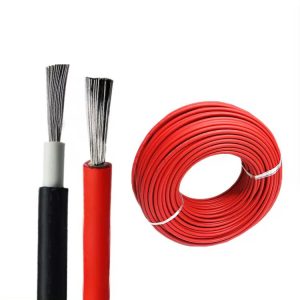
Smaller banks and smaller inverters take the lower rungs: 10mm DC cable for a 1kW unit on 24 V or a 2kW on 48 V, and 4mm DC cable for a 1kW on 48 V. The whole ladder, 0.75mm to 35mm, sits on the DC and solar cable page. Prices track the daily copper rate, so send the size and the metres for the day's figure — and ask which unit the number is in, per metre or per coil, before you compare it with anyone else's.
We draw the copper in Lahore and sell it at the day's rate — no dealer margin, and the line that made the coil answers the message. Send the inverter rating, the bank voltage and the route length: Punjab in 1–2 days, rest of Pakistan in 2–4.