
Factory-direct from Lahore · Nationwide delivery in 2–4 days
+92 319 4262451
WhatsApp
6 mm² on the DC strings, 10 mm² three-core on the AC side to a 40 A MCB, 6 mm² for the array earth.
A 7 kW inverter at full output draws 7000 ÷ 220 = 31.8 A on Pakistan's 220 V single-phase supply, which is a 40 A MCB. That breaker is what rules out 6 mm² on the AC run: it carries 46 A on paper and nothing like that once it is in conduit in June. On the roof each string works at about 17.5 A of design current, and 6 mm² holds a 3% voltage drop out to a 60 m route. The quantity is what surprises people: two strings down one 25 m route eat 100 m of cable.
A rooftop system has three separate electrical jobs and each one takes its own cable, sized its own way. The panels feed the inverter on direct current, outdoors, through single-core cable sized from string current and route length. The inverter feeds the house on 220 V alternating current through ordinary multi-core copper, sized from the breaker above it. And the aluminium frames the panels are bolted to have to be bonded back to earth.
A 7 kW rooftop solar system in Pakistan needs 6 mm² single-core DC cable for the panel strings and the run down to the inverter, 10 mm² three-core copper from the inverter to the AC distribution board on a 40 A MCB, and 6 mm² for bonding the array frames and the inverter body. Those sizes hold for fourteen panels wired as two series strings of seven, 17.5 A of design current per string, a DC route of 60 m or less, a single-phase 220 V supply, and cable clipped direct at 30°C ambient. Combine the two strings into one home run and the current doubles to 35 A, which cuts that 60 m route limit to 30 m.
| Run | Current | Cable | Capacity | Protection |
|---|---|---|---|---|
| Each panel string, DC | 17.5 A design | 6 mm² single core | 46 A | DC isolator |
| Both strings combined, DC | 35 A design | 6 mm² to a 30 m route, else 10 mm² | 46 A / 63 A | DC isolator, string fuses |
| Inverter to AC board, 1-phase 220 V | 31.8 A | 10 mm² 3 core | 63 A | 40 A MCB |
| Inverter to AC board, 3-phase 400 V | 10.1 A/phase | 4 mm² 4 core | 32 A | 16 A MCB |
| Array frames and inverter earth | — | 6 mm² | — | — |
Two numbers printed on the back of your own panels drive all of this: the short-circuit current, Isc, and the voltage at maximum power, Vmp. This worked example uses a plate reading Isc 14 A and Vmp 37 V, fourteen panels split into two series strings of seven, and a 25 m route from the roof edge down to the inverter. Substitute your own plate figures in the same places.
Fourteen panels is the count at 500 W each. Twelve 585 W panels or sixteen 450 W panels come to the same 7 kW, and the cable answer moves only if the plate Isc and Vmp move — read them, do not assume them. The millivolt figure already covers the trip out and the trip back, so the 25 m in that sum is the route, measured one way, and the cable you buy is twice it per string.
Heat is not what limits a 7 kW string; every size below carries the current with room in hand. Distance decides it, and the two columns are the two ways a 7 kW array gets wired.
| Size | Capacity | Voltage drop | Route, one string (17.5 A) | Route, strings combined (35 A) |
|---|---|---|---|---|
| 2.5 mm² | 27 A | 18 mV/A/m | 24 m | not enough capacity |
| 4 mm² | 36 A | 11 mV/A/m | 40 m | 20 m |
| 6 mm² | 46 A | 7.3 mV/A/m | 60 m | 30 m |
| 10 mm² | 63 A | 4.4 mV/A/m | 100 m | 50 m |
| 16 mm² | 85 A | 2.8 mV/A/m | 158 m | 79 m |
Read the right-hand column before anyone joins your two strings on the roof to save a pair of conductors. 4 mm² clears a combined 35 A by a single amp before any derating at all, which is not a margin, so 6 mm² is the floor on a combined run and 10 mm² is the size once that run passes 30 m. Full spec and today's rate sit on the 6mm solar cable and 10mm DC cable pages.
Past the inverter it is an ordinary 220 V circuit, sized the ordinary way. A 7 kW inverter at full output draws 7000 ÷ 220 = 31.8 A. Apply the 1.25 continuous-duty margin — 31.8 × 1.25 = 39.8 A — and the next standard breaker up is 40 A. Now the cable has to clear the breaker, not the load. 6 mm² carries 46 A, six amps over a 40 A MCB; put that cable in conduit on a summer wall and a correction factor of 0.75 takes it to 34.5 A, under its own breaker. 10 mm² at 63 A comes back at 47 A on the same correction and still clears.
Voltage drop on that run is not the issue: over 10 m at 31.8 A on 10 mm² it is 4.4 × 31.8 × 10 ÷ 1000 = 1.40 V, 0.64% of 220 V. Breaker margin is the issue. The three cores are live, neutral and earth, off the standard cable range. On a 400 V three-phase connection the same inverter puts out 7000 ÷ (1.732 × 400) = 10.1 A per phase, a 16 A MCB and 4 mm² four-core — check the inverter nameplate before ordering anything on the AC side. If the system is going on net metering, the run from that board on to the utility meter is a separate calculation: see the net metering cable size guide.
Sizes are easy to look up. Metres are what the quote is actually made of, and this is where a 7 kW job catches people out: two strings on two MPPT inputs send two pairs of conductors down the same route, so one 25 m route eats 100 m of cable. Here is the count for one stated layout, to adjust against your own roof.
| Run | Route | Cable to buy | Size |
|---|---|---|---|
| String 1 to roof edge, DC | 7 m | 14 m (7 red, 7 black) | 6 mm² |
| String 2 to roof edge, DC | 5 m | 10 m (5 red, 5 black) | 6 mm² |
| Roof edge to inverter, DC, both strings | 25 m | 100 m (2 pairs) | 6 mm² |
| Inverter to AC board | 10 m | 10 m of 3 core | 10 mm² |
| Frames, inverter, earth pit | 28 m | 28 m single core | 6 mm² |
Totals for that layout: 124 m of 6 mm² DC split evenly red and black, plus 10 m of 10 mm² three-core and 28 m of 6 mm² for the earth. With 15% for slack, order 72 m of each DC colour. One warning before you compare quotes: coil lengths in this market are not standard, and price lists routinely print a coil price where a per-metre price belongs. Ask for the metres, ask which unit the number is in, and check both against the same run. Send us the route lengths and we will quote the metres.
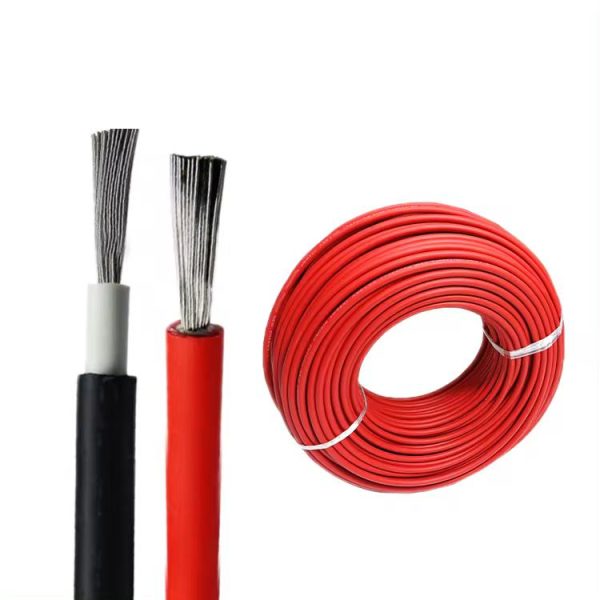
The strings and the home run on a 7 kW roof. Single-core stranded copper drawn on the Pilone line in Lahore — plain annealed class 5, 84 strands of 0.30 mm, not tinned. A 100 m length holds about 5.33 kg of conductor at 53.3 kg/km, which is the fastest check on whether you were sold full copper: put the coil on a scale.
Prices track the daily copper rate. Send the metres and your city on WhatsApp for the exact figure.
The AC run on this system takes 10mm three-core off the standard cable range, the earth takes 6mm earth cable, and a combined home run past 30 m takes 10mm DC cable. All DC and solar cable sizes.
We draw the copper in Lahore and sell it at the day's rate — no dealer margin. Send the route lengths and whether your connection is single or three-phase: Punjab in 1–2 days, rest of Pakistan in 2–4.