
Factory-direct from Lahore · Nationwide delivery in 2–4 days
+92 319 4262451
WhatsApp
Net metering is an AC job. Size the cable from the inverter's AC output current, not from the array.
A 5 kW inverter on Pakistan's 220 V single-phase supply puts out 5000 ÷ 220 = 22.7 A, which is a 32 A MCB and 6 mm² three-core copper from the inverter to the AC distribution board. A 10 kW three-phase inverter puts out 14.4 A per phase — a 20 A MCB and 4 mm² four-core. The run on from the board to the utility meter is a different sum again: it is sized from your sanctioned load, because it carries the house's import as well as the array's export.
Search net metering in Pakistan and you get application forms, NEPRA rules and connection fees. Almost nothing about the cable — which is the part you actually have to buy. And when cable does come up, it is usually the DC cable on the roof, which is the one part of the installation net metering does not touch.
Net metering changes the alternating-current side of a solar installation, not the direct-current side. The cable it puts in question is the run from the inverter to the AC distribution board, sized from the inverter's rated AC output current with a 1.25 continuous-duty margin and a breaker above it, and the run from that board on to the utility meter, sized from the sanctioned load on your connection rather than from the inverter. The panels, the strings and the run down from the roof are sized exactly as they would be on any hybrid or off-grid system: from string current, string voltage and route length.
One boundary worth stating plainly. We make cable. The net-metering application, the NEPRA licence, the agreement and the meter itself are between you, your installer and your distribution company — ask them about those. This page covers the cable.
Three steps, and the arithmetic is short. Take the inverter's rated AC output in watts. Divide by 220 for a single-phase supply, or by 1.732 × 400 for three-phase, to get the current. Multiply by 1.25, because an inverter at full output on a clear afternoon holds that current for hours, and pick the next standard breaker above the answer. Then choose a cable that clears the breaker — not merely the load.
| Inverter | Supply | Output current | Design current | MCB | Cable | Capacity |
|---|---|---|---|---|---|---|
| 3 kW | 220 V, 1-phase | 13.6 A | 17.0 A | 20 A | 4 mm² 3 core | 36 A |
| 5 kW | 220 V, 1-phase | 22.7 A | 28.4 A | 32 A | 6 mm² 3 core | 46 A |
| 7.5 kW | 220 V, 1-phase | 34.1 A | 42.6 A | 50 A | 10 mm² 3 core | 63 A |
| 10 kW | 220 V, 1-phase | 45.5 A | 56.9 A | 63 A | 16 mm² | 85 A |
| 10 kW | 400 V, 3-phase | 14.4 A | 18.0 A | 20 A | 4 mm² 4 core | 32 A |
| 15 kW | 400 V, 3-phase | 21.7 A | 27.1 A | 32 A | 6 mm² 4 core | 41 A |
| 20 kW | 400 V, 3-phase | 28.9 A | 36.1 A | 40 A | 10 mm² 4 core | 57 A |
Read the two 10 kW rows together, because that pair is where quotes go wrong. The same inverter rating takes 4 mm² on a three-phase connection and 16 mm² on a single-phase one — four sizes apart, on one line of the nameplate. And on the single-phase row, note why it is 16 mm² and not 10 mm²: 10 mm² carries exactly 63 A, the same number as the breaker, with nothing left once the cable enters conduit or the ambient passes 30°C. Voltage drop was never the problem on that run; breaker margin was. The usual picks — 4mm 3 core, 6mm 3 core, 16mm 2 core and 10mm 4 core — all sit on the standard cable range.
People assume the meter tails get sized from the solar system. They do not. That run carries everything the house imports through the meter, plus anything the array exports back through it, so the figure that sets it is the sanctioned load on your connection — usually larger than the inverter. If your existing tails already suit the sanctioned load, net metering does not change them; the meter is swapped, not the cable feeding it.
| Sanctioned load | Current at 220 V | Main breaker | Meter tails | Capacity |
|---|---|---|---|---|
| 5 kW | 22.7 A | 32 A | 6 mm² | 46 A |
| 7.5 kW | 34.1 A | 50 A | 10 mm² | 63 A |
| 10 kW | 45.5 A | 63 A | 16 mm² | 85 A |
| 15 kW | 68.2 A | 100 A | 25 mm² | 112 A |
Meter-tail sizing by utility is covered separately for a WAPDA meter, a K-Electric meter and the main meter run. The array frames, the inverter body and the AC board all bond back to the same house earth electrode — 6 mm² on a 3 kW or 5 kW system, 10 mm² on a 10 kW array. The solar earthing cable guide covers the terminations.
Whatever the metering arrangement, the roof is sized the same way: string design current, string voltage, route length, held to a 3% voltage drop. Most Pakistani rooftop strings land on 6 mm², which at a 17.5 A design current reaches a 46 m route on a 200 V string; 10 mm² is the size when two strings are combined into one home run. The panel-to-inverter run-length tables have the full ladder, and the system guides for 3kW, 5kW and 10kW work an example through end to end.
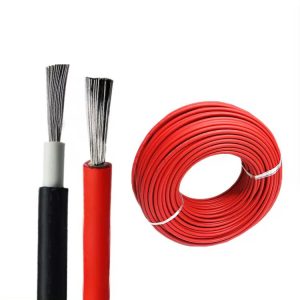
Larger arrays step up to 16mm DC cable on the home run. Panel tails and MC4 leads use the small end of the ladder — 2.5mm single-core DC. The whole range, 0.75mm to 35mm, sits on the DC and solar cable page.
We draw the copper in Lahore and sell it at the day's rate — no dealer margin. Send the inverter rating, whether your connection is single or three-phase, and the two AC route lengths: Punjab in 1–2 days, rest of Pakistan in 2–4.