
Factory-direct from Lahore · Nationwide delivery in 2–4 days
+92 319 4262451
WhatsApp
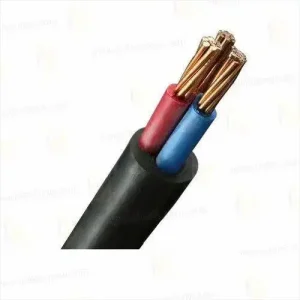
46 A, 7/1.04 class 2 copper, 450/750 V. Three cores — line, neutral and a dedicated earth — PVC insulated and sheathed, drawn on the Pilone line in Lahore.
Quoted per metre at the day's copper rate. Say the length in metres and your city and the coil price comes back with it.
Check the coil before you pay for it
Every coil leaves our factory with a QR code printed on the packaging. Scan it and the factory record for that batch opens: brand, cable size, batch number, year of manufacture and conductor. Compare the batch number on screen with the one printed on your coil — if the two do not match, it did not come from us.
46 A, and the rate is quoted per metre at the day's copper price.
6mm² 3 core standard cable carries 46 A with two conductors loaded — line and neutral, with the third core kept as earth — clipped direct at 30°C. That suits a house submain, an electric stove, or an instant geyser behind a 40 A breaker, because the breaker rating has to sit below the cable's capacity, not above it. Before comparing any two prices, get the unit: per metre, per foot, or per coil of a stated length.
6mm² 3 core standard cable is rated 46 A with two loaded conductors, or 41 A if all three cores carry current, on BS 7671 reference method C (clipped direct) at 30°C ambient. Its conductors are class 2 stranded copper, seven strands of 1.04 mm each, with resistance capped at 3.08 Ω/km by IEC 60228 and a voltage drop of 7.3 mV per amp per metre. Every one of those figures has to be derated for conduit, bunching, and ambient above 30°C, and confirmed by a licensed electrician for the actual run.
| Property | Value |
|---|---|
| Conductor | Plain annealed copper, class 2 stranded |
| Nominal area | 6 mm² × 3 cores |
| Strand construction | 7 / 1.04 mm per core |
| Market strand code | 7/.044 (computes to 6.87 mm²) |
| Max conductor resistance at 20°C | 3.08 Ω/km |
| Current capacity (method C, 2 loaded) | 46 A |
| Current capacity (method C, 3 loaded) | 41 A |
| Voltage drop | 7.3 mV/A/m |
| Voltage rating | 450/750 V |
| Insulation / sheath | PVC / PVC, 70°C conductor rating |
| Conductor copper weight | 160 kg/km (3 × 53.3 kg/km) |
| Copper in a 90 m coil | 14.4 kg |
| Reference standards | IEC 60228 (conductors), IEC 60227 (PVC cables) |
Voltage drop decides long runs, not heat. A 32 A stove circuit taken 25 m on 6mm² drops 32 × 25 × 7.3 ÷ 1000 = 5.8 V. BS 7671 allows 5% on a power circuit, which is 11 V on Pakistan's 220 V supply, so the run has room. Stretch the same circuit to 50 m and the drop is 11.7 V — over the line. At that length the size goes up to 10mm 3 core standard cable, where 4.4 mV/A/m brings the drop back to 7.0 V. Check your own run in the voltage drop calculator.
The confusing part of this market is not the price, it is the unit. One shop prints a figure with no unit at all. The next prices per foot. A third prices a whole coil without saying how long the coil is. Until the unit is known, two quotes cannot be compared — and the gap between per foot and per metre is a factor of 3.281.
| Unit | Equivalent | How to convert |
|---|---|---|
| 1 metre | 3.281 ft | per-foot rate × 3.281 = per-metre rate |
| 1 foot | 0.305 m | per-metre rate ÷ 3.281 = per-foot rate |
| 45 m half coil | 148 ft | per-metre rate × 45 |
| 90 m coil | 295 ft | per-metre rate × 90 |
Worked through: a quote of Rs 22,500 for a 90 m coil is 22,500 ÷ 90 = Rs 250 per metre, and 250 ÷ 3.281 = Rs 76 per foot. Those numbers are arithmetic to show the method, not our rate. Ours comes back on WhatsApp against the day's copper price, and the price per metre page works through more of these conversions.
Meter to distribution board on a 5 or 7 marla house, where the run needs its own earth back to the board.
Electric stoves, instant geysers and motor pumps — single-phase loads in the 20–40 A band that must be earthed.
Feeds to an appliance sub-board where several higher-draw points sit on one circuit.
"Full gauge" is a claim printed on a lot of listings and tested by almost nobody. Copper is what you are paying for, so work out how much of it belongs in a coil and then put the coil on a scale. The arithmetic is three steps and it works for any size.
6 mm² per core × 3 cores = 18 mm² of copper in the cross-section.
Copper runs 8.89 kg per km for every mm². 18 × 8.89 = 160 kg per km of cable.
160 kg/km × 0.09 km = 14.4 kg of bare copper in a 90 m coil.
14.4 kg is a floor, not a target: PVC insulation, the outer sheath and the drum all add weight on top, so a real 90 m coil weighs more. What the number gives you is a sanity check you can run yourself on any coil from any seller, ours included. It is a method, not an accusation. The same arithmetic with the strand codes is set out on the 7/.036 cable size page.
| Cable | Current | Where it goes |
|---|---|---|
| 6mm 2 core standard cable | 46 A | Line and neutral only, earth taken separately |
| 6mm 3 core standard cable (this page) | 46 A | Single phase with its own earth core |
| 6mm 4 core standard cable | 41 A | Three phases and neutral at 400 V |
| 4mm 3 core standard cable | 36 A | One size down: AC points and lighter submains |
| 10mm 3 core standard cable | 63 A | One size up: longer runs and heavier boards |
| 6mm 3 core flexible cable | 46 A | Class 5, for cable that moves or bends |
“Excellent quality copper cables. Fast delivery across Pakistan. Highly recommended for electrical projects.”
“Best cable manufacturer in Lahore. 99.9% pure copper as promised. Very satisfied with the product quality.”
“Good quality cables at competitive prices. Delivery was quick to Karachi. Will order again.”