
Factory-direct from Lahore · Nationwide delivery in 2–4 days
+92 319 4262451
WhatsApp
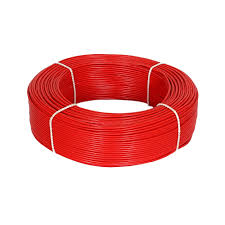
Seven strands of 0.914 mm — 4.60 mm² of copper, sold as 4 mm², rated 36 A. Single core PVC insulated building wire, drawn on the Pilone line in Lahore.
Quoted per metre at the day's copper rate. Send the length in metres and your city for the coil figure.
Check the coil before you pay for it
Every coil leaves our factory with a QR code printed on the packaging. Scan it and the factory record for that batch opens: brand, cable size, batch number, year of manufacture and conductor. Compare the batch number on screen with the one printed on your coil — if the two do not match, it did not come from us.
7/.036 is seven strands of 0.914 mm — 4.60 mm² of copper, sold as 4 mm².
The code is imperial: 7 strands, each 0.036 inch across. Multiply by 25.4 for millimetres, take the area of one strand and multiply by seven, and the conductor computes to 4.60 mm². The trade prices it as 4 mm² and we label it the same way, so both numbers are published here. It carries 36 A on method C at 30°C, and the rate is quoted per metre at the day's copper price.
Every strand code in the Pakistani market reads the same way. Three steps take any of them from the printed code to a real area in mm², and once you can do that, no quote is a mystery.
7/.036 means seven strands, each 0.036 inch in diameter. The number before the slash is the strand count; the number after it is one strand's diameter in inches.
0.036 × 25.4 = 0.914 mm per strand. That is the figure a vernier caliper on a single strand should read.
One strand is π/4 × 0.914² = 0.657 mm². Seven of them give 7 × 0.657 = 4.60 mm² of copper in the conductor.
This is the whole ladder the Pakistani trade quotes in, from the 3/.029 that goes to a light point up to the 19/.052 that feeds a main board. Two numbers matter for each code: the area the geometry actually gives, and the nominal metric size it is sold and priced as. They are not the same number, and every seller in this market — Pilone included — labels by the nominal size.
| Code | Strand dia | Computed area | Sold as | The Pilone cable |
|---|---|---|---|---|
| 3/.029 | 0.737 mm | 1.28 mm² | 1.5 mm² | 3/.029 copper cable |
| 7/.029 | 0.737 mm | 2.98 mm² | 2.5 mm² | 7/.029 copper cable |
| 7/.036 | 0.914 mm | 4.60 mm² | 4 mm² | This page |
| 7/.044 | 1.118 mm | 6.87 mm² | 6 mm² | 6mm (7/.044) single core wire |
| 7/.052 | 1.321 mm | 9.59 mm² | 10 mm² | 10mm 2 core standard cable |
| 7/.064 | 1.626 mm | 14.53 mm² | 16 mm² | 16mm 2 core standard cable |
| 19/.052 | 1.321 mm | 26.03 mm² | 25 mm² | 25mm 4 core standard cable |
7/.036 is seven strands of 0.914 mm — 4.60 mm² of copper — and the Pakistani trade sells and prices it as 4 mm². A code that computes above its nominal size, like 7/.036 at 4.60 mm² against 4 mm², is not a bonus; a code that computes below it, like 3/.029 at 1.28 mm² against 1.5 mm², is not a swindle. They are two naming systems meeting in one market. The figure that decides whether a conductor is fit is the resistance: IEC 60228 caps a 4 mm² class 2 conductor at 4.61 Ω/km, and that is measurable on a delivered coil.
| Property | Value |
|---|---|
| Conductor | Plain annealed copper, stranded (7/.036 in) |
| Strand diameter | 0.914 mm (0.036 in × 25.4) |
| Computed conductor area | 4.60 mm² |
| Nominal area, as sold | 4 mm² (IEC 60228 reference) |
| Max conductor resistance at 20°C | 4.61 Ω/km |
| Current capacity (method C, 2 loaded) | 36 A |
| Voltage drop | 11 mV/A/m |
| Voltage rating | 450/750 V |
| Insulation | PVC, 70°C conductor rating |
| Conductor copper weight | 35.6 kg/km |
| Copper in a 90 m coil | 3.2 kg |
| Reference standards | IEC 60228 (nearest size), IEC 60227 (PVC cables) |
This market quotes the same wire per metre, per foot and per coil, and a coil is not a fixed quantity — 30 m, 45 m and 90 m packs are all sold, and some sellers quote 301 ft — so convert every quote to the same unit before comparing, as the price per metre page works through in full.
| Pack | Length | In feet | Copper inside |
|---|---|---|---|
| Cut length | 1 m | 3.281 ft | 0.04 kg |
| One foot | 0.305 m | 1 ft | 0.01 kg |
| Half coil | 45 m | 148 ft | 1.6 kg |
| Full coil | 90 m | 295 ft | 3.2 kg |
| 301 ft coil | 91.7 m | 301 ft | 3.3 kg |
Feeding a sub-board on a floor or a wing, pulled through conduit one conductor at a time.
Appliance points drawing 7–14 A, where a light-circuit wire has no margin left.
Kitchen and workshop rings where several higher-draw points share one circuit.
"Full gauge" is printed on a great many listings and tested on almost none. Three checks are open to any buyer, and none of them need a laboratory.
A caliper on one strand of 7/.036 should read about 0.914 mm. Count the strands while you are there: seven, not five or six.
Copper is 8.89 kg per km for every mm², so 4 mm² is 35.6 kg/km and a 90 m coil holds 3.2 kg of bare conductor, plus the PVC on top.
The decisive test. IEC 60228 caps a 4 mm² class 2 conductor at 4.61 Ω/km, which is 0.415 Ω across a 90 m coil.
The resistance figure comes straight from the standard: 4.61 Ω per km × 0.09 km = 0.415 Ω end to end on a 90 m coil at 20°C. This is a method any buyer can apply to any coil from any seller, ours included. It is not an accusation against anyone, and we publish no test figures about anyone else's cable because we hold none.
“Excellent quality copper cables. Fast delivery across Pakistan. Highly recommended for electrical projects.”
“Best cable manufacturer in Lahore. 99.9% pure copper as promised. Very satisfied with the product quality.”
“Good quality cables at competitive prices. Delivery was quick to Karachi. Will order again.”