
Factory-direct from Lahore · Nationwide delivery in 2–4 days
+92 319 4262451
WhatsApp
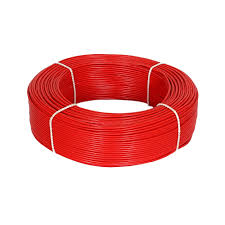
Single-core PVC house wire in the gauge the trade still orders by code rather than by millimetre. Seven strands of 0.029″ copper: 0.029 × 25.4 = 0.7366 mm per strand, which computes to 2.98 mm² of conductor and is sold as 2.5 mm², some shops as 3. 70°C PVC insulation, one core, bought by the coil. Drawn on the Pilone line in Lahore.
Prices track the daily copper rate. Bulk and coil pricing on request.
Check the coil before you pay for it
Every coil leaves our factory with a QR code printed on the packaging. Scan it and the factory record for that batch opens: brand, cable size, batch number, year of manufacture and conductor. Compare the batch number on screen with the one printed on your coil — if the two do not match, it did not come from us.
| Property | Value |
|---|---|
| Conductor | Plain annealed copper, stranded |
| Strand construction | 7 / 0.029″ (7 strands of 0.029 inch wire) |
| Nominal equivalent area | ≈ 2.98 mm² computed — sold as 2.5 mm² |
| Number of cores | 1 |
| Insulation | PVC, single insulation, 70°C conductor rating |
| Typical use | General house wiring: conduit and casing-capping circuits |
| Reference standards | IEC 60228 stranding classes; SWG-to-metric reference (Pilone Cables engineering data) |
Nobody walks into a shop in Lahore and asks for 3 mm² single core. They ask for 7/29, and the man behind the counter knows exactly which coil to reach for. This is general house wire: the contractor wiring a new 5-marla house buys it by the coil for lighting and socket circuits, one colour per line plus neutral and earth, and the electrician rewiring an older house buys it for casing-capping. It is a light circuit gauge, not a submain — for the feed from the meter to the board, you are in 6mm² (7/.044) territory or above.
Pulled into buried PVC conduit on new house wiring, a separate colour for each of line, neutral and earth.
Surface rewiring in older buildings where nothing was ever buried in the wall and the run has to stay accessible.
Tails and links inside distribution boards and control panels, where the run is short and the terminations are many.
You can check any strand code yourself, and it is worth doing, because the imperial codes do not land on the metric names they are sold under. The code reads as strand count over strand diameter in inches. So: 0.029 × 25.4 = 0.7366 mm per strand; one strand's area is 0.7854 × 0.7366² = 0.426 mm²; seven of them give 2.98 mm². That sits between the two metric sizes BS 7671 tabulates, 2.5 mm² and 4 mm², and nearer the smaller one. Exact current and resistance figures for this imperial stranding are not in our standards reference, so size the circuit on the 2.5 mm² numbers — 27 A with two loaded conductors on method C at 30°C, 18 mV/A/m — which is the conservative side of the arithmetic. If the load or the run wants more, buy the metric size properly: 4 mm² (7/.036) is tabulated at 36 A and 11 mV/A/m, and carries the full strand-code table for every other code in the ladder.
“Excellent quality copper cables. Fast delivery across Pakistan. Highly recommended for electrical projects.”
“Best cable manufacturer in Lahore. 99.9% pure copper as promised. Very satisfied with the product quality.”
“Good quality cables at competitive prices. Delivery was quick to Karachi. Will order again.”