
Factory-direct from Lahore · Nationwide delivery in 2–4 days
+92 319 4262451
WhatsApp
3/29 is the lighting wire; 7/29 is the socket wire.
3/29 is three copper strands of 0.029 inch — 1.28 mm² of copper, sold as 1.5 mm² and rated 19.5 A clipped direct at 30°C. 7/29 is seven strands of the same 0.029 inch — 2.98 mm², sold as 2.5–3 mm² and rated 27 A on the same basis. Put 3/29 on lights and fans behind a 6–10 A breaker, 7/29 on socket circuits behind a 16 A breaker, and neither on an AC or geyser point — those circuits start at 4 mm².
The code is strands times strand diameter, and the diameter is in inches — an imperial habit the Pakistani wire trade never dropped. So 3/29 is three strands of 0.029 inch and 7/29 is seven strands of 0.029 inch. The same strand, different count.
The arithmetic: 0.029 inch is 0.7366 mm. One strand's area is π/4 × 0.7366² = 0.426 mm². Three strands: 3 × 0.426 = 1.28 mm². Seven strands: 7 × 0.426 = 2.98 mm². The codes do not land exactly on the IEC 60228 nominal areas, which is why each wire has two names: 3/29 sells as 1.5 mm² even though it carries less copper than that, and 7/29 sells as 3 mm² — some shops bill it as 2.5–3 mm², because it sits between the two nominals.
In Pakistan's wire market, 3/29 and 7/29 are strand codes read as strands times diameter in inches: 3/29 means three copper strands of 0.029 inch, and 7/29 means seven strands of 0.029 inch. Three strands work out to 1.28 mm² of copper, sold as 1.5 mm² wire; seven strands work out to 2.98 mm², sold as 2.5–3 mm². On BS 7671 reference method C — clipped direct, 30°C, two loaded conductors — wire sold as 1.5 mm² is rated 19.5 A and wire sold as 2.5–3 mm² is rated 27 A. In a house on Pakistan's 220 V supply, 3/29 belongs on lighting and fan circuits behind a 6–10 A breaker, and 7/29 belongs on socket circuits behind a 16 A breaker. Neither code is the right wire for a 1.5 ton air conditioner or an electric geyser; those circuits start at 4 mm², confirmed by a licensed electrician.
| Parameter | 3/29 | 7/29 |
|---|---|---|
| Strand make-up | 3 × 0.029 in | 7 × 0.029 in |
| Computed copper area | 1.28 mm² | 2.98 mm² |
| Sold as | 1.5 mm² | 3 mm² (billed 2.5–3) |
| Current capacity, 2 loaded cores | 19.5 A | 27 A |
| Voltage drop | 29 mV/A/m | 18 mV/A/m |
| Breaker it pairs with | 6–10 A MCB | 16 A MCB |
| Typical circuits | Lights, ceiling fans, switch drops | Room socket circuits |
| Product | 3/29 copper cable | 7/29 copper cable |
Notice the shape of those numbers: 7/29 carries 7 ÷ 3 = 2.33 times the copper of 3/29, but 27 ÷ 19.5 is only about 1.4 times the current. Capacity does not scale with area, because a thicker conductor has proportionally less surface to shed its heat through. That is why doubling the strands never doubles the amps — and why the amp rating, not the copper weight, is what a circuit is sized on. 3/29 and 7/29 are two rungs of a longer ladder; the wire strand codes guide charts every code from 3/29 to 7/64 against its metric name.
A house on a 220 V single-phase supply splits into circuits, and each circuit's wire is sized against its breaker, not against the appliance alone. That is the whole logic of the 3/29-or-7/29 choice:
For the whole-house scheme — how many circuits, which size on each, and the earthing to match — start from the best wire for house wiring guide and the SWG–mm² wire size chart.
Heat sets the amp rating; length sets the second limit. Every metre of wire loses millivolts per amp, and on a long run that loss adds up at the far end. Two worked examples, using the mV/A/m figures from the table above.
A lighting circuit on 3/29: 5 A over a 20 m run drops 29 × 5 × 20 ÷ 1000 = 2.9 V. Hold the installation to 3% of 220 V — 6.6 V — and give the final circuit half of it, 3.3 V, because the submain from the meter has already spent the rest. 2.9 V passes.
A socket circuit on 7/29: 10 A over an 18 m run drops 18 × 10 × 18 ÷ 1000 = 3.24 V — just inside the same 3.3 V budget. Stretch the run to 25 m at the same 10 A and it becomes 18 × 10 × 25 ÷ 1000 = 4.5 V, well over budget: shorten the route, split the circuit, or go up a size.
| One-way run | 3/29 at 5 A | 7/29 at 10 A |
|---|---|---|
| 10 m | 1.45 V | 1.80 V |
| 15 m | 2.18 V | 2.70 V |
| 20 m | 2.90 V | 3.60 V |
| 25 m | 3.63 V | 4.50 V |
| 30 m | 4.35 V | 5.40 V |
On the 3.3 V budget, 3/29 at 5 A runs 3.3 ÷ 0.145 = 22 m and 7/29 at 10 A runs 3.3 ÷ 0.18 = 18 m. Most rooms sit inside those lengths; the far corner of a double-storey plot does not. Put your own current and route into the voltage drop calculator before you buy the coil.
The two codes on this page cover lights and sockets, and that is where their job ends. Two circuits in a Pakistani house routinely get wired with 7/29 anyway, and both deserve better:
The shop will not always volunteer this: 7/29 is the answer to "socket ka wire", not to "AC ka wire". Ask by the circuit, not by the habit.
3/29 ka matlab hai teen strand, har aik 0.029 inch ka — kul 1.28 mm² copper, jo bazaar mein 1.5 mm² ke naam se bikta hai. 7/29 mein wohi strand saat hote hain — 2.98 mm², jo 2.5–3 mm² ke naam se bikta hai. Ghar ki wiring mein 3/29 lights aur pankhon ke circuit par jata hai, 6–10 A breaker ke saath; 7/29 socket circuit par, 16 A breaker ke saath.
AC ya geyser ke liye dono chhote hain — wahan 4 mm² (7/36) ya us se bara wire chahiye, apne alag breaker par. Aur 3/29 kabhi socket circuit par na lagayen: garmi aur bhare conduit mein uski 19.5 A rating 16 A breaker se neeche aa jati hai, to wire pehle jalega aur breaker baad mein girega.
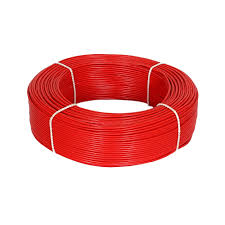
Both codes come off the Pilone line as single-core stranded copper, PVC insulated, 450/750 V — 3/29 copper cable for the lighting circuits, 7/29 copper cable for the sockets. Copper is priced by the day, so the current rate lives on the product page and the exact figure on WhatsApp.
WhatsApp for today's rateSend the codes, total metres per size and your city — delivery in Punjab takes 1–2 days, the rest of Pakistan 2–4.
We draw the copper in Lahore and sell it at the day's rate — no dealer margin, and the line that made the coil answers the message. Tell us the codes, the metres of each and your city: Punjab in 1–2 days, rest of Pakistan in 2–4.