
Factory-direct from Lahore · Nationwide delivery in 2–4 days
+92 319 4262451
WhatsApp
2.5 mm² copper on a 16 A MCB for a 2 kW storage geyser. 4 mm² on a 25 A MCB once the unit reaches 4.5 kW.
A geyser is a resistive load with no starting surge, so the current is the plate wattage divided by 220 V: 2000 W is 9.1 A, 3000 W is 13.6 A, 4500 W is 20.5 A. 2.5 mm² carries 27 A clipped direct at 30°C, which covers every domestic geyser up to 3 kW on paper. What pushes a 3 kW unit onto 4 mm² is not the load — it is a bunched conduit in a hot roof void, and that arithmetic is below.
Two numbers decide the cable, and the size of the tank is neither of them: the element wattage on the rating plate, and how the cable is installed. Take the wattage, divide by 220 V, read the row.
| Geyser rating | Current at 220 V | Cable (copper) | MCB | Typical unit |
|---|---|---|---|---|
| 1.5 kW | 6.8 A | 2.5 mm² (7/.029) | 16 A | Under-sink, 6–10 L |
| 2 kW | 9.1 A | 2.5 mm² (7/.029) | 16 A | 25–35 gallon storage and hybrid |
| 3 kW | 13.6 A | 2.5 mm² (7/.029); 4 mm² if bunched in conduit or in a hot roof void | 20 A | Instant / tankless |
| 4.5 kW | 20.5 A | 4 mm² (7/.036) | 25 A | Large instant |
| 6 kW | 27.3 A | 6 mm² (7/.044) | 32 A | Multi-point instant |
An electric geyser draws its rated wattage divided by 220 V with no starting surge: a 2 kW storage geyser pulls 9.1 A and is correctly wired in 2.5 mm² copper on a 16 A MCB, a 3 kW instant unit pulls 13.6 A and takes 2.5 mm² on a 20 A MCB, and a 4.5 kW instant unit pulls 20.5 A and needs 4 mm² on a 25 A MCB. Those sizes assume the cable is clipped direct at 30°C with two loaded conductors, per BS 7671 reference method C; a cable bunched in conduit in a Lahore roof void carries less and moves the 3 kW row up to 4 mm².
In the market the wire is asked for by its strand code. 7/.029 is what this page calls 2.5 mm² — seven strands of 0.029 inch, about 3.0 mm² of copper. 7/.036 is the 4 mm² size at about 4.6 mm², and 7/.044 is the 6 mm² size. Watch the near-miss: 3/.029 is about 1.29 mm², the lighting wire, and it sounds close enough across a counter to end up in the wrong bag.
Take a 3 kW instant geyser on an 18 m run of 2.5 mm² Class 2 copper from the board to the bathroom, on a 20 A MCB. The load is 3000 ÷ 220 = 13.6 A. The cable carries 27 A clipped direct at 30°C, above both the load and the breaker. Voltage drop is 13.6 A × 18 m × 18 mV/A/m = 4.4 V, or 2.0 % of 220 V against a 5 % limit. Nothing there is undersized. Now pull the same cable through a conduit in a roof void that reaches 45°C in June, bunched with two other circuits.
| Size | Capacity at 30°C | After 0.79 × 0.70 | Margin over 13.6 A |
|---|---|---|---|
| 2.5 mm² | 27 A | 14.9 A | +1.3 A |
| 4 mm² | 36 A | 19.9 A | +6.3 A |
| 6 mm² | 46 A | 25.4 A | +11.8 A |
2.5 mm² has fallen to 14.9 A against a 13.6 A load, and it now sits under the 20 A breaker meant to protect it. That is the case for 4 mm² on a 3 kW geyser and it is the only honest one: not that 2.5 mm² is thin, but that a bunched conduit in a Pakistani summer takes a third of its capacity away. Clipped in open air, or on its own in plaster, 2.5 mm² stays correct and a thicker cable buys nothing. Note the 4 mm² row too: at 19.9 A it lands right on the 20 A MCB, so the better fix is to take the geyser out of the bunch, and 6 mm² is the answer only when it cannot come out. The size-by-size comparison is in 2.5mm vs 4mm cable.
The size below is where the margin runs out. 1.5 mm² carries 19.5 A clipped direct, which looks like plenty for a 2 kW element at 9.1 A until the same factors are applied: 19.5 × 0.79 × 0.70 = 10.8 A. That is 1.7 A of margin on a 2 kW element, and it is under the load outright on a 3 kW unit.
Storage geysers are sold in Pakistan by gallons, and the showroom rarely quotes a wattage. This table maps the tanks on sale to the elements usually fitted to them. It is a starting point; the rating plate is the answer.
| Tank | Typical element | Current at 220 V | Cable | MCB |
|---|---|---|---|---|
| 6–10 L under-sink | 1.5 kW | 6.8 A | 2.5 mm² (7/.029) | 16 A |
| 15 gallon | 2 kW | 9.1 A | 2.5 mm² (7/.029) | 16 A |
| 25 gallon | 2 kW | 9.1 A | 2.5 mm² (7/.029) | 16 A |
| 30 gallon | 2 kW | 9.1 A | 2.5 mm² (7/.029) | 16 A |
| 35 gallon | 2 kW | 9.1 A | 2.5 mm² (7/.029) | 16 A |
| 50 gallon | 2–3 kW | 9.1–13.6 A | 2.5 mm² (7/.029) | 16–20 A |
The rows repeat because the answer repeats. A 30 gallon tank and a 25 gallon tank heat different amounts of water with the same 2 kW element: the bigger one takes longer to come up to temperature, it does not pull more current while it does. That is why a 25 litre unit and a 30 gallon unit end up on identical wire, and why the gallon figure on the carton is the wrong number to size cable with. Hybrid gas-and-electric geysers follow the same rule — the element is wired for its full rating whether the house burns gas eleven months a year or not. Element swaps and re-elemented tanks are covered in the storage geyser wiring guide.
The geyser gets its own run back to the distribution board. Not a spur off the bathroom socket, not a plug in a shaving point — its own MCB and its own cable. Very few household loads sit at full current for twenty to forty minutes, and this is the only one that puts a live element inside a tank of water.
| Geyser rating | Current at 220 V | MCB | Curve | Earth leakage |
|---|---|---|---|---|
| 1.5–2 kW | 6.8–9.1 A | 16 A | Type B | 30 mA RCCB |
| 2.5–3 kW | 11.4–13.6 A | 20 A | Type B | 30 mA RCCB |
| 4.5 kW | 20.5 A | 25 A | Type B | 30 mA RCCB |
| 6 kW | 27.3 A | 32 A | Type B | 30 mA RCCB |
Type B against Type C is worth a sentence. A heating element draws the same current in its first cycle as it does twenty minutes later, so there is no inrush to ride out; Type C exists to tolerate the surge a motor makes, and on this circuit that tolerance only means the breaker waits longer before tripping on a fault. Earthing is not paperwork here either. The protective conductor has to run unbroken from the geyser body back to the board, which makes the point a three-core job — live, neutral and earth. A two-core cable has no earth conductor in it; if the point already has one, pull a separate earth cable of the correct size. Keep the MCB and RCCB in the distribution board outside the bathroom, as in the bathroom wiring guide.
Usually not, and the arithmetic says why. Voltage drop is what decides cable size on a submain or a tubewell run. On a geyser point, heat decides it.
| Load and cable | Drop per metre | Longest run at 5 % |
|---|---|---|
| 2 kW on 2.5 mm² | 9.1 A × 18 mV = 164 mV/m | 67 m |
| 3 kW on 2.5 mm² | 13.6 A × 18 mV = 245 mV/m | 44 m |
| 4.5 kW on 4 mm² | 20.5 A × 11 mV = 226 mV/m | 48 m |
| 6 kW on 6 mm² | 27.3 A × 7.3 mV = 199 mV/m | 55 m |
No bathroom in a 10 marla house is 44 m of cable from the board. A 15 m rule of thumb gets repeated a great deal on this subject; the rows above are where the limit actually sits. Where a run really is long — an outhouse geyser, a servant quarter across a kanal plot — put your own figures into the voltage drop calculator.
Concealed wiring in conduit takes standard Class 2 cable, or singles pulled through the pipe; flexible Class 5 belongs on the visible tail between the isolator and the unit, where it has to bend and come apart for service. The conductor matters more here than anywhere else in the house. A geyser holds full current for half an hour at a time, and that is the duty that exposes copper-clad aluminium sold as copper: the conductor underneath is aluminium, its resistance is higher than the marking implies, and it runs hotter at the same current than the tables on this page assume. On a lighting circuit that may never show. On a geyser point it does. Buy the conductor, not the print on the sheath — we draw solid copper on our own line in Lahore. If the point is already wired and the symptoms have started, work through cable overheating and wire size too small before replacing anything.
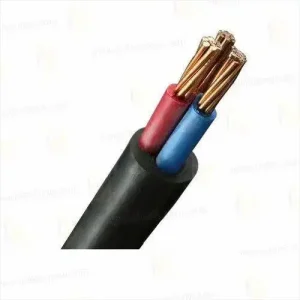
Live, neutral and earth in one sheath — the size for a 4.5 kW instant unit, and for a 3 kW unit whose cable has to share a hot conduit. Stranded copper, 7/0.85 Class 2, PVC insulated and sheathed, 450/750 V, rated 36 A clipped direct at 30°C. Drawn on the Pilone line in Lahore.
Prices track the daily copper rate. Send the length and your city on WhatsApp for the exact figure.
For a 2 kW storage geyser the size is 7/.029 copper cable, pulled as singles in conduit with an earth. Also made in 4mm²: 4mm 2 core cable where a protective conductor is already run, and 4mm 3 core flexible cable for the tail off the isolator. Larger instant units take 6mm 3 core cable.
We draw the copper in Lahore and sell it at the day's rate — no dealer margin. Send the wattage off the rating plate, the length and your city: Punjab in 1–2 days, rest of Pakistan in 2–4.