
Factory-direct from Lahore · Nationwide delivery in 2–4 days
+92 319 4262451
WhatsApp
2.5 mm² copper — 7/.029 at the shop — on a 16 A type C MCB, three core so the pump is earthed.
This page sizes the dry run from the board to a surface water motor — the pump on a plinth that fills the overhead tank; a pump that hangs on its own cable down a borehole is a different cable and a different table, sized in the submersible pump cable size guide. A 0.5–2 HP surface pump draws roughly 3–11 A at 220 V, and 2.5 mm² is rated 27 A, so heat never limits it. Length does: on 2.5 mm², a 1 HP pump reaches 101 m and a 2 HP pump 55 m before the drop passes 5%.
Nearly every wrong answer to "water motor ka wire" starts here. Two machines share the name in Pakistani houses, and they load the cable in completely different ways.
| Surface / booster pump | Submersible / borehole pump | |
|---|---|---|
| Where the motor sits | On a plinth at ground level, beside the underground tank | Down the bore, under water, hanging on the cable |
| Typical cable run | 5–50 m, mostly horizontal | 50–200 m, mostly vertical |
| Cable condition | Dry, clipped or in conduit | Submerged for its whole working life |
| What sets the size | Voltage drop — it binds past about 50 m | Voltage drop — it binds on nearly every job |
| Sized on | This page | The submersible pump guide |
If yours is a single motor on a tubewell rather than a house booster, the horsepower spokes carry the same working for one machine: 1 HP motor cable size and 2 HP motor cable size.
A size with no distance attached to it is half an answer. The cable carries 27 A clipped direct at 30°C and the biggest pump here pulls 11 A, so it will never get hot. What it does on a long run is lose volts — and a motor fed low volts pulls more current, runs hotter, and eventually will not start at all. So the size is set by voltage drop: millivolts per amp per metre, times the current, times the one-way run.
| Surface pump | Running current at 220 V | 1.5 mm² (29 mV/A/m) | 2.5 mm² (18 mV/A/m) | 4 mm² (11 mV/A/m) |
|---|---|---|---|---|
| 0.5 HP | 3 A | 126 m | 203 m | 333 m |
| 1 HP | 6 A | 63 m | 101 m | 166 m |
| 1.5 HP | 8.5 A | 44 m | 71 m | 117 m |
| 2 HP | 11 A | 34 m | 55 m | 90 m |
For a surface water pump on Pakistan's 220 V single-phase supply, 2.5 mm² copper is the working size from 0.5 HP to 2 HP: it carries 27 A against a 3–11 A load, and it holds a 5% voltage drop out to 101 m on a 1 HP pump and 55 m on a 2 HP pump. Step up to 4 mm² when the measured run is longer than those limits, when the supply already sits below 220 V, or when the motor starts direct-on-line at the far end of a long run. 1.5 mm² is not a motor size at all — on a 1 HP pump it is spent at 63 m, with nothing left in hand.
Worked, on a real plot: a 1 HP booster in the corner of the yard, 35 m of cable along the route the conduit actually takes. 18 × 6 × 35 ÷ 1000 = 3.78 V, which is 1.7% of 220 V. Comfortable — 2.5 mm² is the size and thicker copper buys nothing.
Now the case that catches people. A 2 HP pump feeding a tank on the boundary wall, 70 m of cable: 18 × 11 × 70 ÷ 1000 = 13.86 V, which is 6.3% — over budget, exactly as the 55 m row warned. On 4 mm²: 11 × 11 × 70 ÷ 1000 = 8.47 V, 3.9%, and it passes. Check your own length in the voltage drop calculator.
Every distance above is a running-current figure, and a motor's worst moment is its first second. A direct-on-line start pulls roughly five to seven times full-load current until the impeller is up to speed. Put that through a run sitting at its limit: a 1 HP pump on 2.5 mm² at 100 m, starting at six times 6 A = 36 A, drops 18 × 36 × 100 ÷ 1000 = 64.8 V for that moment. The motor tries to start on about 155 V. Sometimes it makes it, hums, and gets hot. Sometimes it does not, and the winding cooks while it keeps trying.
So do not build to the last metre in the table. Past about half the listed length, keep a size in hand or fit a starter that softens the inrush. A run built to the last metre has no margin for the day the motor is a little stiffer or the supply a little lower — which is why a pump that started fine for three summers refuses in the fourth.
Every published cable chart assumes full voltage at the board. Plenty of supplies in Punjab are nowhere near it by evening, and the sag charges the budget twice. The pump's watts do not change, so at 200 V the 2 HP motor draws 11 × 220 ÷ 200 = 12.1 A instead of 11 A — and 5% of 200 V is 10 V, not 11 V. Both changes through the same sum: 10,000 ÷ (18 × 12.1) = 45 m, against 55 m from the table. Nearly a fifth of the run gone before the cable did anything wrong.
Measure the voltage at your board at the hour the pump actually runs, and size against that figure, not the nominal one. Where the street is bad, thicker copper is only a partial defence: it protects what is left of the volts, it cannot put back what the supply took.
2.5 mm² tambe ka wire, 16 A type C MCB par. Dukaan par ise 7/.029 kehte hain — woh takreeban 3 mm² banta hai aur 2.5–3 mm² ke naam se bikta hai. 1 HP ka surface pump 220 volt par takreeban 6 amp kheenchta hai, aur is par 101 meter tak drop 5% se neeche rehta hai. Run 100 meter se ziyada ho, ya pump 2 HP ka ho aur door laga ho, to 7/.036 lein — woh 4.6 mm² banta hai aur 4 mm² ke naam se milta hai. Motor ki body ko earth zaroori hai, is liye hamesha 3-core lein.
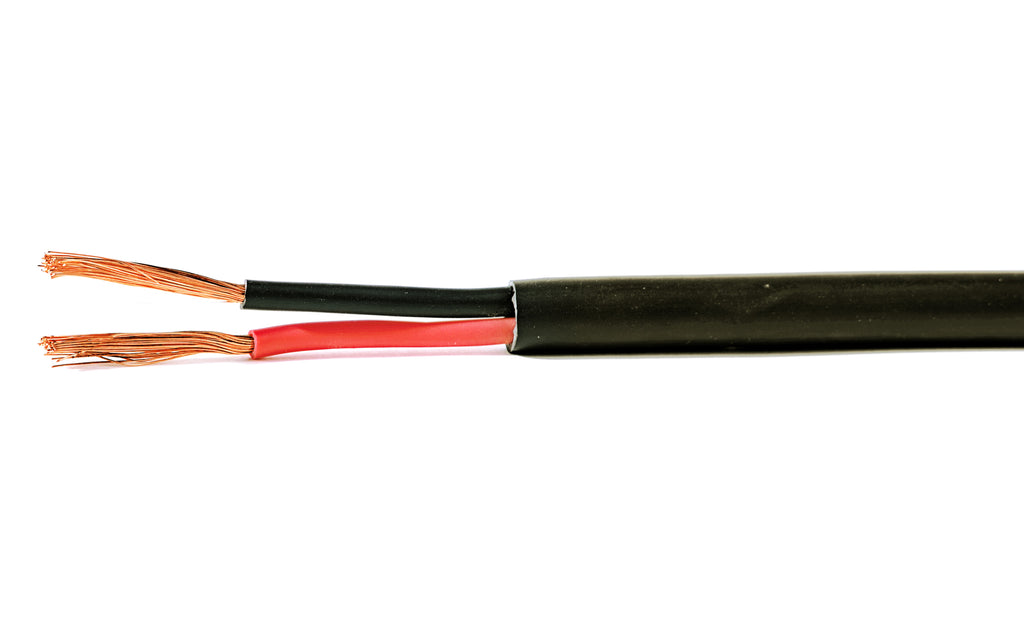
Class 5 stranded copper, 50/0.25, PVC insulated and sheathed, 300/500 V, drawn on the Pilone line in Lahore. Rated 27 A clipped direct at 30°C, 18 mV/A/m.
Cable is priced off the day's copper rate, so we quote per metre and per coil on WhatsApp. Send the metres you measured and your city for the exact figure.
A pump motor has to be earthed, so for the run itself take the three-core version: 2.5mm 3 core flexible cable. Past the run lengths in the table, step up to 4mm 3 core flexible cable or 4mm 2 core flexible cable where the earth is run separately. The drop cable that hangs in a borehole is a different product with different insulation — this PVC flexible is for the dry run above ground. For what a motor run costs by the metre, see 1 HP and 2 HP motor cable price.
We draw the copper in Lahore and sell it at the day's rate — no dealer margin, and the line that made the coil answers the message. Send the size, the metres you measured and your city: Punjab in 1–2 days, rest of Pakistan in 2–4.