
Factory-direct from Lahore · Nationwide delivery in 2–4 days
+92 319 4262451
WhatsApp
A tube well is two cables, and only one of them is sized off the pump. The drop cable goes down the bore. The feeder from the meter to the well head is the one that costs money, and its size is set by the distance, not by the horsepower.
A farm load is small and far away — that is the whole electrical shape of it. A pump drawing 30 A is inside the capacity of 6 mm² copper, but put the well 150 metres out across the fields and 6 mm² loses 32.9 V on the way there. The cable that reaches is three or four sizes above the cable that carries. Work from the current printed on the pump's plate and the one-way metres: a 30 A pump 150 m out lands on 35 mm² for a 3% budget, or 25 mm² if 5% is acceptable.
Farm buyers ask for "tube well cable" as one thing and get quoted for one thing, then find on installation day that they needed two. They are different products with different problems.
| Run | What it is | What decides the size | Where to look |
|---|---|---|---|
| Bore to pump, submerged | Submersible drop cable, permanently in water | The pump maker's specification for that motor and that depth | Pump documentation |
| Meter or transformer to well head | Field feeder, usually buried or on poles | One-way distance — voltage drop, not current | The table below |
| Well head panel to the motor | Short tail from the starter | Full-load current on the plate | Submersible pump cable |
| Farmhouse, sheds, chaff cutter, fans | Ordinary distribution off the same supply | Connected load and diversity | Cable size calculator |
| Buried section of any of the above | Cable in a trench across worked ground | Armour for the route, and a lower buried rating | Underground cable |
Two of those rows deserve a warning. Ploughing, levelling and new bunds move a lot of earth on a farm, so a buried field feeder wants armour and a recorded route far more than a house feed does. And the drop cable inside the bore is not a place to improvise: it lives in water for years, and the pump maker's specification is the specification.
Voltage drop is millivolts per amp per metre, times the current, times the one-way run. On a farm all three numbers work against you: the run is long, the pump is a motor that does not tolerate low volts, and rural supplies are often already sagging before the cable takes its share. This is the same 30 A pump at three ordinary distances.
| Size | Capacity, 2 cores | At 100 m | At 150 m | At 200 m |
|---|---|---|---|---|
| 6 mm² | 46 A | 21.9 V | 32.9 V | 43.8 V |
| 10 mm² | 63 A | 13.2 V | 19.8 V | 26.4 V |
| 16 mm² | 85 A | 8.4 V | 12.6 V | 16.8 V |
| 25 mm² | 112 A | 5.25 V | 7.88 V | 10.5 V |
| 35 mm² | 138 A | 3.75 V | 5.63 V | 7.5 V |
| 50 mm² | 168 A | 2.79 V | 4.19 V | 5.58 V |
Every size in that table carries 30 A without breathing hard — the smallest of them is rated 46 A. Not one of the columns is about capacity. Read across the 100 m column and 25 mm² is the first size inside 6.6 V; at 200 m nothing under 50 mm² holds that budget, and 35 mm² at 7.5 V passes only if you accept 5%. That is the farm sizing problem in one table, and it is why a shop that quotes on the pump rating alone quotes too small.
Single-phase supply, the plate on the pump reads 28 A full load, and the well head is 160 metres from the meter down the edge of the field. Take the plate's current, not the horsepower on the sticker.
Capacity. 16 mm² is 85 A with two loaded cores, clipped direct at 30°C. Even after a substantial derating for a buried run it is far above 28 A. On current alone the job is finished at 16 mm², or smaller.
Voltage drop. On 16 mm²: 2.8 × 28 × 160 ÷ 1000 = 12.54 V, which is 5.7% of 220 V. On 25 mm²: 1.75 × 28 × 160 ÷ 1000 = 7.84 V, or 3.6%. On 35 mm²: 1.25 × 28 × 160 ÷ 1000 = 5.6 V, or 2.5%.
Answer: 35 mm² if you want the motor to see a clean 3%, 25 mm² if a 5% budget is acceptable for your supply and starter. Either way the size is two or three steps above what the current asked for, and the choice between them is a decision about the budget rather than about the pump. On a supply that already sags at the tail of a rural feeder, take the larger one — the motor is spending the whole difference.
A 160 m feeder is also exactly where aluminium earns its keep: the cost per metre is lower and the length is where that shows. The size steps up for the same current because aluminium carries less than copper at the same cross-section, and the per-size figures are on aluminium cable with the trade-off set out in copper vs aluminium. Terminate aluminium only with lugs rated for it.
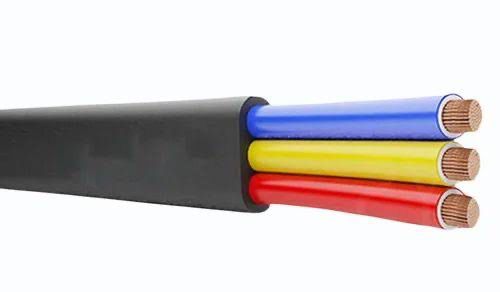
Class 5 stranded copper for starter panels, motor tails and the short worked ends of a farm circuit. For the length inside the bore, buy the drop cable the pump maker specifies.
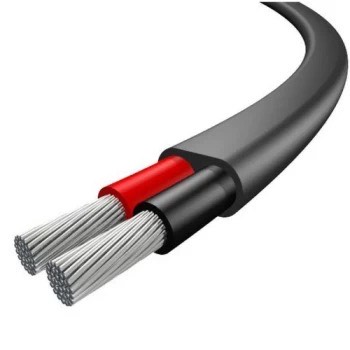
Lower cost per metre on the long run out to the well head or the far shed, where the metres decide the bill. Ampacity per size on the product page.
Cable is priced off the day's copper rate, so we quote per metre and per coil on WhatsApp rather than publish a figure that goes stale. Send the pump's plate current, the one-way metres and your city: Punjab in 1–2 days, rest of Pakistan in 2–4.
The current on the motor's rating plate is the figure the cable is sized against. Horsepower on the box tells us nothing about what the feeder has to carry.
Pace the actual one-way run from the meter to the well head, along the way the cable will go, and add a few metres at each end. On a farm that route is rarely straight.
A buried run needs armour and rates lower than the same cable in air. Tell us which, and whether the trench crosses ploughed ground, and we quote the right construction the first time.
Tell us the current printed on the pump's plate, the one-way distance from the meter to the well head, and whether the run is buried or on poles. You get the size and the day's factory rate, dispatched by courier or transport.