
Factory-direct from Lahore · Nationwide delivery in 2–4 days
+92 319 4262451
WhatsApp
There is no one size. A 1 HP pump on a 220 V supply takes 1.5 mm² out to 63 m, 2.5 mm² out to 102 m and 4 mm² out to 167 m. The run length picks the size, not the horsepower alone.
This page is for a pump hanging in the water at the bottom of a borehole or tubewell. If your pump sits on the ground and fills an overhead tank, the run is short and the sums are different — that job is on cable for a water motor.
Measure the whole route before you pick anything: borehole depth, plus wellhead to the starter panel, plus panel back to the board. Every size below is worked against a 5% voltage-drop budget on 220 V, which is 11 V. Your motor's nameplate current beats the assumed current in every row.
Find your horsepower down the side, your total one-way run along the top, and read the size. Nothing in this table is copied from another chart — every cell is the smallest size whose voltage drop stays inside 11 V at the assumed current, and the arithmetic is in the next section so you can check it.
| Pump | Assumed FLC | 10 m | 25 m | 50 m | 75 m | 100 m | 150 m | 200 m |
|---|---|---|---|---|---|---|---|---|
| 0.5 HP | 3.5 A | 1.5 | 1.5 | 1.5 | 1.5 | 1.5 | 2.5 | 4 |
| 1 HP | 6 A | 1.5 | 1.5 | 1.5 | 2.5 | 2.5 | 4 | 6 |
| 1.5 HP | 8.5 A | 1.5 | 1.5 | 2.5 | 4 | 4 | 6 | 10 |
| 2 HP | 11 A | 2.5 | 2.5 | 2.5 | 4 | 6 | 10 | 10 |
| 3 HP | 16 A | 2.5 | 2.5 | 4 | 6 | 10 | 10 | 16 |
| 5 HP | 26 A | 6 | 6 | 6 | 10 | 16 | 16 | 25 |
Sizes are mm². Two rows carry a floor that voltage drop alone would not set: a 2 HP pump on a 20 A breaker cannot sit on 1.5 mm², because 1.5 mm² is rated 19.5 A and the cable must carry more than the breaker; a 5 HP pump on a 40 A breaker starts at 6 mm² for the same reason. The single HP figure you were given at the pump shop is right only at one length, and it is over-spec at the short end and unsafe at the long end everywhere else. That is the whole case for reading a chart with metres in it.
Three phase changes these numbers completely, and in your favour: a 400 V supply gives nearly twice the drop budget — 20 V instead of 11 V — at about a third of the current. Those runs are on 3 HP motor cable size and 5 HP motor cable size.
A 2.5 mm² copper cable is rated 27 A. A 2 HP pump draws about 11 A. On the current rating alone, 2.5 mm² looks like twice the cable you need at any length. It is not, and here is the number that says so: at 80 m that same cable loses 15.8 V of the 220 the motor was meant to get.
The formula is one line, and every chart on this page is built from it. Volts lost = mV/A/m × amps × metres ÷ 1000. The mV/A/m figure is a property of the conductor size, published in BS 7671. Turn the formula round and it gives the longest run each size can feed inside an 11 V budget: metres = 11,000 ÷ (mV/A/m × amps).
| Size | Trade code | mV/A/m | 1 HP, 6 A | 2 HP, 11 A | 3 HP, 16 A | 5 HP, 26 A |
|---|---|---|---|---|---|---|
| 1.5 mm² | 3/.029 | 29 | 63 m | 34 m | 23 m | 14 m |
| 2.5 mm² | 7/.029 | 18 | 102 m | 56 m | 38 m | 23 m |
| 4 mm² | 7/.036 | 11 | 167 m | 91 m | 63 m | 38 m |
| 6 mm² | 7/.044 | 7.3 | 251 m | 137 m | 94 m | 58 m |
| 10 mm² | 7/.052 | 4.4 | 417 m | 227 m | 156 m | 96 m |
| 16 mm² | 7/.064 | 2.8 | 655 m | 357 m | 245 m | 151 m |
Read the 2.5 mm² row against its 27 A rating and the point lands: the cable runs out of volts at 56 m on a 2 HP pump while still carrying less than half the current it is rated for. Past about 50 m, heat stops being the question. Most published pump charts show you the answer without the budget they used, so you cannot check them. This one shows both.
A tubewell circuit is two purchases, and confusing them is how boreholes get pulled twice in a year. The length that hangs in the water is a drop cable: it needs insulation built to sit permanently submerged, and the maker has to say so on the drum. The length from the wellhead junction to the starter panel, and from the panel back to the distribution board, is ordinary dry-side cable.
Our catalogue is PVC and XLPE copper flexible cable, standard cable, aluminium and solar DC. There is no submersible-rated drop cable in it. Buy the wet length from a maker who states an immersion rating, and check that rating yourself before it goes down the hole. What we draw is the copper for the dry side of the same job, at the day's factory rate.
The sizing does not split, though. Voltage drop accumulates over the whole route, wet metres and dry metres together, so size both parts to the same total length. If the drop cable is 4 mm², the surface run should not be thinner.
Almost every wrong pump cable starts as a wrong length. The depth of the bore is only the first of three runs, and the pump shop usually asks for that one alone.
Bore depth 150 ft, wellhead to the panel 50 ft, panel to the board 20 ft. That is 220 ft. In metres: 220 × 0.3048 = 67 m.
A 2 HP single-phase pump is assumed at 11 A here. Read your own plate: the full-load current is printed on it, and it is the only figure specific to your motor.
2 HP at 67 m falls between the 50 and 75 m columns, so take the longer one: 4 mm². Then prove it with the formula.
The check on 2.5 mm² first, because that is what gets sold for a 2 HP pump: 18 × 11 × 67 ÷ 1000 = 13.3 V, which is 6.0% of 220 V and over the budget. Step up to 4 mm²: 11 × 11 × 67 ÷ 1000 = 8.1 V, which is 3.7%. That passes, with room. Stretch the same pump to an 80 m total and 2.5 mm² loses 18 × 11 × 80 ÷ 1000 = 15.8 V, a 7.2% drop, while 4 mm² loses 9.7 V and holds at 4.4%.
Buy to the measured route plus a working allowance at each end, not to the bore depth. Check your own figures in the voltage drop calculator before you order the coil.
Ask for a size in mm² in a Pakistani shop and you get answered in strand codes. The codes are imperial — 7/.036 is seven strands of 0.036 inch — so the area they compute to does not land exactly on the metric size they are sold as. Both names are on the same drum, and this is the translation.
| Trade code | Actual area | Sold as | Current capacity | Voltage drop | Longest run, 1 HP |
|---|---|---|---|---|---|
| 3/.029 | 1.29 mm² | 1.5 mm² | 19.5 A | 29 mV/A/m | 63 m |
| 7/.029 | 3.0 mm² | 2.5–3 mm² | 27 A | 18 mV/A/m | 102 m |
| 7/.036 | 4.6 mm² | 4 mm² | 36 A | 11 mV/A/m | 167 m |
| 7/.044 | 6.9 mm² | 6–7 mm² | 46 A | 7.3 mV/A/m | 251 m |
| 7/.052 | 9.6 mm² | 10 mm² | 63 A | 4.4 mV/A/m | 417 m |
| 7/.064 | 14.5 mm² | 16 mm² | 85 A | 2.8 mV/A/m | 655 m |
So for a 1 HP borehole pump the shop answer is 3/.029 on a short run and 7/.029 once the total route passes 63 m. One warning about imported charts: American tables give AWG, and the millimetre figure quoted beside an AWG number is usually the conductor diameter, not its area. Number 14 AWG is 1.6 mm across and 2.08 mm² in area. Read one as the other and a pump circuit ends up a size and a half light.
Rural feeders in Punjab and Sindh often sit well under 220 V through the afternoon, and not one of the pump charts that rank for this search starts from that. It matters twice over. The motor's power draw does not fall with the voltage, so the current rises to make it up, and the percentage budget itself shrinks because it is a percentage of a smaller number.
Take the 2 HP pump on an 80 m run again, with the wellhead seeing 200 V. Current becomes 11 × 220 ÷ 200 = 12.1 A. The 5% budget becomes 10 V, not 11. On 4 mm²: 11 × 12.1 × 80 ÷ 1000 = 10.6 V, which is 5.3% and now outside the budget. Step to 6 mm²: 7.3 × 12.1 × 80 ÷ 1000 = 7.1 V, or 3.5%. If your supply sags, go one size up from the chart and measure the voltage at the panel while the pump is running, not while it is off.
Every figure above is a running figure. A direct-on-line motor draws several times its full-load current for the first second or two, and that transient is what stalls a pump at the end of a long cable: the drop that is 4% at running current is a multiple of that at start, so the motor is asked to break away on a badly reduced voltage. It heats, it hums, it trips the overload, and eventually the winding goes. A cable that is correct on the running sums has already dealt with most of this; a cable chosen without any length in the calculation has not.
| Pump | Assumed FLC | MCB | Smallest cable that clears the MCB |
|---|---|---|---|
| 0.5 HP | 3.5 A | 10 A type C | 1.5 mm² (19.5 A) |
| 1 HP | 6 A | 16 A type C | 1.5 mm² (19.5 A) |
| 1.5 HP | 8.5 A | 16 A type C | 1.5 mm² (19.5 A) |
| 2 HP | 11 A | 20 A type C | 2.5 mm² (27 A) |
| 3 HP | 16 A | 25 A type C | 2.5 mm² (27 A) |
| 5 HP | 26 A | 40 A type C | 6 mm² (46 A) |
Take whichever is larger, this size or the one the run length asks for. On any tubewell past 50 m the run length wins every time.
Yeh sirf HP se tay nahi hota — lambai bhi dekhni parti hai. 1 HP pump 220 volt par takreeban 6 amp leta hai. Kul lambai 63 meter tak ho to 1.5 mm² (3/.029) kaafi hai, 102 meter tak 2.5 mm² (7/.029), aur 167 meter tak 4 mm² (7/.036). Kul lambai ka matlab hai boring ki gehrai, phir wellhead se panel tak, phir panel se meter tak — teenon jama karke.
Boring ke andar wala hissa alag cheez hai: uske liye submersible drop cable chahiye jiska paani mein rehne ka rating drum par likha ho. Hum woh nahi banate. Panel aur board wali dry side ka copper hum khud Lahore mein banate hain, aur usi din ke rate par milta hai.
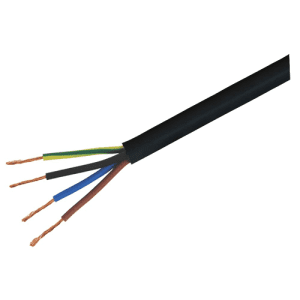
Class 5 stranded copper, PVC insulated and sheathed, 300/500 V, drawn on the Pilone line in Lahore. Rated 32 A on three loaded conductors and 11 mV/A/m — the wellhead-to-panel and panel-to-board run on a three-phase tubewell. For a single-phase pump the same run takes three cores.
Copper cable is priced off the day's copper rate, so we quote per metre and per coil on WhatsApp. Send the HP, the total metres and your city.
Same size, other constructions: 4mm 3 core flexible cable for a single-phase surface run, 4mm 3 core standard cable for a fixed run in conduit. Longer routes step up to 6mm 4 core cable and 10mm 4 core cable; the rates are on 1 HP and 2 HP motor cable price.
We draw the copper in Lahore and sell it at the day's rate — no dealer margin. Give us the horsepower, the bore depth and the surface run with your city, and one message comes back with the size and the number: Punjab in 1–2 days, rest of Pakistan in 2–4.