
Factory-direct from Lahore · Nationwide delivery in 2–4 days
+92 319 4262451
WhatsApp
3 ton: 6 mm² copper on a 25 A MCB. 4 ton: 10 mm² on a 32 A MCB.
A 3 ton air conditioner typically draws 3000–3600 W, about 14–16 A on Pakistan's 220 V supply; a 4 ton draws about 18–22 A. On a 4 ton you can stay at 6 mm² only where the cable is clipped in open air on a short run — once it goes into conduit, take 10 mm². Read the rating plate on your own unit first: the current printed there, not the tonnage, is what the circuit is sized to.
These are the two largest sizes commonly wired as a single-phase point in a Pakistani house — a 3 ton for a hall or a large drawing room, a 4 ton for a shop floor or a ducted room. Both sit well above the 1.5 ton point most homes wire, and neither belongs on the same circuit as anything else.
| Parameter | 3 ton | 4 ton |
|---|---|---|
| Typical power | 3000–3600 W | 4000–4800 W |
| Running current at 220 V | 14–16 A | 18–22 A |
| Start surge, fixed speed | 2–3 × running | 2–3 × running |
| MCB rating | 25 A | 32 A |
| MCB curve | C | C |
| Live and neutral | 6 mm² | 10 mm² |
| Earth | 6 mm² | 10 mm² |
| Isolator at the unit | Double pole, at or above the MCB | Double pole, at or above the MCB |
The arithmetic is plain: 3600 W ÷ 220 V = 16.4 A, and 4800 W ÷ 220 V = 21.8 A. The breaker goes above that figure, and the cable goes above the breaker.
A 3 ton air conditioner on a 220 V single-phase supply draws about 14–16 A while it runs, so the point takes 6 mm² copper on a 25 A MCB: 6 mm² carries 46 A clipped direct in open air at 30°C and 41 A when three conductors are loaded, which leaves the circuit standing above the breaker even after it is derated for conduit and a Lahore summer. 4 mm² clears the running load on paper, but 11 A is the whole of its headroom over the breaker, and conduit and a Lahore summer spend that headroom long before they spend the 21 A that 6 mm² starts with.
| Size | 2 core | 3 core | Voltage drop | Class 2 strands | Trade code | Margin |
|---|---|---|---|---|---|---|
| 2.5 mm² | 27 A | 24 A | 18 mV/A/m | 7/0.67 | 7/.029 | +2 A |
| 4 mm² | 36 A | 32 A | 11 mV/A/m | 7/0.85 | 7/.036 | +11 A |
| 6 mm² | 46 A | 41 A | 7.3 mV/A/m | 7/1.04 | 7/.044 | +21 A |
| 10 mm² | 63 A | 57 A | 4.4 mV/A/m | 7/1.35 | 7/.052 | +38 A |
Nobody can give you the exact derated figure without seeing the installation, which is why the sensible move at this load is to buy the margin rather than the calculation. If you ask for it at the shop by the trade code, 6 mm² is the coil marked 7/.044.
A 4 ton unit at 18–22 A needs a 32 A breaker, and a 32 A breaker needs a cable that stays above 32 A after derating. 6 mm² starts at 46 A and 10 mm² starts at 63 A. Clipped direct on a short run, 6 mm² holds. In conduit, bunched, or on a long run to an outdoor unit on the roof, 10 mm² is the size that still has margin when the summer is at its worst.
Check the supply on the rating plate before you buy either. Most 3 ton units sold here are single-phase 220 V, but a fair number of 4 ton and ducted units are three-phase 400 V. A three-phase unit splits the same power across three lines, so the current in each line is much lower and the cable is sized differently — use the three-phase cable size guide for that one, not this table.
At this load, heat decides the size and length decides whether you go one size up again. The cable's own drop is its voltage drop figure multiplied by the current and the one-way run length. A unit pulling 15 A on 6 mm² over a 30 m run drops 7.3 × 15 × 30 ÷ 1000 = 3.29 V, comfortably inside the 6.6 V budget. Put the same load on 4 mm² and it becomes 11 × 15 × 30 ÷ 1000 = 4.95 V — still inside the budget, which is exactly why voltage drop is the wrong reason to pick 6 mm² here. Heat is the reason.
| Run | 4 mm² at 15 A | 6 mm² at 15 A | 6 mm² at 21 A | 10 mm² at 21 A |
|---|---|---|---|---|
| 10 m | 1.65 V | 1.10 V | 1.53 V | 0.92 V |
| 15 m | 2.48 V | 1.64 V | 2.30 V | 1.39 V |
| 20 m | 3.30 V | 2.19 V | 3.07 V | 1.85 V |
| 25 m | 4.13 V | 2.74 V | 3.83 V | 2.31 V |
| 30 m | 4.95 V | 3.29 V | 4.60 V | 2.77 V |
| 40 m | 6.60 V | 4.38 V | 6.13 V | 3.70 V |
Read the far right of the table and the limits fall out: 6 mm² carrying 15 A runs to about 60 m before it spends the whole 6.6 V, and at 21 A it runs to about 43 m. 10 mm² at 21 A reaches roughly 71 m. Measure the real route — up the wall, along the slab, out to the outdoor unit — not the straight line, and check it against the voltage drop calculator.
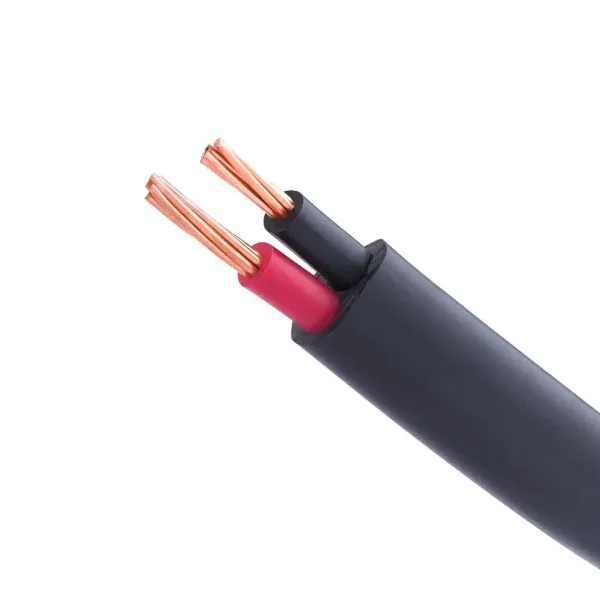
Stranded copper, 7/1.04 class 2, PVC insulated and sheathed, 450/750 V, drawn on the Pilone line in Lahore. Rated 46 A clipped direct at 30°C — the size this point takes. The trade calls this coil 7/.044.
Prices track the daily copper rate. Send the length and your city on WhatsApp for the exact figure.
Also made in 6mm²: 6mm 3 core standard cable, 6mm 4 core cable, 6mm 3 core flexible cable. The 3 core carries live, neutral and earth in one pull, which is what an AC point wants. For a 4 ton in conduit, step up to the 10mm 3 core cable.
We draw the copper in Lahore and sell it at the day's rate — no dealer margin. Tell us the length and your city: Punjab in 1–2 days, rest of Pakistan in 2–4.