
Factory-direct from Lahore · Nationwide delivery in 2–4 days
+92 319 4262451
WhatsApp
No — not on the room's ordinary 6 A point.
A window air conditioner needs its own circuit out of the distribution board with its own MCB, ending in a 16 A socket or, better, hardwired to a double-pole isolator beside the unit. The socket on the wall is only the last 50 mm of the story: what matters is the cable behind it and what else is sharing that cable. The size of that circuit comes from the unit's tonnage — the tonnage guides carry the number.
Almost every Pakistani bedroom has a socket in it, and almost none of them are fit for an air conditioner. The difference is not the socket face. It is whether that socket sits at the end of its own run from the board or halfway along a circuit shared with the fan, the lights and a phone charger.
| Point on the wall | What it was put there for | Cable usually behind it | An AC on it? |
|---|---|---|---|
| 5 or 6 A round-pin socket | Lamp, charger, pedestal fan | 1.5 mm², shared | No |
| 13 or 16 A socket on the room's socket circuit | Fridge, TV, iron | 2.5 mm², shared | No |
| 16 A socket on its own run and MCB | One heavy appliance | 4 mm², dedicated | Yes |
| Double-pole isolator, hardwired | One fixed appliance | 4 mm², dedicated | Yes, and it is the better fit |
A window air conditioner belongs on a dedicated circuit from the distribution board, ending either in a 16 A socket that nothing else shares or in a double-pole isolator wired straight to the unit; a 16 A socket face fitted onto the room's existing shared cable is not the same thing and is the most common way this gets done wrong. The rating printed on the socket describes the socket, not the run feeding it.
Three questions answer this, and you can ask all three in ten minutes. What size is the cable feeding that point? What else is on the same circuit? What is the MCB protecting it? If the answer to the first is 1.5 mm² and the answer to the second is "the fan and the lights", stop there.
Put a number on it. 1.5 mm² copper carries 19.5 A clipped direct in open air at 30°C, and 17.5 A once three conductors are loaded — before any allowance for conduit, bunching, or a July afternoon in Lahore. A window AC drawing 8 A on top of two fans and a lighting load takes a circuit that was comfortable and leaves it running near its ceiling for eight hours a day. What fails first is not the breaker. It is a plug top, or a screw terminal in the point, and the first sign is usually the smell.
So the existing point works only if it is already a dedicated run of the right size, which a normal room socket is not. Adding a proper AC point is one cable and one breaker — the cheapest part of owning an air conditioner.
A window unit comes with a moulded plug on a short lead, so a 16 A socket is the easy route and a legitimate one. Know what you are choosing, though. A plug in a socket is a spring contact carrying the unit's full current for years in a room that gets hot. It loosens, loose contacts heat, and heat oxidises the brass until it gets hotter still. Nearly every burnt AC point starts at that joint, not in the cable.
Hardwiring to a double-pole isolator beside the unit removes that joint and adds a switch that breaks live and neutral together, so the machine can be worked on dead. If you keep the plug, fit a good socket, check it by hand each summer, and replace it the moment it feels warm.
Both are copper and both are sold by the same mm² number, but they are built for different work. Standard cable uses a small number of thick strands — class 2 — and is meant to be pulled into a conduit once and left there. Flexible cable uses many fine strands — class 5 — and is meant to bend and keep bending.
| Construction | Class | 2.5 mm² strands | 4 mm² strands | Where it belongs |
|---|---|---|---|---|
| Standard | 2 | 7/0.67 | 7/0.85 | The fixed run from the board to the point |
| Flexible | 5 | 50/0.25 | 56/0.30 | Tails, appliance leads, anything that moves |
For a window AC that means standard cable in the wall and, if the unit needs a longer tail than the moulded lead gives, flexible for that tail only. A light flexible cord at 300/500 V is not a circuit cable and should never be run from a distribution board. And when you buy, the shop will speak in trade codes rather than mm².
| Trade code | Works out to | Sold as |
|---|---|---|
| 3/.029 | 1.29 mm² | about 1.5 mm² |
| 7/.029 | 3.0 mm² | about 2.5–3 mm² |
| 7/.036 | 4.6 mm² | about 4 mm² |
Once you have decided the point gets its own circuit, the conductor size is a tonnage question. Read the rating plate and take the number from the matching guide.
4 mm² standard cable is what most dedicated AC points in Pakistani homes are run in. Confirm the size on the tonnage guide above, then order the metres from the board to the point — and take the 3 core version so the earth arrives on the same cable rather than being found somewhere in the room.
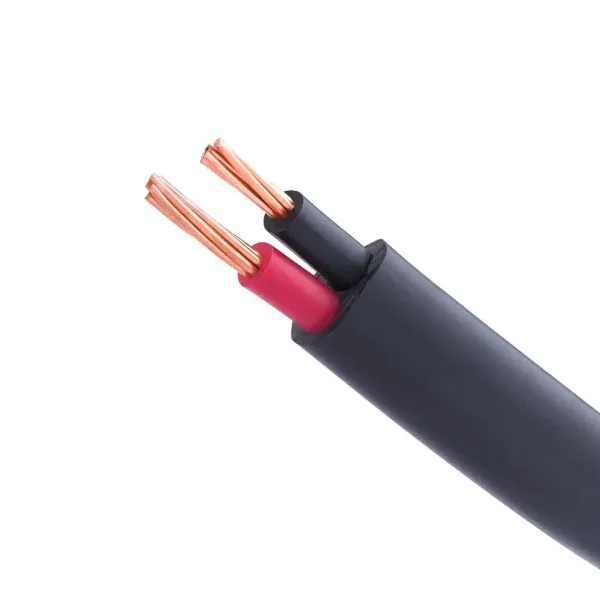
Stranded copper, 7/0.85 class 2, PVC insulated and sheathed, 450/750 V, drawn on the Pilone line in Lahore. Rated 36 A clipped direct at 30°C. The trade calls this coil 7/.036.
Prices track the daily copper rate. Send the length and your city on WhatsApp for the exact figure.
With the earth on the same run: 4mm 3 core cable. For a flexible tail from the point to the unit: 4mm 3 core flexible cable, 2.5mm 3 core flexible cable. All 4mm sizes and specs.
We draw the copper in Lahore and sell it at the day's rate — no dealer margin. Tell us the length and your city: Punjab in 1–2 days, rest of Pakistan in 2–4.