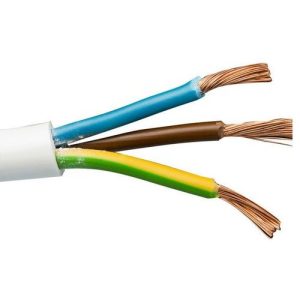
Three 4 mm² class 5 conductors in one flexible sheath — line, neutral and earth — 56 strands of 0.30 mm per core. 36 A with two conductors loaded, 4.95 Ω/km, 300/500 V. This is the cable that goes to an AC point, a single-phase pump drop or a machine tail, where the last few metres have to bend into a gland and stay bent. Made on the Pilone line in Lahore.
Prices track the daily copper rate. Bulk and coil pricing on request.
Check the coil before you pay for it
Every coil leaves our factory with a QR code printed on the packaging. Scan it and the factory record for that batch opens: brand, cable size, batch number, year of manufacture and conductor. Compare the batch number on screen with the one printed on your coil — if the two do not match, it did not come from us.
Specifications
Resistance per IEC 60228. Current capacity and voltage drop per BS 7671, installation method C (clipped direct), 30°C ambient, 2 loaded conductors (line and neutral; earth core not current-carrying). Verify sizing with a licensed electrician for your installation.
Three people buy this size: the electrician wiring an AC point, the fitter making a pump drop, and the workshop that needs a tail it can move. All three want the same thing — line, neutral and earth in one jacket, and copper fine enough to turn into a gland without fighting back. 4 mm² class 5 carries 36 A with two conductors loaded, clipped direct at 30°C, which is about 7.9 kVA on a 220 V single-phase supply. That covers a 1.5-ton split at 7–9 A, a single-phase pump, and most 220 V shop machines with room left over. Read the rating plate on your own unit before you size.
AC point leads
Distribution board to a split unit on a dedicated MCB. Three cores means the earth arrives with the supply, not from the conduit.
Single-phase pump drops
Control panel to a 220 V motor pump: the tail flexes into the gland and takes vibration without work-hardening.
Machine and tool tails
Shop machines and site tools that get moved and re-coiled. Class 5 stranding survives that; a class 2 conductor cracks inside the insulation.
Worked example, using the numbers in the table above. A 1.5-ton split drawing 9 A, 22 m from the distribution board to the outdoor unit: 9 × 22 × 11 ÷ 1000 = 2.2 V of drop. BS 7671 allows 5% on a power circuit, which is 11 V on a 220 V supply, so this run spends a fifth of the budget. At 9 A the full 11 V is not reached until 11000 ÷ (9 × 11) = 111 m; push the cable to its rated 36 A and the same limit arrives at 28 m. Below those lengths heat sets the limit, not the run. Check yours with the voltage drop calculator.
Current capacity depends on how the cable is installed and coiled. A cable left on a drum carries less than one run out flat, because the layers heat each other. Derate for bundling and high ambient temperature. Have a licensed electrician confirm the size for your load and run length — or start with the cable size calculator.
What buyers say
★★★★★ 5/5
“Excellent quality copper cables. Fast delivery across Pakistan. Highly recommended for electrical projects.”
AHMAD HASSAN
★★★★★ 5/5
“Best cable manufacturer in Lahore. 99.9% pure copper as promised. Very satisfied with the product quality.”
MUHAMMAD ALI
★★★★★ 5/5
“Good quality cables at competitive prices. Delivery was quick to Karachi. Will order again.”
IMRAN KHAN
Frequently asked
What is the price of 4mm 3 core flexible cable in Pakistan?
The price changes with the daily copper rate. Pilone Cables sells factory-direct from Lahore, below dealer rates. Message us on WhatsApp at +92 319 4262451 for today's price per meter.
What is 4mm 3 core flexible cable used for?
It is a fine-stranded flexible cable for submersible pump leads, portable machine connections, and single-phase appliance circuits needing an earth core. Rated around 36 A for the two current-carrying cores.
Should I use 2 core flexible instead?
Use 2-core when the load does not need a separate earth conductor. Choose 3-core for pumps and appliances that require line, neutral, and earth in one flexible cable.
Is 4mm cable enough for a 1.5 ton AC?
Yes for the usual case. A 1.5 ton split pulls 7–9 A at 220 V, and 4 mm² carries 36 A with two conductors loaded on method C. Run it as a dedicated circuit on a 20 A MCB, not shared with sockets, and keep the run under about 110 m at that current. Read the rating plate on your own unit first, because inverter and non-inverter models differ. The full sizing table is in the 1.5 ton AC cable guide.
Should I use 4mm flexible or 4mm standard cable?
Flexible if the cable moves, standard if it does not. Class 5 flexible has 56 strands of 0.30 mm per core and takes repeated bending into a gland; class 2 standard has 7 strands of 0.85 mm and is the cheaper build for a fixed clipped run. Both carry the same 36 A at 4 mm² with two conductors loaded. For a fixed run use 4mm 3 core standard cable.
Is 4mm 3 core flexible cable sold per metre or per coil?
Both, and the two figures are not comparable until you convert. We quote per metre against the length you give us. A shop quoting a whole coil is quoting a container, not a fixed quantity — coils are sold as 90 m, 45 m and 30 m here, so divide the coil price by its metre count before you compare. A per-foot rate looks smaller again, because one metre is 3.281 feet. The price per meter page works through every conversion.
Can I use 4mm 3 core flexible cable for a submersible pump?
For a single-phase pump inside its rating, yes — that is one of the jobs this cable is made for. 4 mm² carries 36 A with two conductors loaded, and the third core takes the earth down to the motor rather than relying on the pipe. Size on the full-load amps stamped on the pump plate, not the horsepower on the box, and allow for the starting current. Submerged and borehole sections need cable rated for permanent immersion; this is a dry-side tail. The motor pump cable guide has the sizing table.