PILONE CABLES TECHNICAL TEAM · UPDATED 16 AUGUST 2026
There is no one motor pump cable size. Three things decide it: where the pump sits, what supply feeds it, and how long the route is.
Across the jobs people actually buy for in Pakistan the answer runs from 1.5 mm² on a short single-phase booster line to 25 mm² on a 200 m single-phase 5 HP tubewell — the same pump on a 400 V three-phase connection needing a fraction of that. Find your pump in the table below and follow the link; each of those pages carries the run-length arithmetic for its own case.
Which pump do you have?
Pump type divides this better than horsepower does, because it decides where the length goes. A booster pump beside a tank is a short run where voltage drop rarely binds. A borehole pump puts most of the cable underground and vertical, so drop always binds. And a three-phase tubewell is a different calculation altogether: more volts, less current, a bigger budget. Two rows can fit the same pump, so take the horsepower row when you know the horsepower, and the pump-type row when you do not.
Pump type against the sizing case it creates. Sizes on the linked pages are derived against a 5% voltage-drop budget — 11 V on 220 V single phase, 20 V on 400 V three phase — using BS 7671 voltage drop and current capacity at reference method C (clipped direct), 30°C ambient, with conductor data per IEC 60228. Nameplate current overrides every assumed figure. Verify sizing with a licensed electrician for your installation.
If you do not know which supply you have, the motor's rating plate says so, and so does the meter: a single-phase board has one incoming live, a three-phase board has three. That one fact changes the cable more than the horsepower does.
What every pump circuit needs, whatever the size
Size on the whole route, not the visible part. Voltage drop accumulates over every metre of cable, wet and dry together. On a borehole that means the depth the pump hangs at, plus wellhead to starter panel, plus panel to board. Multiply feet by 0.3048 to get metres.
A dedicated type C MCB, rated above the motor's full-load current and below the cable's current capacity. Type C rides the direct-on-line starting surge; type B trips on it. The breaker protects the cable, not the motor.
An overload relay in the starter, set to the full-load current stamped on the plate. That is what protects the winding. On a pump add dry-run protection, and phase-failure protection on three phase.
An earth conductor the same size as the phases, bonded to the motor body and the delivery pipe. Single phase takes three cores, three phase takes four.
One continuous length inside a well. Never joint or splice cable down a borehole. And the submerged length must be drop cable with an immersion rating stated by its maker — ordinary PVC flexible is for the dry side only.
Pilone Cables draws PVC and XLPE copper flexible, standard, aluminium and solar DC cable. We do not make a submersible-rated drop cable, so buy the wet length from a maker who states an immersion rating and check that rating before it goes down the hole. Current capacities on the linked pages assume clipped direct at 30°C; derate for conduit, burial, grouping and Pakistani summer ambient. Have a licensed electrician confirm the size, the breaker and the earthing for your installation, or start with the cable size calculator and the voltage drop calculator.
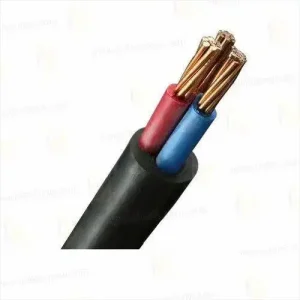
The middle of the pump range, and the size a 1 HP pump needs past 102 m or a 2 HP pump past 56 m. Class 2 stranded copper, PVC insulated and sheathed, 450/750 V, drawn on the Pilone line in Lahore. Rated 32 A on three loaded conductors clipped direct at 30°C, 11 mV/A/m.
There is no one size. Three things decide it: whether the pump sits on the surface or hangs in a borehole, whether the supply is 220 V single phase or 400 V three phase, and the total length of the route the cable takes. Across common Pakistani jobs the answer runs from 1.5 mm² on a short booster line to 25 mm² on a 200 m single-phase 5 HP tubewell.
Can I use ordinary flexible cable for a submersible pump?
Only on the dry side. The length that hangs in the water must be drop cable with an immersion rating stated by its maker. Ordinary PVC flexible cable is built for a dry protected run and belongs between the wellhead junction, the starter panel and the board. Pilone Cables does not make a submersible drop cable; we draw the copper for the dry side.
3 core or 4 core cable for a motor pump?
Count the conductors the motor needs. A single-phase pump takes live, neutral and an earth of the same size, so 3 core. A three-phase pump takes three phases plus earth, so 4 core. The core count does not change the size; the run length and the current do.
Does a motor pump need its own breaker?
Yes, a dedicated type C MCB rated above the motor's full-load current and below the cable's capacity. A type C curve rides the direct-on-line starting surge where a type B trips on it. The MCB protects the cable, not the motor: the winding is protected by the overload relay in the starter, set from the nameplate.
Tell us the pump, we will tell you the size
We draw the copper in Lahore and sell it at the day's rate — no dealer margin. Send the horsepower, the supply on the plate, the total run and your city, and one message comes back with the size and the number: Punjab in 1–2 days, rest of Pakistan in 2–4.