3 HP motor: single phase or three phase, and what size cable?
PILONE CABLES TECHNICAL TEAM · UPDATED 16 AUGUST 2026
Single phase, 220 V, about 16 A: 2.5 mm² to 38 m, 4 mm² to 63 m, 6 mm² to 94 m, 10 mm² to 156 m, on a 25 A type C MCB. Three phase, 400 V, about 5.1 A per line: 2.5 mm² four-core reaches 251 m, on a 10 A type C MCB.
Three horsepower is the size where the supply matters more than the horsepower. The same motor on three phase asks for a fraction of the copper, so read the nameplate for the phase and the full-load current before you price anything. Then measure the whole route — bore depth plus the surface runs on a tubewell — because length is what sets the size once the phase is settled. Every metre figure here is one way, on a 5% voltage-drop budget.
3 HP motor cable size on a 220 V single-phase supply
Three horsepower is 2,238 W of shaft output, not of input, and the difference lands on the supply as current — which is why a 3 HP plate on 220 V typically reads near 16 A rather than the 10.2 A that dividing 2,238 by 220 suggests. A 3 HP single-phase motor at 16 A needs 2.5 mm² copper on any run up to 38 m, 4 mm² from there to 63 m, 6 mm² to 94 m, 10 mm² to 156 m and 16 mm² to 245 m — each figure being the length at which voltage drop reaches 5% of a 220 V supply, with the circuit on a 25 A type C MCB and the cable clipped direct at 30°C. 2.5 mm² is the floor whatever the length, because the cable has to be rated above the breaker protecting it.
Volts lost in the cable at an assumed full-load current of 16 A on a 220 V single-phase supply. Figure = mV/A/m × 16 A × run ÷ 1000; the budget is 5% of 220 V, which is 11 V. Run is one way, along the route the cable takes. Copper, PVC; two loaded conductors. Voltage drop and current capacity per BS 7671, reference method C (clipped direct), 30°C ambient; conductor data per IEC 60228. The assumed current is a typical plate figure — use the full-load current printed on your own motor if it differs. Verify sizing with a licensed electrician for your installation.
Total run
Size
Trade code
Volts lost
Drop
10 m
2.5 mm²
7/.029
2.88 V
1.3%
25 m
2.5 mm²
7/.029
7.20 V
3.3%
50 m
4 mm²
7/.036
8.80 V
4.0%
75 m
6 mm²
7/.044
8.76 V
4.0%
100 m
10 mm²
7/.052
7.04 V
3.2%
150 m
10 mm²
7/.052
10.56 V
4.8%
200 m
16 mm²
7/.064
8.96 V
4.1%
Work a row and the ladder makes sense. At 100 m the 6 mm² that looks generous loses 7.3 mV/A/m × 16 A × 100 m ÷ 1000 = 11.68 V, which is 5.3% and over the budget by a hair. Step to 10 mm²: 4.4 × 16 × 100 ÷ 1000 = 7.04 V, or 3.2%. Meanwhile 6 mm² is rated 46 A against a 16 A load. The current rating was never the question. Other horsepowers are on the submersible pump cable size chart.
3 HP on 400 V three phase: the same motor, a fraction of the copper
Most 3 HP tubewells in rural Punjab and Sindh run on a three-phase connection, and nearly every sizing chart published for them is Indian and written for 415 V. Our supply is 400 V, and the arithmetic changes twice over in your favour. The current per line falls, and the drop budget rises to 5% of 400 V, which is 20 V.
Here is the conversion, out in the open. On single phase the motor takes 220 V × 16 A = 3,520 VA from the supply. Feed the same machine from 400 V three phase and that input becomes 3,520 ÷ (1.732 × 400) = 5.1 A per line, on the assumption that efficiency and power factor are unchanged. Real three-phase plates for 3 HP usually land a little under that, so 5.1 A is the safe side of the estimate — and your nameplate beats it either way.
Longest one-way run on a 400 V three-phase supply at an assumed 5.1 A per line, keeping voltage drop inside 5% of 400 V (20 V). Derived as 20,000 mV ÷ (three-phase mV/A/m × 5.1 A). The three-phase mV/A/m is 0.866 of the tabulated two-core figure, which is the column most charts use by mistake. Current capacity is three loaded conductors, BS 7671 reference method C (clipped direct), 30°C ambient, copper, PVC; conductor data per IEC 60228. Verify sizing with a licensed electrician for your installation.
Size
Trade code
Two-core mV/A/m
Three-phase mV/A/m
Capacity, 3 loaded
Longest run at 5.1 A
1.5 mm²
3/.029
29
25.1
17.5 A
156 m
2.5 mm²
7/.029
18
15.6
24 A
251 m
4 mm²
7/.036
11
9.5
32 A
412 m
6 mm²
7/.044
7.3
6.3
41 A
622 m
Those distances are the physics, not a shopping list. On paper 1.5 mm² four-core clears both the 10 A breaker and a 156 m run, but a tubewell cable is dragged, clamped and buried, and 2.5 mm² is the sensible floor for anything permanent. Note also that four cores are needed — three phases and an earth — and that the capacities above are the three-loaded-conductor figures, which are lower than the two-core ones quoted on single-phase pages. Three-phase feeder sizing beyond pumps is covered on three-phase cable size.
Do not mix the two columns. Taking the 20 V three-phase budget and pairing it with a single-phase current, or using the two-core mV/A/m on a three-phase run, gives an answer that is wrong in one direction or the other. Use the single-phase table if your plate says 220 V, the three-phase table if it says 400 V. Current capacities assume clipped direct at 30°C; derate for conduit, burial, grouping and Pakistani summer ambient. Have a licensed electrician confirm the size, the breaker and the earthing for your installation, or start with the cable size calculator and the voltage drop calculator.
Breaker, starter and the cores you need
Single phase: 25 A type C MCB on a dedicated way, with 2.5 mm² (27 A) as the smallest cable the circuit allows. Three phase: 10 A type C triple pole, with 1.5 mm² four-core (17.5 A on three loaded conductors) clearing it on paper and 2.5 mm² the practical floor.
The MCB protects the cable, not the motor. The winding is protected by the overload relay in the starter, set to the full-load current stamped on the plate. On a tubewell add dry-run protection and, where the supply is unstable, phase-failure protection — a three-phase motor running on two phases burns out fast.
Count the cores from the supply. Single phase takes three: live, neutral and an earth of the same size. Three phase takes four: three phases and earth. Earth the motor body and the delivery pipe on a pump.
Direct-on-line starting draws several times the running current for a second or two. A type C curve rides it; a type B does not. On a long run that transient is what stalls a motor, because the drop that is 4% at running current is a multiple of that at start.
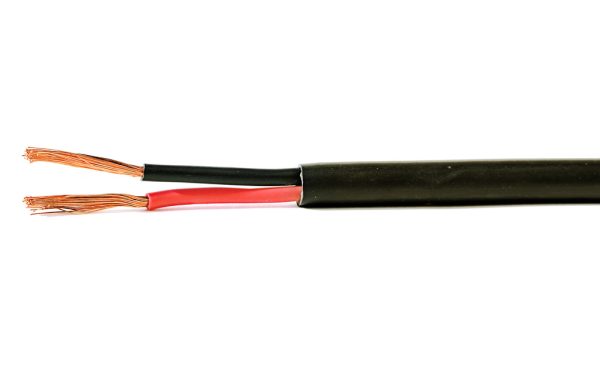
The single-phase 3 HP size between 63 and 94 m of total run. Class 5 flexible copper, PVC insulated and sheathed, drawn on the Pilone line in Lahore. Rated 46 A on two loaded conductors clipped direct at 30°C, 7.3 mV/A/m.
Pehle supply dekhein. Single phase 220 volt par motor takreeban 16 amp leti hai: 38 meter tak 2.5 mm² (7/.029), 63 meter tak 4 mm² (7/.036), 94 meter tak 6 mm² (7/.044), aur 156 meter tak 10 mm² (7/.052). Three phase 400 volt par wahi motor sirf 5.1 amp leti hai, is liye 2.5 mm² char core 251 meter tak chal jaata hai.
Single phase ya three phase — tubewell ke liye kaunsa?
Where a three-phase connection exists, take it. At 3 HP the same motor draws about 16 A on 220 V single phase and about 5.1 A per line on 400 V three phase, and the drop budget rises from 11 V to 20 V. That combination cuts the copper on a long tubewell run by two or three sizes. The motor nameplate tells you which supply the machine you own is built for.
Is 4mm cable enough for a 3 HP motor?
On single phase, only out to 63 m of total run. 4 mm² carries 36 A against a 16 A load, so current is never the limit; voltage drop is. At 63 m the loss is 11.09 V, which is the whole 5% budget. Past that take 6 mm² to 94 m or 10 mm² to 156 m. On three phase, 4 mm² covers 412 m.
What MCB size for a 3 HP motor?
Single phase at 16 A: a 25 A type C MCB, which makes 2.5 mm² at 27 A the smallest cable allowed on the circuit. Three phase at 5.1 A per line: a 10 A type C triple-pole MCB. Type C rides the direct-on-line starting surge. The breaker protects the cable; the overload relay in the starter, set from the nameplate, protects the motor.
Why does a three-phase 3 HP motor need thinner cable than a single-phase one?
Three reasons compound. The current per line is about a third of the single-phase figure for the same output. The drop budget is 5% of 400 V, which is 20 V instead of 11 V. And the three-phase millivolt-per-amp-per-metre figure is 0.866 of the two-core one. Together they move a 100 m run from 10 mm² down to 1.5 mm² on paper.
How do I work out the total cable length I need to buy?
Add three lengths, not one: the depth the pump hangs at, the wellhead to the starter panel, and the panel back to the board. A 3 HP tubewell at 180 ft, with 60 ft from the wellhead to the panel and 20 ft to the board, is 260 ft, and 260 × 0.3048 = 79 m. On single phase that run takes 6 mm²; on three phase 2.5 mm² covers it. Buy to the measured route plus an allowance at each termination.
What does cable for a 3 HP motor cost?
Copper cable is priced off the day's copper rate, so a number published here would be stale within weeks. Send the size, the total metres and your city on WhatsApp and we quote per metre and per coil at the factory rate: Punjab in 1–2 days, rest of Pakistan in 2–4.
Send the phase and the run length
We draw the copper in Lahore and sell it at the day's rate — no dealer margin. Tell us whether the plate says 220 V or 400 V, the nameplate current, the total metres and your city, and one message comes back with the size and the number: Punjab in 1–2 days, rest of Pakistan in 2–4.