
Factory-direct from Lahore · Nationwide delivery in 2–4 days
+92 319 4262451
WhatsApp
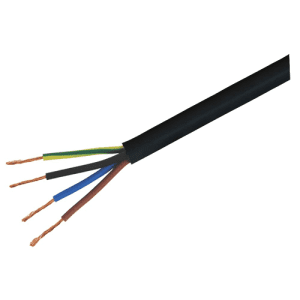
Four 2.5 mm² class 5 conductors — three phases plus a neutral or an earth — 50 strands of 0.25 mm each, PVC insulated and sheathed to 300/500 V. 24 A with three loaded conductors on reference method C, 18 mV/A/m, 7.98 Ω/km, about 16.6 kVA at 400 V. This is the tail for a small three-phase machine that gets moved: a bench lathe, a dough mixer, a small compressor, a portable distribution board. Drawn on the Pilone line in Lahore.
Prices track the daily copper rate. Bulk and coil pricing on request.
Check the coil before you pay for it
Every coil leaves our factory with a QR code printed on the packaging. Scan it and the factory record for that batch opens: brand, cable size, batch number, year of manufacture and conductor. Compare the batch number on screen with the one printed on your coil — if the two do not match, it did not come from us.
2.5mm 4 core flexible cable is quoted at the day's copper rate, per metre.
2.5 mm² 4 core flexible cable is quoted at the day's copper rate, per metre — send the metres and your city on WhatsApp and today's number comes back. Three of the four conductors are loaded on a three-phase circuit, so it carries 24 A on BS 7671 reference method C at 30°C, about 16.6 kVA at 400 V; with two loaded it is 27 A. The class 5 conductor is 50 strands of 0.25 mm, which is what lets it be coiled and carried without the cores work-hardening.
At this size the per-foot trick does the most damage, because the numbers are small enough that the gap looks like rounding rather than a third. Convert every quote to a rate per metre before comparing. And say the decimal clearly: 2.5mm and 25mm sound almost identical across a counter and are ten times apart in copper.
| Quoted as | Length in metres | To get the per-metre rate |
|---|---|---|
| Per metre | 1 m | Nothing to do |
| Per foot | 0.305 m | Multiply the per-foot rate by 3.281 |
| Per yard | 0.914 m | Multiply the per-yard rate by 1.094 |
| Per 90 m coil | 90 m (295 ft) | Divide the coil price by 90 |
| Per 45 m half coil | 45 m (148 ft) | Divide by 45 |
| Per 100 m drum | 100 m (328 ft) | Divide by 100 |
Coil lengths are not standardised in Pakistan, so get the metre count written on the invoice before you pay. We quote per metre against the length you give us. The price per meter page covers every conversion, and how cable is priced in Pakistan explains what moves the rate.
24 A with three conductors loaded, 27 A with two, clipped direct at 30°C. On a 400 V three-phase supply 24 A is about 16.6 kVA (1.732 × 400 × 24 ÷ 1000) — a small three-phase motor, a control panel, or a portable board feeding a couple of machines.
| Size | Strands (class 5) | 2 loaded | 3 loaded | Voltage drop | Copper in a 90 m coil |
|---|---|---|---|---|---|
| 1.5 mm² | 30/0.25 | 19.5 A | 17.5 A | 29 mV/A/m | 4.8 kg |
| 2.5 mm² | 50/0.25 | 27 A | 24 A | 18 mV/A/m | 8.0 kg |
| 4 mm² | 56/0.30 | 36 A | 32 A | 11 mV/A/m | 13 kg |
| 6 mm² | 84/0.30 | 46 A | 41 A | 7.3 mV/A/m | 19 kg |
| 10 mm² | 80/0.40 | 63 A | 57 A | 4.4 mV/A/m | 32 kg |
| 16 mm² | 126/0.40 | 85 A | 76 A | 2.8 mV/A/m | 51 kg |
Length decides this size more often than load. At its full 24 A the 20 V that BS 7671's 5% allows on a 400 V circuit is spent at 46 m; on a single-phase run at 27 A the 11 V budget is gone at 23 m. A trailing lead that gets extended by one more drum is exactly how a circuit that measured fine on day one stops being fine.
These are clipped-direct figures at 30°C. A flexible cable loaded while still wound on its drum cannot shed heat and has to be run out first. Conduit, bundling and a Lahore roof in June each take another bite, handled by BS 7671 correction factors rather than one invented number. Work yours out with the cable size calculator and the voltage drop calculator, then have a licensed electrician confirm it.
| Property | Value |
|---|---|
| Conductor | Plain annealed copper, class 5 flexible stranded |
| Nominal area | 2.5 mm² × 4 cores |
| Strand construction | 50 / 0.25 mm per core (typical) |
| Max conductor resistance at 20°C | 7.98 Ω/km |
| Current capacity (method C, 3 loaded) | 24 A |
| Voltage drop | 18 mV/A/m |
| Voltage rating | 300/500 V |
| Insulation / sheath | PVC / PVC, 70°C conductor rating |
| Conductor copper weight | ≈ 88.8 kg/km (4 × 22.2 kg/km) |
| Reference standards | IEC 60228 (conductors), IEC 60227 (PVC flexible cables) |
Same copper, same 2.5 mm², different stranding. Class 5 divides the area into 50 strands of 0.25 mm; class 2 uses 7 strands of 0.67 mm. The thin strands slide past each other when the cable bends, so a flexible core survives being coiled, dragged and reeled. A class 2 core flexed often enough work-hardens and breaks inside a sheath that still looks undamaged.
| Property | Class 5 (flexible) | Class 2 (standard) |
|---|---|---|
| Strands | 50/0.25 | 7/0.67 |
| Max resistance | 7.98 ohm/km | 7.41 ohm/km |
| Current capacity | 24 A / 27 A | 24 A / 27 A |
| Bends repeatedly | Yes | No |
| Typical use | Extension leads, portable boards | Socket circuits in conduit |
Buy flexible only where the cable moves. For the socket circuits of a house, the class 2 build is the same copper for less and is what the wiring is designed around — the 2.5mm cable page works through where this size belongs, and 5 marla house wiring shows how many coils of it a house actually takes.
Bench lathes, dough mixers, small compressors and pedestal drills drawing up to the 24 A this cable carries.
The last few metres from an isolator to a machine that gets pushed around the workshop floor and cannot take a rigid cable.
Site boards feeding three-phase sockets, where the incoming lead is coiled and moved with the board.
Four core at this size means three phases and a fourth conductor — a neutral where single-phase circuits sit downstream, an earth where they do not. Three of the four are loaded, which is why the rating drops from the 27 A a two-core version of the same conductor carries to 24 A here. That is about 16.6 kVA at 400 V (1.732 × 400 × 24 ÷ 1000): small-machine territory, not submain territory. The buyer is usually a workshop electrician making up a machine tail, not a wireman running fixed cable in a wall — for that job class 2 standard cable is the right family. For a single-phase machine with an earth, drop to 2.5mm 3 core flexible cable; for a bigger three-phase machine, step up to 4mm 4 core flexible cable at 32 A.
Worked example — a 16 A machine 20 m from the panel.
Voltage drop is current × length × the tabulated 18 mV/A/m, divided by 1000. So 16 × 20 × 18 ÷ 1000 = 5.8 V, which is 1.4% of 400 V — inside the 5% BS 7671 allows on a power circuit, 20 V here. Load the same lead to its full 24 A and the 20 V budget is spent at 20 ÷ (24 × 18 ÷ 1000) = 46 m. Check yours with the voltage drop calculator before you cut the coil.
Core count follows the circuit. Two core is line and neutral with a separate earth. Three core is line, neutral and earth, or three phases with no neutral. Four core is three phases plus a neutral. The conductor is the same 2.5 mm² in every build; only the number of loaded conductors changes the rating.
| Cores | What runs in it | Loaded | Current capacity |
|---|---|---|---|
| 2 core | Line and neutral, earth run separately | 2 | 27 A |
| 3 core | Line, neutral and earth — or three phases, no neutral | 2 or 3 | 27 A / 24 A |
| 4 core | Three phases plus neutral | 3 | 24 A |
The same size in the other builds: 2.5mm 2 core flexible cable and 2.5mm 3 core flexible cable. One step up in the same four-core flexible build is 4mm 4 core flexible cable at 32 A; one step down, 1.5mm 4 core flexible cable at 17.5 A.
2.5 mm² is not 25 mm². They are a factor of ten apart in copper and do completely different jobs: 2.5 mm² is a socket circuit, 25 mm² is a submain or motor feeder at 96 A. Say the decimal out loud when you order, because the two sound alike across a counter. If the size you want is the large one, go to 25mm 4 core cable.
A 90 m coil of this size is light enough to carry in one hand, which is exactly why a short one is easy to miss. Three checks settle it.
Conductor mass = area × cores × 8.89 kg/km per mm². For 2.5 mm² 4 core that is 2.5 × 4 × 8.89 = 89 kg/km, so a 90 m coil holds about 8 kg of copper before insulation and sheath.
A class 5 core at this size is about 50 strands of 0.25 mm. Cut the end square and count under good light. Fewer, thicker strands means a class 2 conductor sold as flexible.
Get the metre count in writing before you pay, then check it with a measuring wheel. A short coil is the quietest way a per-coil price stops being the price you calculated.
“Excellent quality copper cables. Fast delivery across Pakistan. Highly recommended for electrical projects.”
“Best cable manufacturer in Lahore. 99.9% pure copper as promised. Very satisfied with the product quality.”
“Good quality cables at competitive prices. Delivery was quick to Karachi. Will order again.”