
Factory-direct from Lahore · Nationwide delivery in 2–4 days
+92 319 4262451
WhatsApp
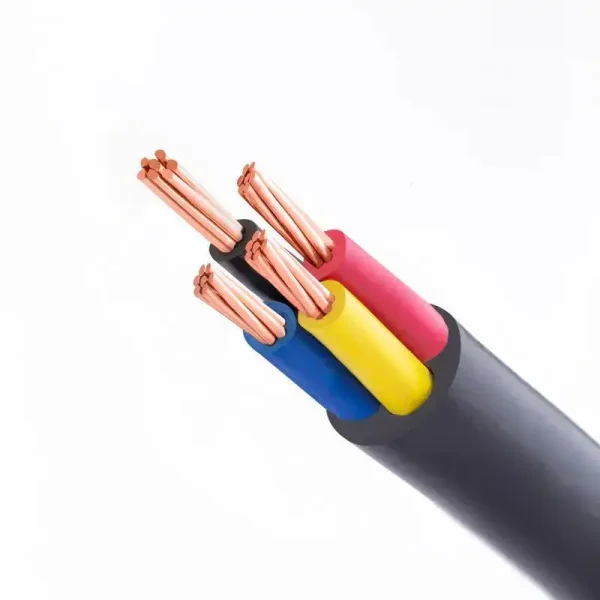
Four 25 mm² class 2 copper conductors, 7/2.14 mm strands per core, PVC insulated and sheathed to 450/750 V. 96 A on reference method C, 0.727 Ω/km, about 80 kg of copper in a 90 m coil. Drawn on the Pilone line in Lahore.
Prices track the daily copper rate. Bulk and coil pricing on request.
Check the coil before you pay for it
Every coil leaves our factory with a QR code printed on the packaging. Scan it and the factory record for that batch opens: brand, cable size, batch number, year of manufacture and conductor. Compare the batch number on screen with the one printed on your coil — if the two do not match, it did not come from us.
25mm 4 core cable is quoted at the day's copper rate, per metre.
25 mm² 4 core standard cable is quoted at the day's copper rate, per metre — the rupee figure moves with copper and is fixed on the day you order, so send the length in metres and your city on WhatsApp and you get today's number. What the rate buys does not move: three loaded conductors carrying 96 A on BS 7671 reference method C at 30°C, which is about 66 kVA on a 400 V three-phase supply. If a seller gives you a bare number, ask which unit it is: the same cable is sold per metre, per foot and per coil, and the three are not comparable until you convert them.
People ask for this in a dozen forms — 25mm 4 core copper cable price in Pakistan, 4 core 25mm cable price in Pakistan — and what comes back cannot be compared, because the unit is missing. One shop quotes a figure with no unit at all. The next quotes per foot. A third quotes a whole coil without saying how long the coil is. Reduce every one of them to a rate per metre first, and that takes one division.
| Quoted as | Length in metres | To get the per-metre rate |
|---|---|---|
| Per metre | 1 m | Nothing to do |
| Per foot | 0.305 m | Multiply the per-foot rate by 3.281 |
| Per yard | 0.914 m | Multiply the per-yard rate by 1.094 |
| Per 90 m coil | 90 m (295 ft) | Divide the coil price by 90 |
| Per 45 m half coil | 45 m (148 ft) | Divide by 45 |
| Per 100 m drum | 100 m (328 ft) | Divide by 100 |
A per-foot rate always looks cheaper than the per-metre rate for the same cable, because a foot is less than a third of a metre. That is arithmetic, not a discount. And “coil” is a container, not a quantity — get the metre count in writing before you pay. We quote per metre against the length you give us, so ask for the 25 mm 4 core copper cable price with your metre count and your city and one number comes back; the price per meter page works through every conversion.
96 A with three loaded conductors, clipped direct at 30°C. On a 400 V three-phase supply that is about 66 kVA (1.732 × 400 × 96 ÷ 1000) — the reason this size is the default submain from a main panel to a plaza's distribution boards, and the usual feeder for a large motor.
| Size | Strands (class 2) | Current capacity | Voltage drop | 5% limit at full load | Copper in a 90 m coil |
|---|---|---|---|---|---|
| 6 mm² | 7/1.04 | 41 A | 7.3 mV/A/m | 67 m | 19 kg |
| 10 mm² | 7/1.35 | 57 A | 4.4 mV/A/m | 80 m | 32 kg |
| 16 mm² | 7/1.70 | 76 A | 2.8 mV/A/m | 94 m | 51 kg |
| 25 mm² | 7/2.14 | 96 A | 1.75 mV/A/m | 119 m | 80 kg |
| 35 mm² | 19/1.53 | 119 A | 1.25 mV/A/m | 134 m | 112 kg |
Heat sets one limit. Run length sets the other, and on a submain it is usually the one that bites. Voltage drop is current × length × the tabulated mV/A/m, divided by 1000. A 60 A load over a 35 m run on this cable drops 60 × 35 × 1.75 ÷ 1000 = 3.7 V, which is 0.9% of 400 V — comfortably inside the 5% BS 7671 allows on a power circuit, 20 V here. Push the same cable to its full 96 A and the drop reaches 20 V at about 119 m, the figure in the table's 5% limit column. Beyond that distance the length picks the size, not the load.
Those 96 A assume the cable is clipped direct in open air at 30°C. Pull it through conduit, bundle it with other circuits, or run it under a Lahore roof in June and it carries less. BS 7671 handles that by multiplying the tabulated figure by correction factors for ambient temperature and grouping. We publish the tabulated number and the method rather than one invented “real world” figure, because the factor depends on your installation. Work yours out with the cable size calculator and the voltage drop calculator, then have a licensed electrician confirm it.
| Property | Value |
|---|---|
| Conductor | Plain annealed copper, class 2 stranded |
| Nominal area | 25 mm² × 4 cores |
| Strand construction | 7 / 2.14 mm per core (class 2, computes to 25.2 mm²) |
| Trade strand code | 19/.052 in — 26 mm² computed, sold as 25 mm² |
| Max conductor resistance at 20°C | 0.727 Ω/km |
| Current capacity (method C, 3 loaded) | 96 A |
| Three-phase capacity at 400 V | ≈ 66 kVA |
| Voltage drop | 1.75 mV/A/m |
| Voltage rating | 450/750 V |
| Insulation / sheath | PVC / PVC, 70°C conductor rating |
| Conductor copper weight | ≈ 890 kg/km (4 × 222.3 kg/km) |
| Copper in a 90 m coil | ≈ 80 kg (conductor only) |
| Reference standards | IEC 60228 (conductors), IEC 60227 (PVC cables) |
Half the Pakistani trade still orders by strand code rather than by mm². The code says two things: how many strands, and how thick each strand is in inches. 19/.052 is nineteen strands of 0.052 inch wire. Convert and you can check any code yourself: 0.052 × 25.4 = 1.321 mm across, area = 0.7854 × 1.321² = 1.37 mm² per strand, × 19 = 26 mm².
| Code | Strand diameter | Computed area | Sold as |
|---|---|---|---|
| 3/.029 | 0.737 mm | 1.29 mm² | 1.5 mm² |
| 7/.029 | 0.737 mm | 3.0 mm² | 2.5 mm² |
| 7/.036 | 0.914 mm | 4.6 mm² | 4 mm² |
| 7/.044 | 1.118 mm | 6.9 mm² | 6 mm² |
| 7/.052 | 1.321 mm | 9.6 mm² | 10 mm² |
| 7/.064 | 1.626 mm | 14.5 mm² | 16 mm² |
| 19/.052 | 1.321 mm | 26 mm² | 25 mm² |
Pilone labels by the same convention the market uses, and the honesty runs both ways: this cable is sold as 25 mm², and both computed areas for that name — the metric 7/2.14 build and the older imperial 19/.052 build — are printed in the tables above. Down at 7/.064 the arithmetic goes the other way, 14.5 mm² sold as 16. Ask a shop for 25 mm cable, for 25mm wire, or for 19/.052, and you are asking for the same conductor — wire and cable mean the same thing at this size, and neither word tells the shopkeeper how many cores you want. The 7/.036 single core page carries the same table for the smaller codes.
Main panel to distribution boards in plazas, factories and large houses — three phases plus neutral in one sheath.
Pumps, compressors and machines drawing up to the 96 A this cable carries, about 66 kVA at 400 V.
Floor-to-floor distribution on trays and in trunking, where the run is protected from impact.
Standard cable is fixed wiring. It goes on a tray, in trunking, in conduit or clipped to a wall, indoors. If the run goes underground, crosses a yard, or sits anywhere a shovel or a trolley can reach it, use armoured cable instead — the steel wire armour is the part doing the protecting, not the PVC sheath. For a run that has to flex or be dragged, you want the class 5 family instead; our flexible line stops at 16mm 4 core flexible cable, so at 25 mm² the fixed class 2 build is the one to use.
Core count follows the circuit, not the load. Four core carries three phases plus a neutral. Three core carries either a single-phase circuit with its earth or three phases without a neutral. Two core carries line and neutral, with the earth run separately. The conductor is the same 25 mm² copper in all three; what changes is how many conductors are loaded, and that changes the current capacity.
| Cores | What runs in it | Loaded | Current capacity |
|---|---|---|---|
| 2 core | Line and neutral, earth run separately | 2 | 112 A |
| 3 core | Line, neutral and earth — or three phases with no neutral | 2 or 3 | 112 A / 96 A |
| 4 core | Three phases plus neutral | 3 | 96 A |
The same size in the other two builds: 25mm 3 core cable and 25mm 2 core standard cable. One step down in the same four-core build is 16mm 4 core cable at 76 A, then 10mm 4 core cable at 57 A. Above 25 mm² we make the larger sections in aluminium cable — the metal some shops call “silver cable”, which is aluminium, not silver, and needs a larger section than copper for the same current.
25 mm² is not 2.5 mm². They are a factor of ten apart in copper and they do completely different jobs: 25 mm² is a submain at 96 A, 2.5 mm² is house wiring at 24 A. Say the decimal out loud when you order, because 25mm cable and 2.5mm cable sound alike across a counter. If the size you want is the small one, go to 2.5mm 4 core flexible cable.
“Full gauge” is a claim on a lot of listings and almost never comes with a test you can run. Here are three you can run yourself, on any seller's cable including ours. They need a weighing scale, a tape and a vernier.
Conductor mass = area × cores × 8.89 kg/km per mm². For 25 mm² 4 core that is 25 × 4 × 8.89 = 889 kg/km, so a 90 m coil holds about 80 kg of copper before insulation and sheath.
Cut the end square. A 25 mm² class 2 core is 7 strands of about 2.14 mm. Fewer strands, or a thinner strand, means a smaller conductor whatever the sheath is printed with.
Get the metre count in writing before you pay, then check it with a measuring wheel. A short coil is the quietest way a per-coil price stops being the price you calculated.
“Excellent quality copper cables. Fast delivery across Pakistan. Highly recommended for electrical projects.”
“Best cable manufacturer in Lahore. 99.9% pure copper as promised. Very satisfied with the product quality.”
“Good quality cables at competitive prices. Delivery was quick to Karachi. Will order again.”