
Factory-direct from Lahore · Nationwide delivery in 2–4 days
+92 319 4262451
WhatsApp
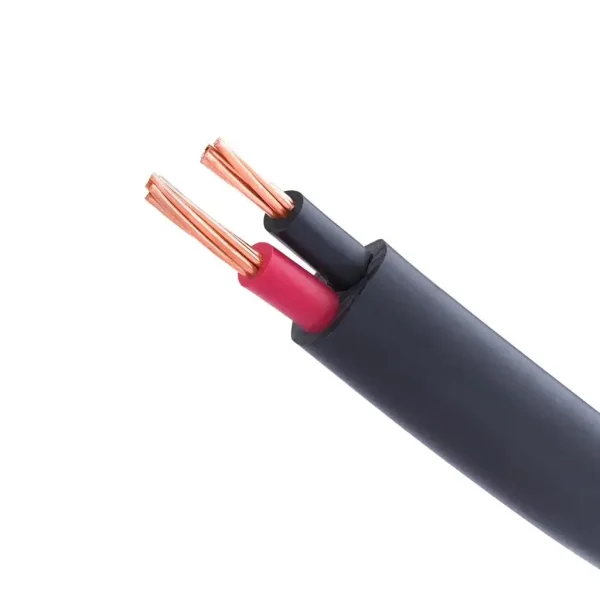
Two 25 mm² class 2 copper conductors, 7 strands of 2.14 mm per core, PVC insulated and sheathed to 450/750 V. 112 A with both conductors loaded on reference method C, 0.727 Ω/km, 1.75 mV/A/m. This is the single-phase size at the top of the range: the tail from the meter to the main board, and the submain from that board onward. About 40 kg of copper in a 90 m coil. Drawn on the Pilone line in Lahore.
Prices track the daily copper rate. Bulk and coil pricing on request.
Check the coil before you pay for it
Every coil leaves our factory with a QR code printed on the packaging. Scan it and the factory record for that batch opens: brand, cable size, batch number, year of manufacture and conductor. Compare the batch number on screen with the one printed on your coil — if the two do not match, it did not come from us.
25mm 2 core cable is quoted at the day's copper rate, per metre.
25 mm² 2 core standard cable is quoted at the day's copper rate, per metre — send the length in metres and your city on WhatsApp and today's number comes back. Two core means line and neutral and nothing else, so two conductors are loaded and the cable carries 112 A on BS 7671 reference method C at 30°C, about 24.6 kVA at 220 V. That is more than a domestic single-phase connection is ever allowed to draw, which is why people buy this size for the length of the run rather than for the load on it.
Searches for 25 mm cable and 25mm wire arrive at quotes in three different units, and the units are rarely stated. A per-foot rate always looks cheapest because a foot is under a third of a metre. A coil price means nothing until you know the coil's length. Reduce everything to a rate per metre before comparing, and say the core count as well — neither “wire” nor “cable” tells the counter whether you want two cores or four.
| Quoted as | Length in metres | To get the per-metre rate |
|---|---|---|
| Per metre | 1 m | Nothing to do |
| Per foot | 0.305 m | Multiply the per-foot rate by 3.281 |
| Per yard | 0.914 m | Multiply the per-yard rate by 1.094 |
| Per 90 m coil | 90 m (295 ft) | Divide the coil price by 90 |
| Per 45 m half coil | 45 m (148 ft) | Divide by 45 |
| Per 100 m drum | 100 m (328 ft) | Divide by 100 |
Coil lengths are not standardised in Pakistan, so get the metre count written down before you pay rather than after. We quote per metre against the length you give us. The price per meter page works through every conversion, and how cable is priced in Pakistan explains why the rupee figure moves with copper.
112 A on two loaded conductors, clipped direct at 30°C. The ladder below shows what each step of size buys on a single-phase run: more current, and a longer reach before voltage drop rather than heat decides the size.
| Size | Strands (class 2) | Current capacity | Voltage drop | 5% limit at full load | Copper in a 90 m coil |
|---|---|---|---|---|---|
| 6 mm² | 7/1.04 | 46 A | 7.3 mV/A/m | 33 m | 9.6 kg |
| 10 mm² | 7/1.35 | 63 A | 4.4 mV/A/m | 40 m | 16 kg |
| 16 mm² | 7/1.70 | 85 A | 2.8 mV/A/m | 46 m | 26 kg |
| 25 mm² | 7/2.14 | 112 A | 1.75 mV/A/m | 56 m | 40 kg |
| 35 mm² | 19/1.53 | 138 A | 1.25 mV/A/m | 64 m | 56 kg |
Read the 5% limit column carefully, because it is shorter than people assume. At full load none of these sizes reaches 70 m on a 220 V circuit — the single-phase voltage budget of 11 V is simply small. Most real meter tails are nowhere near full load, which is why 25 mm² reaches much further in practice than the column suggests; the number to put into the arithmetic is the load you actually have, not the cable's rating.
These figures assume the cable is clipped direct in open air at 30°C. In conduit, bundled with other circuits, or under a Lahore roof in June it carries less, and BS 7671 handles that with correction factors for ambient temperature and grouping rather than a single invented figure. Work yours out with the cable size calculator and the voltage drop calculator, then have a licensed electrician confirm it.
| Property | Value |
|---|---|
| Conductor | Plain annealed copper, class 2 stranded |
| Nominal area | 25 mm² × 2 cores |
| Strand construction | 7 / 2.14 mm per core (typical) |
| Max conductor resistance at 20°C | 0.727 Ω/km |
| Current capacity (method C, 2 loaded) | 112 A |
| Voltage drop | 1.75 mV/A/m |
| Voltage rating | 450/750 V |
| Insulation / sheath | PVC / PVC, 70°C conductor rating |
| Conductor copper weight | ≈ 444.6 kg/km (2 × 222 kg/km) |
| Reference standards | IEC 60228 (conductors), IEC 60227 (PVC cables) |
A good part of the Pakistani trade orders by strand code rather than by mm², and the code is readable once you know it states two things: how many strands, and how thick each one is in inches. 19/.052 is nineteen strands of 0.052 inch wire. One line of arithmetic checks any code: 0.052 × 25.4 = 1.321 mm across, area = 0.7854 × 1.321² = 1.37 mm² per strand, × 19 = 26 mm².
| Code | Strand diameter | Computed area | Sold as |
|---|---|---|---|
| 3/.029 | 0.737 mm | 1.29 mm² | 1.5 mm² |
| 7/.029 | 0.737 mm | 3.0 mm² | 2.5 mm² |
| 7/.036 | 0.914 mm | 4.6 mm² | 4 mm² |
| 7/.044 | 1.118 mm | 6.9 mm² | 6 mm² |
| 7/.052 | 1.321 mm | 9.6 mm² | 10 mm² |
| 7/.064 | 1.626 mm | 14.5 mm² | 16 mm² |
| 19/.052 | 1.321 mm | 26 mm² | 25 mm² |
Ask for 25 mm cable, for 25mm wire, or for 19/.052 and you are asking for the same conductor. Add “two core” or you will be handed whatever build is nearest the front. This cable is sold as 25 mm²: the metric 7/2.14 build is in the specification table above, and the older imperial 19/.052 build computes to 26 mm². Lower down the table the arithmetic runs the other way — 7/.064 computes to 14.5 mm² and is sold as 16. The wire strand codes guide carries the full vocabulary.
The run from a single-phase WAPDA or K-Electric meter to the main breaker, where the whole house load passes through two conductors.
Main board to a floor board in a kanal house, or to a shop unit in a plaza, on a single-phase connection.
Single-phase pump feeders long enough that the run length, not the motor rating, is what picks the size.
Two core means line and neutral, and nothing else — the earth arrives separately, usually as a single green conductor or through the conduit's own earth. That is exactly the shape of a single-phase incomer, which is why this build sells to house wiremen and shop fitters rather than to factories. At 112 A on two loaded conductors it carries about 24.6 kW at 220 V (220 × 112 ÷ 1000), which is more than a domestic single-phase connection will ever be allowed to draw; the reason people buy it is length, not load. If the supply is three-phase, the neutral has to come inside the same sheath and you want 25mm 4 core cable; if the run needs an integral earth, 25mm 3 core standard cable. One step down in the same two-core build is 16mm 2 core cable at 85 A.
Worked example — how far 25mm 2 core will reach.
Voltage drop is current × length × the tabulated 1.75 mV/A/m, divided by 1000. A 90 A load 30 m from the meter drops 90 × 30 × 1.75 ÷ 1000 = 4.7 V, which is 2.1% of 220 V — inside the 5% BS 7671 allows on a power circuit, 11 V here. Load the same cable to its full 112 A and the 11 V budget is spent at 11 ÷ (112 × 1.75 ÷ 1000) = 56 m. Past that distance the run length picks the size, not the load — check yours with the voltage drop calculator.
Core count follows the circuit, not the load. Two core carries line and neutral, with the earth arriving separately. Three core adds a protective conductor inside the same sheath, or carries three phases without a neutral. Four core carries three phases plus a neutral. Same 25 mm² copper in each; what changes is how many conductors are loaded, and that changes the rating.
| Cores | What runs in it | Loaded | Current capacity |
|---|---|---|---|
| 2 core | Line and neutral, earth run separately | 2 | 112 A |
| 3 core | Line, neutral and earth — or three phases, no neutral | 2 or 3 | 112 A / 96 A |
| 4 core | Three phases plus neutral | 3 | 96 A |
The same size in the other builds: 25mm 3 core standard cable and 25mm 4 core cable. One step down in the same two-core build is 16mm 2 core cable at 85 A, then 10mm 2 core cable at 63 A. Above 25 mm² the larger sections are made in aluminium cable, which needs a bigger section than copper for the same current.
“Full gauge” appears on a lot of listings without a test attached. Here are three you can run yourself on any seller's cable, ours included, with a weighing scale, a tape and a vernier.
Conductor mass = area × cores × 8.89 kg/km per mm². For 25 mm² 2 core that is 25 × 2 × 8.89 = 445 kg/km, so a 90 m coil holds about 40 kg of copper before insulation and sheath.
Cut the end square. A 25 mm² class 2 core is 7 strands of about 2.14 mm. Fewer strands, or a thinner strand, means a smaller conductor whatever the sheath is printed with.
Get the metre count in writing before you pay, then check it with a measuring wheel. A short coil is the quietest way a per-coil price stops being the price you calculated.
“Excellent quality copper cables. Fast delivery across Pakistan. Highly recommended for electrical projects.”
“Best cable manufacturer in Lahore. 99.9% pure copper as promised. Very satisfied with the product quality.”
“Good quality cables at competitive prices. Delivery was quick to Karachi. Will order again.”