PILONE CABLES TECHNICAL TEAM · UPDATED 16 AUGUST 2026
1.5 mm² up to 63 m, 2.5 mm² up to 102 m, 4 mm² up to 167 m — on a 16 A type C MCB.
A 1 HP single-phase motor pump draws about 6 A at 220 V, so the current rating of the cable is never the problem. The length is. Measure the whole route — if the pump is in a borehole, that means depth plus the surface run — and read the size off that number, not off the horsepower. The metres below are one-way, on a 5% voltage-drop budget of 11 V.
1 HP motor wire size in mm, by run length
A 1 HP motor at 6 A needs 1.5 mm² copper on any run up to 63 m, 2.5 mm² from there to 102 m, and 4 mm² from there to 167 m — each figure being the point at which voltage drop reaches 5% of a 220 V supply, with the cable protected by a 16 A type C MCB and installed clipped direct at 30°C. Every one of those sizes is rated well above 6 A; what runs out first is volts, not amps.
Volts lost in the cable at 6 A on a 220 V single-phase supply. Figure = mV/A/m × 6 A × run ÷ 1000; the budget is 5% of 220 V, which is 11 V. Run is one way, along the route the cable takes. Copper, PVC; voltage drop and current capacity per BS 7671, reference method C (clipped direct), 30°C ambient; conductor data per IEC 60228. Verify sizing with a licensed electrician for your installation.
Total run
Size
Trade code
Volts lost
Drop
10 m
1.5 mm²
3/.029
1.74 V
0.8%
25 m
1.5 mm²
3/.029
4.35 V
2.0%
50 m
1.5 mm²
3/.029
8.70 V
4.0%
63 m
1.5 mm²
3/.029
10.96 V
5.0%
75 m
2.5 mm²
7/.029
8.10 V
3.7%
100 m
2.5 mm²
7/.029
10.80 V
4.9%
150 m
4 mm²
7/.036
9.90 V
4.5%
200 m
6 mm²
7/.044
8.76 V
4.0%
Work one row yourself to see there is no trick in it. At 100 m on 2.5 mm²: 18 mV/A/m × 6 A × 100 m ÷ 1000 = 10.8 V, which is 4.9% of 220 V. One metre further and the answer changes. That is why a chart with no distance column in it cannot be right for you except by luck. Other horsepowers are on the submersible pump cable size chart.
Where the 6 amps comes from, and when to ignore it
One horsepower is 746 W of shaft output, not of input. A single-phase motor has to be fed more than it delivers, and the difference lands on the supply as current, which is why a 1 HP pump on 220 V typically shows a full-load current near 6 A on its plate rather than the 3.4 A that dividing 746 by 220 suggests. Take 6 A as the working figure only until you can read the real one.
The plate is bolted to the motor and it carries the number that matters. Look for the full-load current, usually printed as FLC or simply A, and use that in the formula in place of 6. A 1 HP motor pump built for high head or fitted with a capacitor-start winding can sit a full amp or more above the typical figure, and on a 150 m run one amp moves the answer by a whole size.
Two 1 HP installations, same motor, different cable. A booster pump standing beside an underground tank might be 15 m from the board: 1.5 mm² and nothing more, and that job is covered on cable for a water motor. A 1 HP borehole pump at 120 ft with a 40 m surface run totals 77 m and needs 2.5 mm². Same horsepower, two sizes apart on the shelf.
1 HP motor ke liye kitne mm ka wire — dukaan par kya maangna hai
Shops in Pakistan answer in strand codes, not in mm². Ask for a size and you will be handed a code, so it helps to know which code is which before the conversation starts.
Strand code to metric size for a 1 HP motor circuit. Actual area is the imperial code multiplied out; sold-as is the IEC 60228 nominal size it is supplied against. Longest run is one way at 6 A on a 5% budget of 220 V. Current capacity is two loaded conductors, BS 7671 reference method C, 30°C, copper, PVC. Verify sizing with a licensed electrician for your installation.
Ask for
Actual area
Sold as
Capacity
Longest run at 1 HP
3/.029
1.29 mm²
1.5 mm²
19.5 A
63 m
7/.029
3.0 mm²
2.5–3 mm²
27 A
102 m
7/.036
4.6 mm²
4 mm²
36 A
167 m
7/.044
6.9 mm²
6–7 mm²
46 A
251 m
Urdu mein: 1 HP motor 220 volt par takreeban 6 amp leti hai. Agar kul lambai 63 meter tak hai to 3/.029 kaafi hai; 102 meter tak 7/.029; aur 167 meter tak 7/.036. Lambai poori naapein — boring ki gehrai, phir panel tak, phir board tak.
Breaker, starter and the third core
16 A type C MCB, on a circuit of its own. The 16 A rating clears the 6 A running current with room for the direct-on-line start, and a type C curve rides that surge where a type B trips on it. Every size in the table above is rated above 16 A, so the cable protects itself.
The breaker is not the motor's protection. An MCB protects the cable. The winding is protected by the overload relay in the starter, set to the full-load current on the plate. On a pump, add dry-run protection as well — running dry destroys more motors than bad cable does.
Three cores, not two. Live, neutral and an earth of the same size, bonded to the pump body and to the delivery pipe. A motor sitting in water or standing in a wet pit is the one appliance where the earth is doing real work.
Derate before you commit. The capacities above are clipped direct at 30°C. Buried, bunched, or in conduit through a Lahore summer, they come down; take the correction factors for your method out of BS 7671 and go one size up if the margin over the breaker closes.
Voltage drop, not current capacity, decides the size on a pump run — check your own metres with the voltage drop calculator before you buy. If the pump hangs in a borehole, the submerged length must be drop cable with an immersion rating stated by its maker; ordinary flexible cable is for the dry side only. Have a licensed electrician confirm the size, the breaker and the earthing for your installation, or start with the cable size calculator.
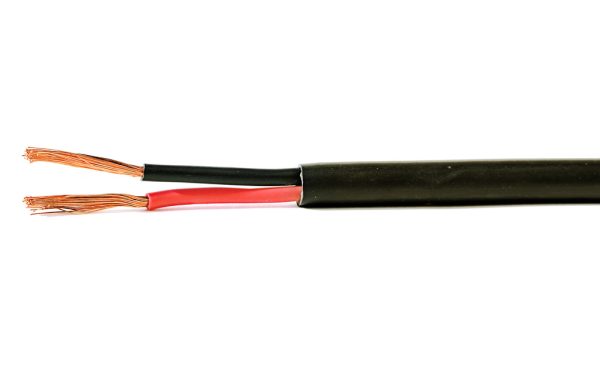
The size a 1 HP pump needs once the total run passes 63 m. Class 5 flexible copper, PVC insulated and sheathed, drawn on the Pilone line in Lahore. Rated 27 A on two loaded conductors clipped direct at 30°C, 18 mV/A/m.
Lambai dekh kar. Motor 220 volt par takreeban 6 amp leti hai, is liye 63 meter tak 1.5 mm² (3/.029), 102 meter tak 2.5 mm² (7/.029), aur 167 meter tak 4 mm² (7/.036). Breaker 16 A type C, aur teen core lein taake earth bhi barabar ho.
Is 1.5mm wire enough for a 1 HP motor, or should it be 2.5mm?
1.5 mm² is enough on current — it carries 19.5 A against a 6 A load — and it stays inside a 5% voltage drop out to 63 m. Past 63 m it does not, and that is the only reason to move to 2.5 mm². Measure the total run before you decide; a borehole pump almost always crosses the line.
What is 7/.036 in mm, and is it enough for a 1 HP motor?
7/.036 is seven strands of 0.036 inch, which multiplies out to 4.6 mm² and is sold as 4 mm². It is far more than a 1 HP motor needs on current, and it is the right choice only when the run is long: between 102 and 167 m at 6 A. Below 102 m, 7/.029 does the same job for less copper.
What MCB size for a 1 HP motor?
16 A, type C, on a dedicated way. It sits above the 6 A running current with headroom for the direct-on-line start, and below the 19.5 A capacity of the smallest cable in the table. The breaker guards the cable; the overload relay in the starter, set from the nameplate, guards the motor.
Why does a 1 HP pump trip or run hot on a long cable?
Because the motor is not getting 220 V. Volts lost in the cable mean the motor pulls more current to do the same work, the winding heats, and the overload trips. On 1.5 mm² at 100 m the loss is 17.4 V, well past the 11 V budget. Check the size against the total run, then measure the voltage at the panel with the pump running.
What does cable for a 1 HP motor cost?
Copper cable is priced off the day's copper rate, so a figure published today is wrong next month. We quote per metre and per coil on WhatsApp instead. Send the size, the total metres and your city: Punjab in 1–2 days, rest of Pakistan in 2–4. Ranges by size are on the price list.
Send the run length, get the size and the rate
We draw the copper in Lahore and sell it at the day's rate — no dealer margin. Tell us the horsepower, the total metres and your city, and one message comes back with both numbers: Punjab in 1–2 days, rest of Pakistan in 2–4.