
Factory-direct from Lahore · Nationwide delivery in 2–4 days
+92 319 4262451
WhatsApp
A split AC install is two cables, bought separately.
The power cable runs from the distribution board to the indoor unit and is sized from the tonnage — 3 core, live, neutral and earth. The interconnecting cable runs from the indoor unit to the outdoor unit and on most home splits carries the outdoor unit's full supply plus a communication core, so it is usually 4 core, and its size is the figure in the installation manual for your model — never below that figure. On 1 and 2 ton units manuals commonly give 1.5 mm² to 2.5 mm² per core, a size under the power cable feeding the point, because the two cables are sized for different jobs. Where the manual gives a range, take the larger one.
Almost every guide on this subject answers "what cable for a split AC" with a single size. That is half an answer. An installer leaves your house having pulled two separate cables, and if you order only one you will be back at the shop the same afternoon.
| Power cable | Interconnecting cable | |
|---|---|---|
| Where it runs | Distribution board to the indoor unit | Indoor unit to the outdoor unit |
| Typical length | 15–30 m | 3–10 m |
| What it carries | The whole unit's supply | The outdoor unit's supply and the control signal |
| Cores | 3 | 4, sometimes 3 + signal or 5 |
| Construction | Standard, class 2 stranded, 450/750 V | Flexible, class 5 stranded |
| Sized from | The unit's tonnage and the run length | The unit's installation manual |
The size of the power cable is a tonnage question, and it is answered on the page for your unit: 1 ton, 1.5 ton, 2 ton, 3 and 4 ton. Whether the unit is inverter or fixed speed does not change that size — here is why. The rest of this page is about the cable that runs out through the wall.
The power cable is easy: 3 core, live, neutral and earth, in one pull from the board. Buying a 2 core cable and finding an earth somewhere else is the shortcut that turns an AC casing into a live surface.
The interconnecting cable is where the count varies. On the common residential arrangement the indoor unit is fed from the point and passes the supply out to the outdoor unit along with the signal the two boards talk on — live, neutral, earth and one communication core, so 4 core. Some manufacturers use 3 core plus a separate shielded signal pair; a few use 5. Count the terminals in the outdoor unit's connection block and read the manual before you cut anything. There is no universal answer here.
On a normal residential split the interconnecting cable is sized to the figure in the installation manual for that model and never below it: on 1 and 2 ton units manuals commonly give 1.5 mm² to 2.5 mm² per core, 4 core, in class 5 flexible, and on larger units the figure steps up with the unit. That is usually one size under the power cable, and the reason is in the table above — the power cable is sized from the tonnage and the run from the board, the interconnect from the manual for a few metres out to the outdoor unit. Where the manual gives a range, take the larger one.
Here is the reasoning most pages skip. If the interconnecting cable feeds the outdoor unit, it is carrying the compressor's current — the same current the power cable carries. It is short, which helps, but it also runs down an outside wall in direct sun and gets rained on. So there is a good case for taking the top of the manual's range rather than the bottom, and no case at all for going under it.
| Size | 3 core capacity | Voltage drop | Class 5 strands | Where it fits |
|---|---|---|---|---|
| 1.5 mm² | 17.5 A | 29 mV/A/m | 30/0.25 | Small units and short runs, where the manual specifies it |
| 2.5 mm² | 24 A | 18 mV/A/m | 50/0.25 | The figure many 1 and 2 ton manuals give |
| 4 mm² | 32 A | 11 mV/A/m | 56/0.30 | Larger units, or where the manual asks for it on a long exposed run |
Flexible, class 5 stranded cable is the right construction here. The interconnect gets bent tight behind the indoor unit and dressed around the pipe work, and a class 2 conductor with seven thick strands does not take that treatment well. Keep the class 2 standard cable for the fixed run inside the wall.
This is the part nobody adds up. The drop on the power cable and the drop on the interconnect are in series, and the unit sees the sum of them. Take a point drawing 9 A, a 20 m run from the board on 4 mm², and an 8 m interconnect. The power cable loses 11 × 9 × 20 ÷ 1000 = 1.98 V before the interconnect has started.
| Interconnect | Its drop over 8 m | Power cable over 20 m | Total | Of the 6.6 V budget |
|---|---|---|---|---|
| 1.5 mm² | 2.09 V | 1.98 V | 4.07 V | 62% |
| 2.5 mm² | 1.30 V | 1.98 V | 3.28 V | 50% |
| 4 mm² | 0.79 V | 1.98 V | 2.77 V | 42% |
A short interconnect is forgiving, which is why 1.5 mm² gets away with it on many installs. Stretch the same cable to a rooftop outdoor unit fifteen metres away and it stops being forgiving. Measure the real route for both cables — up the wall, along the slab, out through the sleeve — add a couple of metres to each for dressing and terminations, and put the two lengths through the voltage drop calculator before you order.
Cable here is sold by the coil, and coil lengths are not standard between makers — so ask for the coil length along with the rate. It matters on this job more than most: a power run of 15–30 m and an interconnect of 3–10 m is 18–40 m of cable in two different constructions, and one split AC rarely takes a whole coil of either.
So ask for both by the metre, in one message, with the coil length quoted beside the rate. Then you know whether you are buying part of a coil or being sold a full one you cannot use.
Most home splits are 1.5 or 2 ton, and both take 4 mm² on the power run. Confirm yours on the tonnage guide above, then take the 3 core version so the earth comes down the same cable.
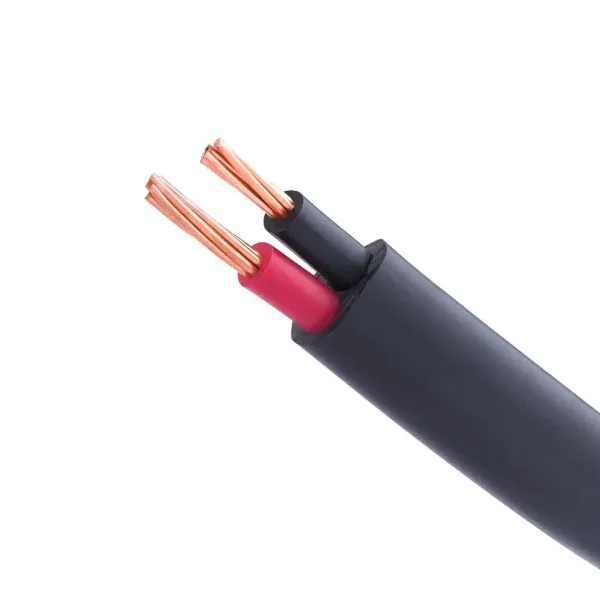
Stranded copper, 7/0.85 class 2, PVC insulated and sheathed, 450/750 V, drawn on the Pilone line in Lahore. Rated 36 A clipped direct at 30°C. The trade calls this coil 7/.036.
Prices track the daily copper rate. Send the length and your city on WhatsApp for the exact figure.
For the power run with an earth: 4mm 3 core cable. For the interconnect, class 5 flexible in the size the manual gives: 2.5mm 3 core flexible cable, 2.5mm 4 core flexible cable, 1.5mm 4 core flexible cable. All 2.5mm sizes and specs.
We draw the copper in Lahore and sell it at the day's rate — no dealer margin. Send both lengths and your city: Punjab in 1–2 days, rest of Pakistan in 2–4.