
Factory-direct from Lahore · Nationwide delivery in 2–4 days
+92 319 4262451
WhatsApp
No. The wire size does not change.
An inverter air conditioner takes the same conductor size as a fixed-speed unit of the same tonnage. The soft start removes the momentary surge on the breaker; it does not reduce the current the unit pulls when it is cooling flat out, and that is what the cable is sized to. Take the number from the tonnage guide for your unit. What the inverter genuinely changes is the breaker curve, how much a stabilizer buys you, and how much a bad earth costs you.
A fixed-speed compressor has two states: off, and full. Every time it comes on it slams to full speed and pulls a surge of two to three times its running current for a second or two. An inverter compressor ramps its speed up and down with the cooling demand, so it never takes that step. That is a real difference — but it is a difference in the first second, not in the eighth hour.
| Behaviour | Fixed speed | Inverter |
|---|---|---|
| Start | 2–3 × running current, for a second or two | Ramps up, no step surge |
| Running at full cooling | Rating-plate current | Rating-plate current |
| Once the room is cold | Cuts out, then restarts | Slows down and keeps running |
| What the cable is sized to | Full-cooling current | Full-cooling current |
| MCB rating | From the running current | From the running current |
| MCB curve in practice | C | B or C |
| Tolerance of a poor earth | Low | Lower — the control board is the casualty |
An inverter air conditioner and a fixed-speed unit of the same tonnage are wired in the same conductor size, because the cable is sized to the current the unit draws when it is working hardest, and at full cooling both draw the figure printed on the rating plate. What the variable-speed compressor removes is the momentary start surge, which changes which breaker curve is comfortable, not which cable is safe.
There is a second reason beyond the peak, and it cuts the other way. A fixed-speed unit cools the room, cuts out, and lets the cable cool with it. An inverter unit drops to a low speed and keeps running — for hours. A conductor carrying a moderate current continuously can settle at a higher temperature than one carrying a bigger current in bursts. Continuous running is an argument for keeping the margin, not for spending it.
You will find answers online that put an inverter AC on 1 mm² or 1.5 mm² because "it draws less". Look at what those sizes carry before you believe it. The numbers below are for cable clipped direct in open air at 30°C, which is the friendliest case there is — a cable in conduit in a Lahore summer carries less.
| Size | 2 core | 3 core | Voltage drop | Margin over 20 A |
|---|---|---|---|---|
| 1 mm² | 10 A | 10 A | 44 mV/A/m | −10 A |
| 1.5 mm² | 19.5 A | 17.5 A | 29 mV/A/m | −0.5 A |
| 2.5 mm² | 27 A | 24 A | 18 mV/A/m | +7 A |
| 4 mm² | 36 A | 32 A | 11 mV/A/m | +16 A |
1 mm² sits 10 A below a 20 A breaker and 1.5 mm² sits half an amp below it. On both, the cable would reach its limit before the device protecting it noticed. That is not a size choice, it is a fault waiting for a hot afternoon.
The number you came for is on the guide for your unit's size. Read the rating plate first — a 1.5 ton inverter and a 1.5 ton fixed-speed unit land on the same page and the same answer.
The MCB rating comes from the running current and does not move. The curve is a different question. A C-curve device tolerates a larger inrush before it opens than a B-curve device of the same rating, which is why C curves are the usual fit on a fixed-speed AC point — a B-curve device of the right rating can be tripped by the compressor's start rather than by any fault.
An inverter has no such start, so a correctly rated B-curve device will usually hold. That does not make it the better choice. C is safe on either unit and it is what most electricians here carry, so unless there is a reason to be precise, leave the curve alone and make sure the rating and the cable are right. Fitting a smaller breaker to match an inverter's part-load draw is the one change to avoid: the unit will still ask for its full current on the hottest day of the year.
Watts do not care about volts, and this is where most people's intuition is backwards. A point drawing 2000 W takes 2000 ÷ 220 = 9.1 A on a healthy supply. When the street sags to 190 V in the evening, the same 2000 W becomes 2000 ÷ 190 = 10.5 A. The current goes up as the voltage goes down.
The cable's own drop then stacks on top of that sag at the unit's terminals. At 10.5 A over a 20 m run, 4 mm² loses 11 × 10.5 × 20 ÷ 1000 = 2.31 V and 2.5 mm² loses 18 × 10.5 × 20 ÷ 1000 = 3.78 V. Going one size up buys back about 1.5 V. That is worth having, and it is honestly not the answer to a street sitting at 190 V — the stabilizer, or the unit's own input range, is. Check your model's spec sheet: many inverter units publish a wide operating voltage range and cover normal sag without help, and a stabilizer bought for a unit that did not need one is money that could have gone into the cable.
Two more things at the point itself. Run the earth in the same size as the live and neutral, straight from the board — an inverter's control board is the part that dies from a poor earth, and it dies quietly rather than tripping anything. And do not feed the unit through an extension lead or off a household UPS unless the unit's own documentation says it is rated for it.
Most AC points in Pakistani homes end up on 4 mm² or 6 mm² copper, depending on the tonnage on the rating plate. Confirm yours on the guide for your size, then order by the metre. We draw the copper in Lahore and quote the day's rate on WhatsApp — send the size, the length and your city in one message.
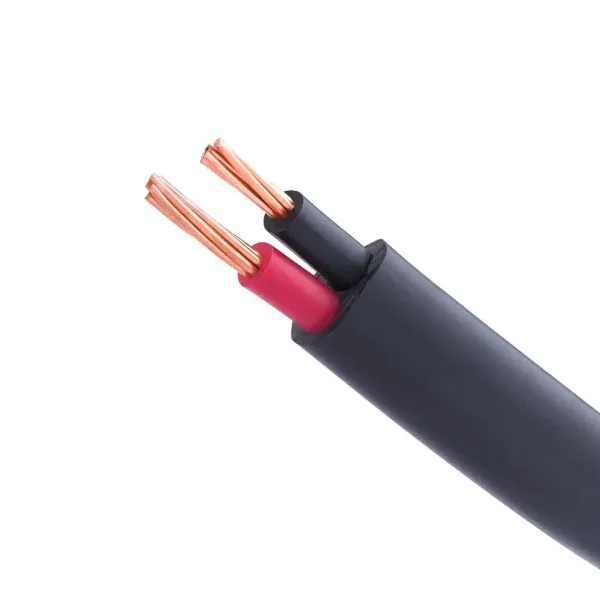
Stranded copper, 7/0.85 class 2, PVC insulated and sheathed, 450/750 V, drawn on the Pilone line in Lahore. Rated 36 A clipped direct at 30°C. The trade calls this coil 7/.036.
Prices track the daily copper rate. Send the length and your city on WhatsApp for the exact figure.
Also made in 4mm²: 4mm 3 core cable, 4mm 3 core flexible cable. One size up: 6mm 3 core cable. The 3 core carries live, neutral and earth in one pull, which is what the control board wants behind it.
We draw the copper in Lahore and sell it at the day's rate — no dealer margin. Tell us the length and your city: Punjab in 1–2 days, rest of Pakistan in 2–4.