
Factory-direct from Lahore · Nationwide delivery in 2–4 days
+92 319 4262451
WhatsApp
Measure at the main board and at the load while the heavy appliance is running: low at both means the supply, normal at the board and low at the load means your cable, and the difference is the drop.
Where it is the cable, the fix is a larger conductor on that run — and the length sets the size, not the current. 2.5 mm² carries 27 A comfortably, but at 20 A over a 30 m run it loses 10.8 V, which is 4.9% of 220 V and outside a 3% budget. Work your own numbers in the voltage drop calculator, or read the tables below.
Every voltage-drop guide written for a stable grid skips this step, and in Pakistan it is the first one. The feeder in the street sags at peak hours whatever you do inside the house, so before anyone buys copper, find out which of the two is losing the volts.
Take two readings at the same moment, with the pump or the AC actually running: one at the main distribution board, one at the appliance terminals. If the board reads 190 V and the appliance reads 188 V, the supply is down and your cable is losing 2 V — a thicker cable buys you those 2 V and nothing else. If the board reads 218 V and the appliance reads 205 V, your own run is losing 13 V, and that is the number a larger conductor removes. Take both readings on the same meter, one after the other, and keep the load constant between them.
The honest conclusion is often the unwelcome one: where the supply itself is low, the answer is a stabiliser or a complaint to the utility, not a bigger coil. We would rather say that than sell the wrong fix.
Voltage drop is the voltage a cable loses along its own length: millivolts per amp per metre, multiplied by the current and by the one-way run. The usual design budget is 3% for lighting circuits and 5% for everything else, measured from the origin of the installation to the point of use. On Pakistan's 220 V single-phase supply that is 6.6 V and 11 V.
Two things about that budget catch people out. It covers the whole path, so the submain from the meter to the board has already spent part of it before the final circuit starts — give a final circuit half the allowance and you will not be caught short. And it is a design limit, not a failure threshold: a motor at 5% down is inside the rules and still starting harder than it would at 2%.
One figure per size does all the work. Multiply it by the current and by the one-way run in metres, then divide by 1,000 to get volts.
| Size | Voltage drop | Capacity, 2 loaded cores | Resistance, class 2 |
|---|---|---|---|
| 1.5 mm² | 29 mV/A/m | 19.5 A | 12.1 Ω/km |
| 2.5 mm² | 18 mV/A/m | 27 A | 7.41 Ω/km |
| 4 mm² | 11 mV/A/m | 36 A | 4.61 Ω/km |
| 6 mm² | 7.3 mV/A/m | 46 A | 3.08 Ω/km |
| 10 mm² | 4.4 mV/A/m | 63 A | 1.83 Ω/km |
| 16 mm² | 2.8 mV/A/m | 85 A | 1.15 Ω/km |
| 25 mm² | 1.75 mV/A/m | 112 A | 0.727 Ω/km |
| 35 mm² | 1.25 mV/A/m | 138 A | 0.524 Ω/km |
A three-phase 400 V run works to different figures and a different budget, and reusing this column for it will undersize the cable. That case is on three-phase cable size.
Turn the sum around and it answers the question people actually have: how far can I go before the size has to change?
| Size | 10 A | 16 A | 20 A | 32 A |
|---|---|---|---|---|
| 1.5 mm² | 22 m | 14 m | 11 m | — |
| 2.5 mm² | 36 m | 22 m | 18 m | — |
| 4 mm² | 60 m | 37 m | 30 m | 18 m |
| 6 mm² | 90 m | 56 m | 45 m | 28 m |
| 10 mm² | 150 m | 93 m | 75 m | 46 m |
| 16 mm² | 235 m | 147 m | 117 m | 73 m |
Measure the run the cable takes, not the distance across the plot: down the wall, along the chase, out through the sleeve and up to the terminal, plus a metre at each end. On a farm or a plot with an outbuilding that route is often twice what people guess.
A socket submain to an outbuilding, 20 A, 30 m one way, single phase. On paper 2.5 mm² is the obvious choice: it is rated 27 A and the load is 20 A, so it passes on current with 7 A to spare.
Now the length. 18 × 20 × 30 ÷ 1000 = 10.8 V, which is 4.9% of 220 V. It clears the 5% limit by a fifth of a volt and fails a 3% budget outright, and that is before the submain feeding the board has spent anything. Step up to 4 mm²: 11 × 20 × 30 ÷ 1000 = 6.6 V, exactly 3.0% — on the line, not inside it. Step up again to 6 mm²: 7.3 × 20 × 30 ÷ 1000 = 4.38 V, 2.0%, with room for the day the load grows.
That is the whole point of this page. All three sizes carry 20 A without getting hot. Only the last two deliver usable voltage at the far end, and the gap between 4 and 6 mm² on a long run is worked through on 4mm vs 6mm cable.
A submersible or a booster pump that runs happily once it is going but refuses to start — hums, draws, trips — is the classic long-cable case, and it is arithmetic rather than a fault. Drop scales with current, and a direct-on-line induction motor pulls a multiple of its running current for the instant it breaks away; the figure is on the motor plate, and it is the one to work with, not a rule of thumb. A run losing 5 V while the pump turns can be losing several times that at the instant it tries to start, and the motor never reaches the voltage it needs.
The same mechanism explains lights that dim when the AC compressor or the water motor kicks in. The starting current is shared with everything on that submain for a fraction of a second, and the dip you see is the drop in the cable feeding all of it. If the dimming is confined to one circuit, look at that circuit's size; if the whole house dips, look at the submain from the meter, or at the supply. Pump runs have their own sizing walk-through on cable for a submersible pump.
Only the share your own cable is losing, and that is usually smaller than people hope. Take a 1,800 W load on an 18 m run at a sagging 190 V: the current is 1800 ÷ 190 = 9.5 A, and the cable's own loss is 18 × 9.5 × 18 ÷ 1000 = 3.08 V on 2.5 mm² against 11 × 9.5 × 18 ÷ 1000 = 1.88 V on 4 mm². Going up a size buys back 1.2 V of the 30 V the street has taken away.
So size the cable for the run because the run demands it, not as a defence against a weak feeder. Where the whole street is down, a stabiliser or the utility is the answer. Where your own board reads fine and the far end does not, the copper is the answer — and one size up is usually enough, because the drop falls roughly in step with the increase in conductor area.
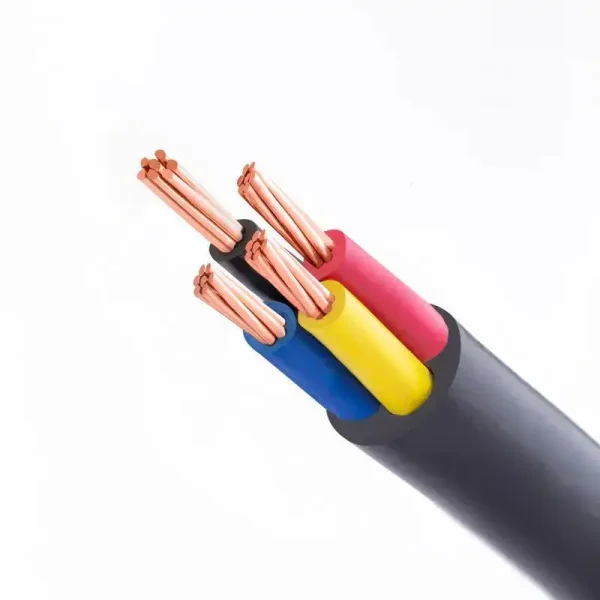
The size most long single-phase runs land on: 7.3 mV/A/m, so 45 m at 20 A inside a 3% budget, and 46 A of capacity on method C. Class 2 stranded copper, 7/1.04, PVC insulated and sheathed to 450/750 V, drawn in Lahore.
Cable is priced off the day's copper rate, so we quote per metre and per coil on WhatsApp. Send the size, the metres and your city: Punjab in 1–2 days, rest of Pakistan in 2–4.
Neighbouring sizes: 4mm 2 core cable price where the run is shorter, 10mm 2 core cable for a submain from the meter, and 6mm 3 core standard cable where the earth runs in the same sheath.
We draw the copper in Lahore and sell it at the day's rate — no dealer margin. Send the load, the one-way run length and your city: Punjab in 1–2 days, rest of Pakistan in 2–4.