
Factory-direct from Lahore · Nationwide delivery in 2–4 days
+92 319 4262451
WhatsApp
2.5 mm² carries 27 A and 4 mm² carries 36 A, both clipped direct at 30°C. Take 2.5 mm² for socket and lighting circuits on a 16 A breaker; take 4 mm² for an AC point, a geyser, or any circuit on a 20 A breaker.
The current rating is only half the decision. 2.5 mm² loses 18 mV per amp per metre and 4 mm² loses 11, so on a long run the thinner cable runs out of voltage budget before it runs out of current capacity. This page is about fixed house wiring on a 220 V supply, not speaker cable.
One size up is a 33% gain in current capacity, a 39% cut in voltage drop, and 60% more copper in the conductor. Those three numbers are the whole argument, and every row below comes from the same two standards.
| Property | 2.5 mm² | 4 mm² |
|---|---|---|
| Standard (class 2) strands | 7/0.67 | 7/0.85 |
| Flexible (class 5) strands | 50/0.25 | 56/0.30 |
| Max resistance, class 2, 20°C | 7.41 Ω/km | 4.61 Ω/km |
| Max resistance, class 5, 20°C | 7.98 Ω/km | 4.95 Ω/km |
| Capacity, 2 loaded cores | 27 A | 36 A |
| Capacity, 3 loaded cores | 24 A | 32 A |
| Voltage drop | 18 mV/A/m | 11 mV/A/m |
| Conductor copper | 22.2 kg/km | 35.6 kg/km |
| Trade code | 7/.029 | 7/.036 |
Read the two-core row for an ordinary single-phase circuit, even on a three-core cable: live and neutral are the only loaded conductors and the earth carries nothing in normal service. The three-core row is for three-phase.
On a 220 V single-phase supply, 2.5 mm² copper is the right size for socket, lighting and small-appliance circuits protected at 16 A, on runs under about 20 metres, clipped or in surface trunking. 4 mm² is the right size for an air conditioner point, a geyser, a kitchen submain, any circuit protected at 20 A, and any run past 20 metres — because at 36 A against 27 A it keeps a working margin over the breaker once the cable is derated for conduit, bundling and summer ambient, and at 11 mV/A/m against 18 it spends its voltage budget more slowly. You drop to 2.5 mm² only when the load, the breaker and the run length all allow it.
Heat decides the size on short runs; length decides it on long ones. Voltage drop is millivolts per amp per metre, times the current, times the one-way run. Take a real circuit: 20 A of load, 20 metres from the distribution board, 220 V supply. On 2.5 mm² that is 18 × 20 × 20 ÷ 1000 = 7.2 V, which is 3.3% of 220 V. On 4 mm² it is 11 × 20 × 20 ÷ 1000 = 4.4 V, or 2.0%. Hold the installation to 3% — 6.6 V on a 220 V supply — and 2.5 mm² has already spent its budget at 20 metres while 4 mm² still has a third of it left.
| Load | 2.5 mm² | 4 mm² | 6 mm² |
|---|---|---|---|
| 10 A | 36.7 m | 60.0 m | 90.4 m |
| 16 A | 22.9 m | 37.5 m | 56.5 m |
| 20 A | 18.3 m | 30.0 m | 45.2 m |
| 24 A | 15.3 m | 25.0 m | 37.7 m |
Across the table 4 mm² buys about 1.64 times the run length of 2.5 mm² at the same current, because 18 ÷ 11 = 1.64. That ratio holds at every load, which is why the question "how far can I run it" has one answer and not a chart full of them. Put your own current and length into the voltage drop calculator before you buy the coil.
No competing page shows this, and it is two lines of arithmetic. IEC 60228 caps a 2.5 mm² class 2 conductor at 7.41 Ω/km measured at 20°C. A PVC cable working at its 70°C conductor rating is 50 degrees hotter, and copper gains roughly a fifth of its resistance over that rise, so call it 7.41 × 1.2 = 8.9 Ω/km. Current flows out along one conductor and back along the other, so the loop is twice that: 2 × 8.9 = 17.8, which the tables round to 18 mV/A/m.
Do the same on 4 mm²: 4.61 × 1.2 = 5.53, doubled is 11.06, tabulated as 11 mV/A/m. The arithmetic reproduces every row of the voltage-drop column on this site, which means you can check our numbers rather than trust them. It also explains why a cable pushed hotter than 70°C drops more than the table says.
The counter does not speak in mm². Ask for 2.5 and you are handed 7/.029; ask for 4 and you are handed 7/.036. The codes are imperial: the first number is the strand count, the second is one strand's diameter in inches. Convert one and the whole system opens up. 0.029 inch × 25.4 = 0.7366 mm; one strand is π/4 × 0.7366² = 0.426 mm²; seven of them make 2.98 mm². The same three steps on 7/.036 give 0.914 mm per strand, 0.657 mm² each, 4.60 mm² in the conductor.
Do it for every code the trade sells and you get the table below. Nobody publishes it, and every line of it can be checked with a calculator.
| Trade code | Strand diameter | Computed area | Sold as | Difference | Capacity, 2 cores |
|---|---|---|---|---|---|
| 3/.029 | 0.737 mm | 1.28 mm² | 1.5 mm² | 15% under | 19.5 A |
| 7/.029 | 0.737 mm | 2.98 mm² | 2.5 mm² | 19% over | 27 A |
| 7/.036 | 0.914 mm | 4.60 mm² | 4 mm² | 15% over | 36 A |
| 7/.044 | 1.118 mm | 6.87 mm² | 6 mm² | 14% over | 46 A |
| 7/.052 | 1.321 mm | 9.59 mm² | 10 mm² | 4% under | 63 A |
| 7/.064 | 1.626 mm | 14.53 mm² | 16 mm² | 9% under | 85 A |
Read the "difference" column carefully, because it is the source of most shop-counter arguments. A code that computes above its nominal size is not a bonus and one that computes below it is not a swindle — they are two naming systems meeting in one market, and the imperial ladder was never built to land on the metric one. 7/.029 computes 19% above 2.5 mm², which is why some sellers call it 3 mm²; 7/.052 computes 4% below 10 mm² and is still sold as 10.
The figure that settles whether a conductor is fit for its label is resistance, because that is what IEC 60228 actually defines: 7.41 Ω/km for 2.5 mm² class 2, 4.61 for 4 mm². Both are measurable on a delivered coil with a decent meter, and a conductor that meets the resistance cap for the size it is sold as is the size it is sold as, whatever the strand code computes to. Ask for the resistance figure, not the reassurance. The two single-core codes are stocked as 7/.036 single core copper cable and 7/.029 copper cable.
Cable is priced off the day's copper rate, so the honest way to compare two sizes is by the copper in them, not by a rupee figure that goes stale in a week. A 2.5 mm² conductor holds 22.2 kg of copper per kilometre; a 4 mm² conductor holds 35.6. Per 100 metres that is 2.22 kg against 3.56 kg, and 35.6 ÷ 22.2 = 1.6. So 4 mm² costs about 1.6 times the copper of 2.5 mm², per core, on the same length — and a three-core cable multiplies both sides equally, so the ratio does not move.
Set that against what it buys: 9 A more capacity, 1.64 times the run length, and a circuit that still clears its breaker after derating. On a single AC point of 15 to 20 metres the whole difference is under two kilograms of copper. Repeated across every circuit in a house it stops being small, which is why a house is wired in 1.5 and 2.5 mm² with 4 mm² kept for the circuits that need it, rather than upsized everywhere. Send us the metres and your city for both rates in one message.
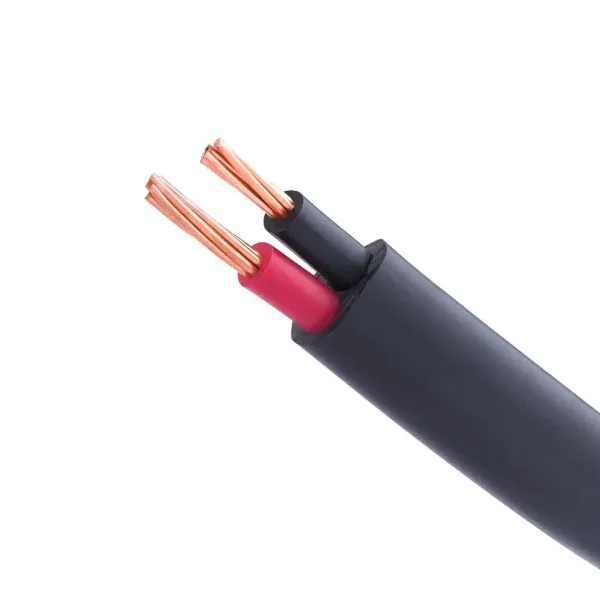
Class 2 stranded copper, 7/0.85, PVC insulated and sheathed, 450/750 V, drawn on the Pilone line in Lahore. Rated 36 A clipped direct at 30°C, 4.61 Ω/km at 20°C.
Cable tracks the daily copper rate, so we quote per metre and per coil on WhatsApp rather than publish a figure that goes stale. Ask for both sizes in one message and compare.
For a circuit with its own earth take the three-core: 4mm 3 core standard cable for a fixed run in conduit, or 4mm 3 core flexible cable where the tail has to bend. At the smaller size, 2.5mm 2 core standard cable and 2.5mm 3 core cable price cover the socket and lighting circuits.
We draw the copper in Lahore and sell it at the day's rate — no dealer margin, and the line that made the coil answers the message. Send both sizes, the metres and your city: Punjab in 1–2 days, rest of Pakistan in 2–4.