
Factory-direct from Lahore · Nationwide delivery in 2–4 days
+92 319 4262451
WhatsApp
2.5 mm² copper on a 16 A MCB, three cores, for the 2 kW element in a typical Pakistani storage or hybrid tank.
A 2000 W element draws 9.1 A at 220 V whether it sits in a 25 gallon tank or a 35 gallon one, so the gallon figure on the carton is not the number that sizes the cable. The rating plate is. 2.5 mm² carries 27 A clipped direct at 30°C, well clear of that element on its 16 A MCB. The tank-by-tank table and the derating arithmetic are on the geyser wire size chart.
A storage or hybrid geyser is wired from the element rating, not the tank size: a 2 kW element draws 2000 ÷ 220 = 9.1 A and takes 2.5 mm² copper — the wire sold as 7/.029 — on a 16 A Type B MCB, three cores so the earth reaches the tank, whether the tank is 15, 25, 30 or 35 gallon. A 3 kW element draws 13.6 A and keeps 2.5 mm² on a clipped or plastered run with the breaker moved to 20 A; a 4.5 kW element draws 20.5 A and needs 4 mm² on 25 A. Those capacities are copper clipped direct at 30°C with two loaded conductors, per BS 7671 reference method C — derate for conduit, grouping and a hot roof void.
The hybrid tank is the default Pakistani geyser: a gas burner underneath, an electric element in the side, and a household that runs it on gas most of the year and switches to electric when the gas pressure drops. That usage pattern tempts people into a thinner wire, on the reasoning that the element hardly ever runs.
It does not work that way. A cable does not carry a seasonal average; it carries whatever passes through it on the day it is switched on, and on a hybrid unit that is the full element current for as long as the water is heating. A 2 kW element is 9.1 A in January exactly as it would be in June. Worse, the winter case is the one where a marginal circuit is loaded hardest: gas pressure is lowest in the cold months, which is precisely when the whole street turns to the element. Wire the electric side as if it were the only side, with its own MCB and its own earth, even if the unit is plumbed for gas from day one.
Storage tanks get re-elemented. The old element burns out, the plumber has a bigger one on the van, and the tank comes back up to temperature faster than it ever did. Nothing about the pipework changes. The circuit changes completely, and nobody tells the distribution board.
| Old element | New element | New current | Existing 2.5 mm² | MCB |
|---|---|---|---|---|
| 1.5 kW | 2 kW | 9.1 A | Holds | 16 A, no change |
| 2 kW | 3 kW | 13.6 A | Holds on a clipped or plastered run; check the derating | 16 A → 20 A |
| 2 kW | 4.5 kW | 20.5 A | No — go to 4 mm² | 16 A → 25 A |
The bottom row is the one worth spelling out. 2.5 mm² carries 27 A clipped direct at 30°C, so against a 20.5 A load it looks like it survives — but it clears a 25 A breaker by only 2 A, and once the cable is in conduit or in a warm ceiling that margin is gone. A 4.5 kW element belongs on 4 mm². And in every row, the breaker has to move with the element: leaving a 16 A MCB on a 3 kW element gives you nuisance tripping, and leaving a 25 A MCB on 2.5 mm² gives you something worse than nuisance.
A storage geyser is a metal tank of water with a live element inside it, mounted where people stand wet. The protective conductor has to run unbroken from the tank body to the distribution board, so the point is a three-core job: live, neutral and earth. Two-core cable has no earth conductor in it and is not an option here, whatever it costs per metre. Where a conduit already carries a separate protective conductor of the right size, two singles plus that earth are acceptable — the earth still has to be there.
Add a 30 mA RCCB on the circuit, keep the MCB, the RCCB and the isolator in the board outside the bathroom, and give the geyser its own way back to that board rather than a spur off the socket circuit. It holds full current for twenty to forty minutes at a time, which is not what a shared socket circuit is designed around. The rest of the room is covered in the bathroom wiring guide.
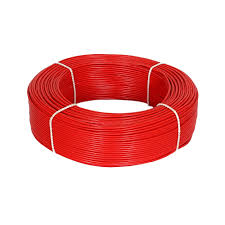
The wire a 2 kW storage or hybrid geyser point is normally pulled in: seven strands of 0.029 inch, about 3.0 mm² of copper, run as live, neutral and earth singles through conduit. Drawn on the Pilone line in Lahore.
Prices track the daily copper rate. Send the length and your city on WhatsApp for the exact figure.
A re-elemented tank at 4.5 kW takes 4mm 3 core standard cable — live, neutral and earth in one sheath, 36 A clipped direct at 30°C — or 4mm 7/.036 single core copper if the point is being pulled as singles. For the earth conductor on its own, see the earth cable range.
We draw the copper in Lahore and sell it at the day's rate — no dealer margin. Send the element wattage off the rating plate, the length and your city: Punjab in 1–2 days, rest of Pakistan in 2–4.