
Factory-direct from Lahore · Nationwide delivery in 2–4 days
+92 319 4262451
WhatsApp
Lights and the exhaust fan on 1.5 mm² — the wire sold as 3/.029 — on a 6 A MCB. Any socket on 2.5 mm² (7/.029) at 16 A sited outside the wet zone, the geyser on its own circuit back to the board, and the whole room behind a 30 mA RCD.
A bathroom is the lightest room in the house electrically and the most dangerous one. Its lighting circuit runs at well under an amp, so ampacity is never the deciding question here — placement, earthing and the geyser feed are.
A washroom in a Pakistani house on a 220 V single-phase supply takes 1.5 mm² copper for lights and the exhaust fan on a 6 A MCB, 2.5 mm² for a socket outlet on 16 A, and a dedicated circuit for the water heater sized to the element on its rating plate — 2.5 mm² for a storage geyser, 4 mm² for an instant one. Every point is earthed, and the room's circuits sit behind a 30 mA residual current device. Those sizes hold for a normal run in conduit; past about 13 m to the geyser, voltage drop takes over, which is worked through below.
| Bathroom point | Typical load | Cable (strand code) | Capacity | MCB |
|---|---|---|---|---|
| Ceiling or shower light | 10–60 W | 1.5 mm² (3/.029) | 19.5 A | 6 A |
| Mirror or vanity light | 10–40 W | 1.5 mm² (3/.029) | 19.5 A | 6 A |
| Exhaust fan | 30–60 W | 1.5 mm² (3/.029) | 19.5 A | 6 A |
| Socket, outside the wet zone | up to 2000 W | 2.5 mm² (7/.029) | 27 A | 16 A |
| Storage geyser point | 1500–3000 W | 2.5 mm² (7/.029) | 27 A | 16 A, dedicated |
| Instant geyser point | 3000–4500 W | 4 mm² (7/.036) | 36 A | 25 A, dedicated |
| Earth conductor to the bathroom | — | 6 mm² (7/.044) | 46 A | — |
The fork on the geyser row is arithmetic, not preference: a 3000 W storage element draws 3000 ÷ 220 = 13.6 A, which 2.5 mm² at 27 A carries with margin, while a 4500 W instant heater draws 4500 ÷ 220 = 20.5 A and needs 4 mm² at 36 A. Take the wattage off your own plate and read the size ladder on the geyser wire size guide or, for a tankless unit, the instant geyser wire size guide.
Add up what a washroom actually draws with the geyser left out: a 40 W ceiling light, a 20 W mirror light and a 50 W exhaust fan is 110 W, which at 220 V is half an amp. The 1.5 mm² conductor feeding it is rated 19.5 A. Nothing on that circuit is anywhere near its limit, and no amount of thicker wire makes a bathroom safer.
What does make it safer is the earth, the RCD and where the accessories sit. Water lowers the resistance of everything, including a person, so a fault current that would be a nuisance in a bedroom is a serious shock in a shower. That is why the bathroom is the one room where the wiring decisions are about layout rather than about size.
This is the number that actually moves in a bathroom, because water heaters end up on roofs and at the far end of the house. 2.5 mm² drops 18 mV per amp per metre. Hold the installation to 3% of 220 V — 6.6 V — and give a final circuit about half of it, 3.3 V, since the run from the meter to the board has already spent the rest.
A 3000 W storage geyser at 13.6 A, 12 m from the board on 2.5 mm², drops 18 × 13.6 × 12 ÷ 1000 = 2.94 V — inside budget, and that budget runs out at about 13 m on this size. Move the same heater to a roof tank 25 m away and 2.5 mm² is at nearly double its share, so the run goes up a size or two.
| Run | 2.5 mm² | 4 mm² | 6 mm² |
|---|---|---|---|
| 10 m | 2.45 V | 1.50 V | 0.99 V |
| 12 m | 2.94 V | 1.80 V | 1.19 V |
| 15 m | 3.67 V | 2.24 V | 1.49 V |
| 20 m | 4.90 V | 2.99 V | 1.99 V |
| 25 m | 6.12 V | 3.74 V | 2.48 V |
Measure the route, not the room — down the wall, along the chase, up through the slab — and put your own length into the voltage drop calculator.
Five points and an earth run make a full washroom: a ceiling light, a mirror light, an exhaust fan, a socket on the dry side and a geyser point, with one earth conductor back to the board. Points times the average run back to the board, times the conductors each run carries.
Lights and fan: 3 × 10 m × 2.5 conductors = 75 m of 1.5 mm². Socket: 1 × 10 × 3 = 30 m of 2.5 mm². Storage geyser on a 12 m run: 1 × 12 × 3 = 36 m, so 66 m of 2.5 mm² in total. Add 15% for cutting waste and it is about 86 m of 1.5 mm² and 76 m of 2.5 mm². The 6 mm² earth is not a points calculation at all: it is a single cut length, about 8 m, run from the bathroom back to the earth bar — measure that route and cut to it.
A coil of house wire in Pakistan is 90 m, so read that result honestly: a bathroom is a cut-length job, not a coil job. Nobody buys wire one washroom at a time. Add these metres to the house list rather than ordering them alone — the method is on how much cable a house needs, and a worked plot total is on 5 marla house wiring. Two bathrooms on one plan roughly double the figures above.
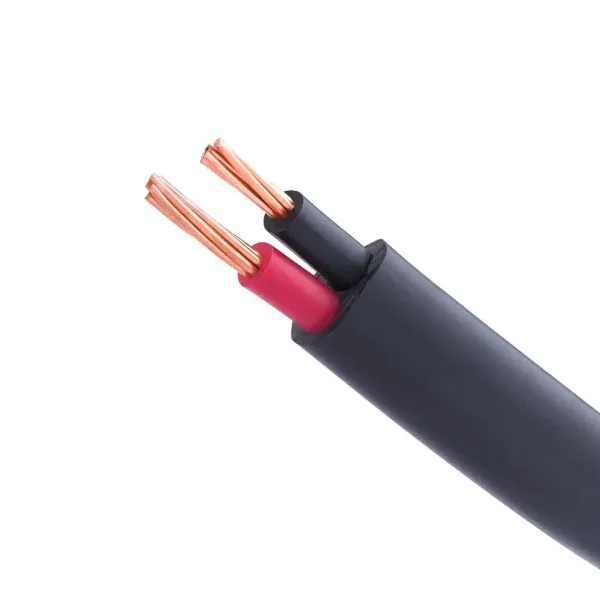
Class 2 stranded copper, PVC insulated and sheathed, 450/750 V, drawn on the Pilone line in Lahore. Rated 27 A clipped direct at 30°C — the size this guide calls for on a socket and on a storage geyser point.
Prices track the daily copper rate, so we quote per metre and per coil on WhatsApp. Send the whole house list and your city rather than one bathroom's cut lengths.
Wiring in conduit is pulled as single core: 3/.029 single core copper cable for the lights and fan, 7/.029 copper cable price for the socket and the storage geyser, 4mm single core copper cable for an instant geyser point, and 6mm single core copper cable for the earth run.
We draw the copper in Lahore and sell it at the day's rate — no dealer margin. Send the full list and your city for today's number: Punjab in 1–2 days, rest of Pakistan in 2–4.