
Factory-direct from Lahore · Nationwide delivery in 2–4 days
+92 319 4262451
WhatsApp
2.5 mm² copper — the wire shops sell as 7/.029 — on a 16 A MCB up to 2000 W. From 2200 W the heater wants its own 20 A way from the board, and a hard-wired 3000 W heater takes 4 mm² (7/.036).
Room heaters run from 1000 W to 3000 W, which is 4.5 A to 13.6 A on Pakistan's 220 V supply. Two things decide where in that ladder you land: the figure on the rating plate, and whether the element sits on a thermostat or straight across the supply.
An electric heater point takes 2.5 mm² copper — 7/.029 in trade code — on a 16 A MCB up to about 2000 W, its own 20 A way from 2200 W upward, and 4 mm² (7/.036) where a 3000 W heater is hard-wired rather than plugged in. The arithmetic is plain: 1000 ÷ 220 = 4.5 A, 2200 ÷ 220 = 10 A, 3000 ÷ 220 = 13.6 A. Against that, 2.5 mm² is rated 27 A clipped direct at 30°C, so it holds margin over a 16 A breaker even after the cable is derated for conduit and heat.
Read your own plate first: rod, halogen, fan and oil-filled bodies of the same size differ by a thousand watts.
| Heater | Typical plate rating | Current at 220 V | Point cable | Trade code | MCB | Own way? |
|---|---|---|---|---|---|---|
| 1-rod or small fan heater | 1000 W | 4.5 A | 2.5 mm² | 7/.029 | 16 A | No — the room socket circuit |
| 2-rod, halogen, small convector | 1500–2000 W | 6.8–9.1 A | 2.5 mm² | 7/.029 | 16 A | No, if nothing else heavy shares it |
| 3-rod or large convector | 2200–2500 W | 10–11.4 A | 2.5 mm², 4 mm² past 16 m | 7/.029 or 7/.036 | 20 A | Yes |
| Fixed heater, hard-wired | 3000 W | 13.6 A | 4 mm² | 7/.036 | 20 A | Yes |
Above 3000 W the job stops being a heater point and becomes a fixed high-load circuit, sized the way the geyser wire size guide works it through. And if the heater in question is an oil-filled radiator on a long lead, the weak part is the lead rather than the wall — that case is set out in the oil heater wire size guide.
A rod or halogen heater is an element straight across the supply with a switch in front of it. Turn it on and it draws its full plate current for as long as it is on, hour after hour. An oil-filled radiator or a convector with a thermostat draws the same current, then shuts the element off once the room is warm and takes it again in bursts. Same plate figure, different thermal duty on the cable.
That is why the ladder moves at 2200 W. Below it a heater still leaves room on the 16 A way for the lamp and the charger already there. Above it, one that never cycles has taken most of the way for itself, and the next thing plugged in on a cold evening trips the breaker.
Distance is the second thing that moves the answer, and it moves it sooner than people expect on the bigger heaters. Take a 2500 W convector at 11.4 A on a point 22 m from the distribution board — an upstairs bedroom on a normal plot. In 2.5 mm² the cable loses 18 × 11.4 × 22 ÷ 1000 = 4.51 V. Hold the installation to 3% of 220 V, which is 6.6 V, give this final circuit half of it at 3.3 V because the submain has spent the rest, and 2.5 mm² is outside the budget. In 4 mm² the same run loses 11 × 11.4 × 22 ÷ 1000 = 2.76 V and is inside it. Heat sets the size on short runs; length sets it on long ones.
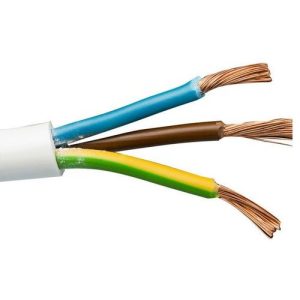
Single-core PVC wiring cable, 450/750 V, drawn on the Pilone line in Lahore. Rated 27 A clipped direct at 30°C — the wire a heater point is pulled in.
Cable tracks the daily copper rate, so we quote per metre and per coil on WhatsApp. Send the length and your city.
For a long run or a hard-wired 3000 W heater, 4mm 3 core cable or the single-core 4mm 7/.036 copper wire.
We draw the copper in Lahore and sell it at the day's rate — no dealer margin. Tell us the metres and your city: Punjab in 1–2 days, rest of Pakistan in 2–4.