
Factory-direct from Lahore · Nationwide delivery in 2–4 days
+92 319 4262451
WhatsApp
For the point in the wall: 2.5 mm² copper — the wire shops sell as 7/.029 — on a 16 A MCB. For the iron's own lead: a made-up 3-core flexible cord, 1 mm² minimum and 1.5 mm² for a 2200 W steam iron.
An iron draws 1000–2200 W, which is 4.5–10 A on Pakistan's 220 V supply. Two different things get called "electric iron wire" and they are not the same purchase. This page sizes both.
Search "electric iron wire" in Pakistan and half the results sell a replacement lead for the iron, half sell wire for the wall. Both searchers are right. Settle which one you are before you buy anything.
| The point cable | The iron's lead | |
|---|---|---|
| Where it runs | Board to the socket in the wall | Plug to the heel of the iron |
| Make-up | 2.5 mm² copper, PVC, fixed wiring | 3-core flexible cord, sheathed |
| Size for a 2200 W iron | 2.5 mm² (7/.029) | 1.5 mm² 3 core |
| Smallest defensible | 2.5 mm² on a 16 A MCB | 1 mm² — rated 10 A |
| What kills it | Heat and derating in conduit | Flexing at the heel, heat off the soleplate |
| Sold as | Cable, cut off a coil | A made-up lead, plug fitted |
| Do we make it? | Yes | No — we sell cable, not fitted leads |
An electric iron needs two different wires and they do not substitute for each other. The point in the wall takes 2.5 mm² copper — 7/.029 in trade code — on a 16 A MCB, because a 2200 W steam iron draws about 10 A and 2.5 mm² is rated 27 A clipped direct at 30°C, leaving margin once the cable is derated for conduit and summer heat. The iron's own lead is a separate 3-core flexible cord, 1 mm² minimum and 1.5 mm² on a 2200 W steam model, because it also has to survive flexing at the heel.
Dry, travel and steam irons are typically rated 1000–2200 W. At 220 V: 1000 ÷ 220 = 4.5 A, 2200 ÷ 220 = 10 A. There is no start surge — an iron is a resistive element on a thermostat — so the question is margin, not inrush. Read your own plate; it is on the heel.
| Parameter | Value |
|---|---|
| Appliance | Electric iron or press (dry, steam, travel) |
| Power, typical | 1000–2200 W |
| Running current at 220 V | 4.5–10 A |
| Load character | Resistive, thermostat cycling, no surge |
| Point cable | 2.5 mm² copper (7/.029) |
| Cores | 3 — live, neutral, earth |
| Breaker | 16 A MCB |
| Socket | 16 A, 3 pin, earthed |
| Appliance lead | 3 core flexible, 1–1.5 mm² |
It carries the current and it still is not the size to run. 1.5 mm² clears a 16 A breaker by 3.5 A before any correction — a margin that conduit, grouping and a Lahore summer spend between them.
| Size | Trade code | Capacity | Voltage drop | Margin on 16 A |
|---|---|---|---|---|
| 1 mm² | — | 10 A | 44 mV/A/m | −6 A |
| 1.5 mm² | 3/.029 | 19.5 A | 29 mV/A/m | +3.5 A |
| 2.5 mm² | 7/.029 | 27 A | 18 mV/A/m | +11 A |
| 4 mm² | 7/.036 | 36 A | 11 mV/A/m | +20 A |
Length settles it a second time. A 2200 W iron on a socket 12 m from the board draws 10 A. On 2.5 mm² the cable loses 18 × 10 × 12 ÷ 1000 = 2.16 V; on 1.5 mm², 29 × 10 × 12 ÷ 1000 = 3.48 V. Hold the installation to 3% of 220 V — 6.6 V — and give the final circuit half, 3.3 V, since the submain has spent the rest. 2.5 mm² is inside that budget at 12 m; 1.5 mm² is already outside it. Check your run in the voltage drop calculator.
Neither failure is about capacity. At the heel the cord bends on every stroke, strands work-harden and break one by one, and the few left carry the whole 10 A through a shrinking cross-section — which is why the sheath goes soft and brown before anything trips. At the plug a screw backs off and 10 A through a poor contact heats the pin. A breaker sees neither: it looks for tens of amps, and both faults are a few watts of heat in one centimetre.
So, plainly: our flexible cable is PVC, 300/500 V, rated 70 °C at the conductor. Right for the point in the wall and for general appliance leads; not the high-temperature silicone lead sold specifically for irons, which we do not make. Fault at the heel, buy a made-up 3-core heat-resistant lead. Fault at the wall — warm socket, browned faceplate — the point cable is what to replace.
Deewar wale point ke liye 2.5 mm² copper — dukaan par ise 7/.029 kehte hain — 16 A MCB par, aur 3-core lein taake earth bhi sath chale. Iron 220 volt par 4.5 se 10 amp kheenchta hai. 1.5 mm² (3/.029) capacity mein guzar to jata hai, magar 16 A breaker se sirf 3.5 amp upar rehta hai, aur conduit aur garmi ke baad woh margin bacha nahi rehta. Iron ka apna wire alag cheez hai: plug se iron tak 3-core flexible lead, kam se kam 1 mm², aur 2200 W steam iron ke liye 1.5 mm² — bani banai li jati hai, coil se kaat kar nahi.
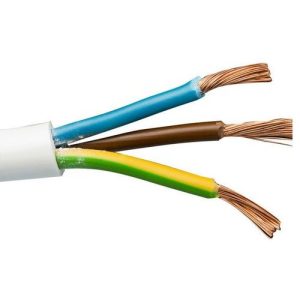
Class 5 stranded copper, 50/0.25, PVC insulated and sheathed, 300/500 V. Rated 27 A clipped direct at 30°C, 70 °C conductor. This is the sheathed 2.5 mm² for a surface run or a spur to the socket — not the 7/.029 single core pulled through conduit.
Cable tracks the daily copper rate, so we quote per metre and per coil on WhatsApp. Send the length and your city.
For the point chased into the wall — the 7/.029 this page sizes — take the single-core 2.5mm 7/.029 copper cable, 450/750 V. Neither of these is the iron's own lead: that is a made-up 3-core heat-resistant cord, and we do not make it. A lighter appliance lead is made in 1.5mm 3 core flexible cable.
We draw the copper in Lahore and sell it at the day's rate — no dealer margin. Tell us the metres and your city: Punjab in 1–2 days, rest of Pakistan in 2–4.