
Factory-direct from Lahore · Nationwide delivery in 2–4 days
+92 319 4262451
WhatsApp
The wall point is 2.5 mm² on a 16 A MCB — the ordinary socket circuit. The lead you plug into it should be 1.5 mm², not 0.75.
A vacuum cleaner draws typically 1,000–2,000 W — 4.5–9.1 A at 220 V, in bursts rather than all day — against 2.5 mm² copper rated 27 A clipped direct at 30°C. The cable that overheats on this job is the lead on the floor, not the wire in the wall: a 0.75 mm² cord is rated 6 A, and 9.1 A through it is 3.1 A over.
A vacuum cleaner in a Pakistani home takes no dedicated wiring: it runs from the ordinary socket circuit, 2.5 mm² copper on a 16 A MCB, which carries 27 A clipped direct at 30°C against a cleaner's 4.5–9.1 A. What has to be sized is the extension lead, and the size is 1.5 mm², rated 19.5 A — not the 0.75 mm² light flex most boards are sold with. Read your own rating plate first: a small stick cleaner and a 2 kW drum machine are not the same load.
| Cable | Carries | Voltage drop | Class 5 strands | Against 9.1 A |
|---|---|---|---|---|
| 0.75 mm² light flex | 6 A | 62 mV/A/m | 24/0.20 | Under-rated by 3.1 A |
| 1 mm² flex | 10 A | 44 mV/A/m | 32/0.20 | Bare minimum, no margin |
| 1.5 mm² flex | 19.5 A | 29 mV/A/m | 30/0.25 | The lead to buy |
| 2.5 mm² point cable | 27 A | 18 mV/A/m | 50/0.25 | The socket circuit itself |
This is how most Pakistani homes actually run a vacuum: one socket, two rooms away, and a reel across the floor. Current first — 2,000 ÷ 220 = 9.1 A.
On the thin white 0.75 mm² flex that cheap boards are made from, the cord is already over its rating before length enters the sum. Add the length and it loses 62 × 9.1 × 10 ÷ 1000 = 5.64 V, which is 2.6% of the 220 V supply spent inside the lead alone, on top of whatever the house run has already used. On a 1.5 mm² lead the same 10 m loses 29 × 9.1 × 10 ÷ 1000 = 2.64 V, and the cord is rated 19.5 A — twice the load, with margin left to stay cool.
Then unwind it. A reel left coiled cannot lose the heat it makes, because every turn sits against warm turns on both sides. Run the drum fully out before you switch the cleaner on, every time, whatever the lead is made of.
An undersized lead does not fail the way people expect it to. PVC insulation is built around a 70°C conductor temperature, and a cord worked above its rating simply lives above that figure — it goes hard and brittle over months rather than melting in one go. The warning signs are a plug that is warm to the touch and a flex that has lost its spring where it enters the plug body. Nothing trips, because nothing has faulted yet.
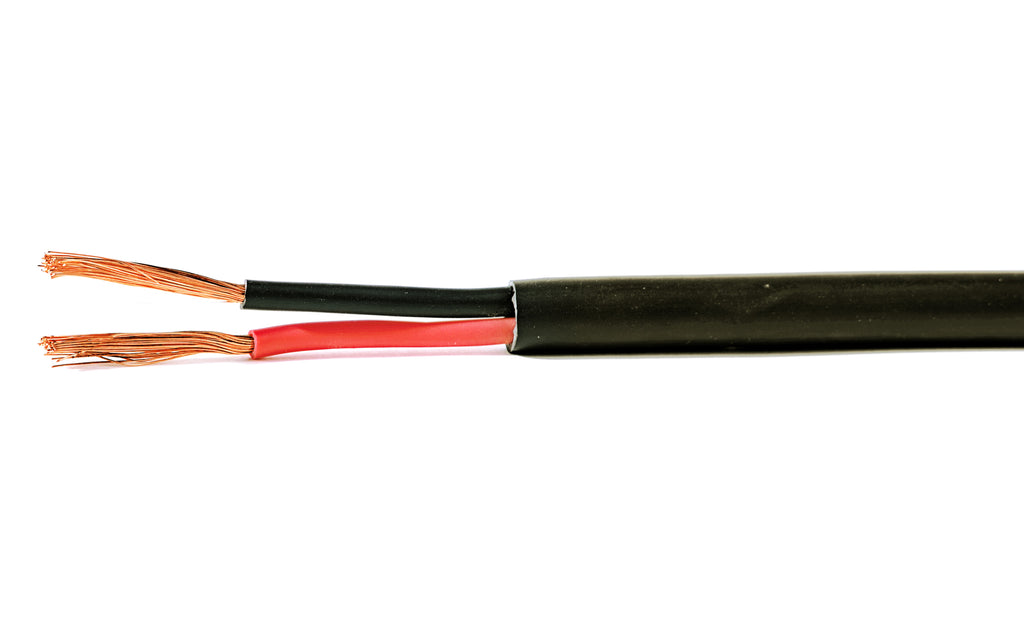
Class 5 stranded copper, 50/0.25, PVC insulated and sheathed, 450/750 V, drawn on the Pilone line in Lahore. Rated 27 A clipped direct at 30°C.
Cable is priced off the day's copper rate, so we quote per metre and per coil on WhatsApp rather than publish a figure that goes stale. Send the metres and your city for the exact number.
For a socket point with the earth in the same cable, take the 2.5mm 3 core flexible cable. For making up an extension lead the size is 1.5mm 3 core flexible cable — three cores, because the cleaner's body needs the earth as much as the wall socket does.
We draw the copper in Lahore and sell it at the day's rate — no dealer margin, and the same line that made the coil answers the message. Tell us the metres and your city: Punjab in 1–2 days, rest of Pakistan in 2–4.