
Factory-direct from Lahore · Nationwide delivery in 2–4 days
+92 319 4262451
WhatsApp
4 mm² copper on its own 20 A MCB, hardwired — the size the trade calls 7/36.
A built-in electric oven draws 2000–3500 W, which is 9.1–15.9 A on Pakistan's 220 V supply, and it holds that current for an hour at a time. 4 mm² is rated 36 A clipped direct at 30°C, so it still clears a 20 A breaker after derating for conduit and a hot kitchen; only an oven at the 2000–2500 W end of the range drops to 2.5 mm² on a 16 A MCB. Run it 3-core so the earth is 4 mm² too, and terminate at a cooker connection unit, not a plug.
A kettle takes 2000 W for three minutes. An oven takes it for ninety. Nothing in the current figure changes, but everything downstream of it does: the cable sits at its working temperature the whole time, the conduit around it warms up, and there is no diversity to borrow — the oven is simply on.
For a built-in electric oven in Pakistan, run 4 mm² copper on a dedicated 20 A MCB: the oven draws 2000–3500 W, which is 2000 ÷ 220 = 9.1 A to 3500 ÷ 220 = 15.9 A, and 4 mm² is rated 36 A clipped direct at 30°C. 2.5 mm² carries the load on paper at 27 A, but apply a 0.75 correction for conduit and kitchen ambient and it becomes 20.3 A against a 20 A breaker — the margin is gone. 4 mm² becomes 27 A and keeps 7 A.
| Parameter | Value |
|---|---|
| Appliance | Built-in electric or baking oven |
| Power, typical | 2000–3500 W |
| Running current at 220 V | 9.1–15.9 A |
| Breaker rating | 20 A MCB, dedicated |
| Live, neutral and earth | 4 mm² copper |
| Trade code | 7/.036 |
| Capacity, 4 mm² | 36 A |
| Derated at 0.75 | 27 A |
| Termination | Cooker connection unit |
The plate on the back of the oven, not the model name, sets the row. Find your wattage, read across, and take the breaker in the last column — the cable is chosen against the breaker, not against the oven.
| Oven rating | Current at 220 V | Cable | Trade code | MCB |
|---|---|---|---|---|
| 2000 W | 9.1 A | 2.5 mm² | 7/.029 | 16 A |
| 2500 W | 11.4 A | 2.5 mm² | 7/.029 | 16 A |
| 3000 W | 13.6 A | 4 mm² | 7/.036 | 20 A |
| 3500 W | 15.9 A | 4 mm² | 7/.036 | 20 A |
| 6000 W, oven + hob | 27.3 A | 6 mm² | 7/.044 | 32 A |
Length rarely decides this circuit, but check it anyway. Hold the installation to 3% of 220 V — 6.6 V — and give the final circuit half of it, 3.3 V, since the submain has spent the rest. A 3000 W oven at 13.6 A on an 18 m kitchen run drops 11 × 13.6 × 18 ÷ 1000 = 2.69 V on 4 mm², inside that 3.3 V. The same run in 2.5 mm² drops 18 × 13.6 × 18 ÷ 1000 = 4.41 V and is over it. The last row is a cooker circuit, not an oven circuit — that job is on the electric stove wire size guide.
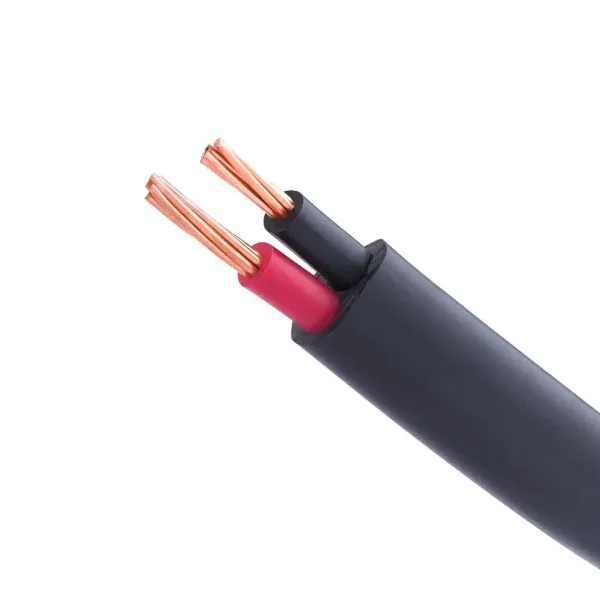
Class 2 stranded copper, 7/0.85, PVC insulated and sheathed, 450/750 V, drawn on the Pilone line in Lahore. Rated 36 A clipped direct at 30°C, 11 mV/A/m, 4.61 ohm/km.
Cable is priced off the day's copper rate, so we quote per metre and per coil on WhatsApp rather than publish a figure that goes stale. Send the metres and your city.
For an oven point take the three-core version so the earth is 4 mm² too: 4mm 3 core cable for the chased run, or 4mm 3 core flexible cable for the tail into the cabinet. The two-core sizes — 4mm 2 core cable price, 4mm 2 core flexible cable — suit circuits with the earth run separately.
We draw the copper in Lahore and sell it at the day's rate — no dealer margin, and the line that made the coil answers the message. Tell us the metres and your city: Punjab in 1–2 days, rest of Pakistan in 2–4.