
Factory-direct from Lahore · Nationwide delivery in 2–4 days
+92 319 4262451
WhatsApp
1.5 mm² copper on a 10 A MCB — the wire the trade sells as 3/29.
A domestic fridge, freezer or deep freezer draws 100–400 W, which is 0.5–1.8 A on Pakistan's 220 V supply, and 1.5 mm² carries 19.5 A clipped direct at 30°C. That margin is not there for the running load, which is tiny. It is there for the compressor start, and for the fact that the cable is buried in a warm wall and shares a conduit.
A fridge is a small load that switches on and off all day. Between cycles it takes almost nothing; when the compressor kicks in, the motor pulls a brief surge — as a rule of thumb two to three times the running current, with the LRA on the rating plate as the figure to trust. That is why a 1.8 A appliance is not wired in the thinnest thing on the shelf.
For a refrigerator point in a Pakistani home, run 1.5 mm² copper on a 10 A MCB, three cores so the earth is 1.5 mm² as well: the appliance draws 100–400 W, which is 100 ÷ 220 = 0.5 A to 400 ÷ 220 = 1.8 A, and 1.5 mm² is rated 19.5 A clipped direct at 30°C. Go up to 2.5 mm² only where the same point also feeds a second cold appliance, or where the fridge socket sits on the general room circuit with heating appliances on it.
| Parameter | Value |
|---|---|
| Appliance | Refrigerator, freezer or deep freezer |
| Power, typical | 100–400 W |
| Running current at 220 V | 0.5–1.8 A |
| Start surge | LRA on the plate — rule of thumb, 2–3× running |
| Breaker rating | 10 A MCB |
| Live, neutral and earth | 1.5 mm² copper |
| Trade code | 3/.029 |
| Capacity, 1.5 mm² | 19.5 A |
The fridge point in the wall is rarely the problem. The lead between the wall and the fridge is. A common extension board is made in 0.75 mm², which is rated 6 A and drops 62 mV per amp per metre — more than twice what 1.5 mm² drops.
| Size | Capacity | Voltage drop | Class 5 strands | Drop at a 5.4 A start, 10 m |
|---|---|---|---|---|
| 0.75 mm² | 6 A | 62 mV/A/m | 24/0.20 | 3.35 V |
| 1 mm² | 10 A | 44 mV/A/m | 32/0.20 | 2.38 V |
| 1.5 mm² | 19.5 A | 29 mV/A/m | 30/0.25 | 1.57 V |
| 2.5 mm² | 27 A | 18 mV/A/m | 50/0.25 | 0.97 V |
Work it through on a 1.8 A fridge whose compressor starts at three times running, so 5.4 A, sitting on a 10 m extension lead: 62 × 5.4 × 10 ÷ 1000 = 3.35 V lost inside the lead itself, at the exact moment the motor most needs voltage. On 1.5 mm² the same start loses 1.57 V. Neither figure trips anything, and neither is a fire — it is the compressor that pays, in a house where the street voltage is already sagging. Run the fridge from a wall socket on its own way from the board.
Very common in Pakistani kitchens and stores, and the current answer is easy: a 250 W fridge and a 350 W deep freezer together are 600 W, or 600 ÷ 220 = 2.7 A. Even if both compressors happened to start together at three times running, 8.1 A still sits inside a 10 A MCB and well inside 1.5 mm². The cable is not the reason to separate them.
The reason is what one fault costs. Share the point and a single tripped breaker, a burnt socket or a chewed lead takes out both stores of food, and in a house that already loses power to load-shedding, that is the failure that actually happens. Two ways from the board, one for each, is a few metres of 1.5 mm² and a spare MCB.
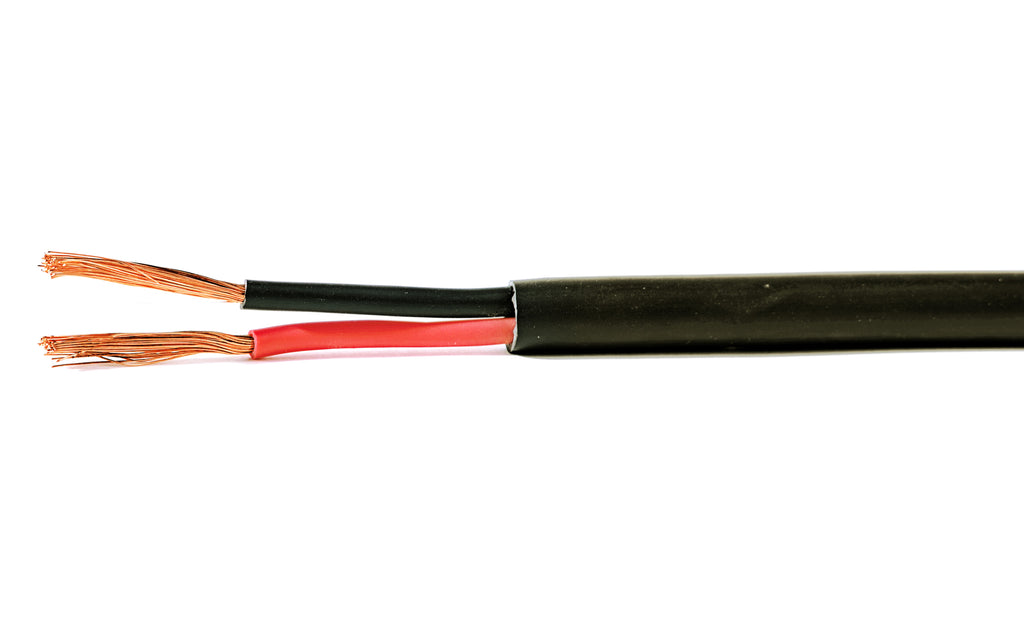
Class 5 stranded copper, 30/0.25, PVC insulated and sheathed, 300/500 V, drawn on the Pilone line in Lahore. Rated 19.5 A clipped direct at 30°C, 29 mV/A/m.
Cable is priced off the day's copper rate, so we quote per metre and per coil on WhatsApp rather than publish a figure that goes stale. Send the metres and your city.
For a fridge point take the three-core version so the earth matches: 1.5mm 3 core flexible cable. For a chased conduit run, 1.5mm single core solid cable pulled as separate conductors. All 1.5mm sizes and specs.
We draw the copper in Lahore and sell it at the day's rate — no dealer margin, and the line that made the coil answers the message. Tell us the metres and your city: Punjab in 1–2 days, rest of Pakistan in 2–4.