
Factory-direct from Lahore · Nationwide delivery in 2–4 days
+92 319 4262451
WhatsApp
4 mm² copper (7/.036) on its own 20 A MCB for a 3000 W stove, the same 4 mm² on a 25 A MCB at 4000 W, and 6 mm² (7/.044) on a 32 A MCB at 6000 W.
Size this one off the rating plate, not off the appliance name. An electric stove's plate figure is the sum of every hotplate and the oven together: 3000 ÷ 220 = 13.6 A, 6000 ÷ 220 = 27.3 A. A cooking range is also the one fixed load that lives in the hottest room in the house, so the derated capacity — not the table figure — is what has to clear the breaker.
An electric cooking stove in Pakistan takes 4 mm² copper on a dedicated 20 A MCB where the plate says 3000 W, 4 mm² on a 25 A MCB at 4000 W, and 6 mm² on a 32 A MCB at 6000 W, always 3 core so the earth matches the live and neutral. Below 2000 W a single hotplate is a plug-in appliance and belongs on the kitchen socket circuit, which is 2.5 mm² on a 16 A MCB. The dividing line is not the size of the stove; it is whether the plate rating stays under 10 A.
| Appliance | Plate rating | Current at 220 V | Cable | MCB | Own way? |
|---|---|---|---|---|---|
| Single hotplate | 1500–2000 W | 6.8–9.1 A | 2.5 mm² (7/.029) | 16 A | No — kitchen socket circuit |
| Double hotplate or small cooker | 3000 W | 13.6 A | 4 mm² (7/.036) | 20 A | Yes |
| Cooking range, hobs and oven | 4000 W | 18.2 A | 4 mm² (7/.036) | 25 A | Yes |
| Large range or double oven | 6000 W | 27.3 A | 6 mm² (7/.044) | 32 A | Yes |
A built-in oven on its own circuit is the same arithmetic on a smaller number — the oven cable size guide works it through. Everything else on the counter, from the kettle to the microwave, stays on the kitchen socket circuit covered in the kitchen wiring guide.
A 4000 W range draws 4000 ÷ 220 = 18.2 A. Both 2.5 mm² and 4 mm² carry that on paper — 27 A and 36 A clipped direct at 30°C. Two corrections separate them. First, length: over a 14 m run 2.5 mm² loses 18 × 18.2 × 14 ÷ 1000 = 4.59 V, while 4 mm² loses 11 × 18.2 × 14 ÷ 1000 = 2.80 V. Hold the installation to 3% of 220 V — 6.6 V — and give this final circuit half of it, 3.3 V, because the submain has already spent the rest. 2.5 mm² is outside that budget; 4 mm² is inside it.
Second, heat. A kitchen ceiling in June is nowhere near the 30°C the table assumes, and the cable is usually in conduit as well. Suppose the correction factors for your method and ambient multiply out to 0.75: 2.5 mm² becomes 27 × 0.75 = 20.3 A, below the 25 A breaker protecting it, while 4 mm² becomes 36 × 0.75 = 27 A and still sits above it. Take the exact factors for your own method from BS 7671; the point is that the derated figure, never the table figure, is what the breaker has to sit under.
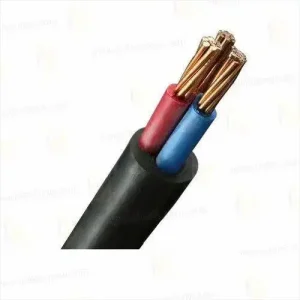
Class 2 stranded copper, 7/0.85, PVC insulated and sheathed, 450/750 V, drawn on the Pilone line in Lahore. Rated 36 A clipped direct at 30°C.
Cable tracks the daily copper rate, so we quote per metre and per coil on WhatsApp. Send the length and your city.
For a 6000 W range take 6mm 3 core standard cable, or the single-core 6mm 7/.044 copper wire where the run is pulled through conduit core by core.
We draw the copper in Lahore and sell it at the day's rate — no dealer margin. Tell us the metres and your city: Punjab in 1–2 days, rest of Pakistan in 2–4.