
Factory-direct from Lahore · Nationwide delivery in 2–4 days
+92 319 4262451
WhatsApp
Single-core copper, sized per circuit: 1.5 mm² (3/.029) for lights and fans, 2.5 mm² (7/.029) for sockets, 4 mm² (7/.036) on its own 20 A MCB for each AC, and 6–10 mm² for the main from the meter to the board.
There is no single best wire for a whole house, because a fan circuit and an AC circuit carry different current — the size follows the circuit. What makes any of those wires "best" is full-gauge strands, pure copper and the right size for the job, none of which a brand slogan supplies. The whole table, with the amps behind it, is below.
A house is wired as separate circuits from the distribution board, and each circuit gets the size its load demands. The loads are simple arithmetic on Pakistan's 220 V supply: a 1.5 ton AC at 1500–1800 W draws 1500 ÷ 220 = 6.8 A up to 1800 ÷ 220 = 8.2 A; a geyser draws its plate wattage over 220 — 2000 W is 9.1 A, 4500 W is 20.5 A; lighting circuits sit under a 6–10 A breaker. Against those loads, this is the sheet:
| Circuit | Size | Trade code | Cable rating | MCB | Worked out in |
|---|---|---|---|---|---|
| Lighting and fans | 1.5 mm² | 3/.029 | 19.5 A | 6 A | 3/.029 single core coil |
| Sockets and kitchen | 2.5 mm² | 7/.029 | 27 A | 16 A | 7/.029 single core coil |
| AC point, one per unit | 4 mm² | 7/.036 | 36 A | 20 A type C | 1.5 ton AC guide |
| Geyser, by plate kW | 2.5–4 mm² | 7/.029–7/.036 | 27–36 A | 16–25 A | geyser cable guide |
| Meter to board (main) | 6–10 mm² | 7/.044–7/.052 | 46–63 A | Main switch, per total load | cable size calculator |
| Earth run to the rods | Same as the main — 6–10 mm² | 7/.044–7/.052 | — | — | earthing wire size guide |
The best wire for house wiring in Pakistan is single-core copper, sized circuit by circuit: 1.5 mm² (the code shops call 3/.029) for lighting and fan circuits on a 6–10 A breaker, 2.5 mm² (7/.029) for socket and kitchen circuits on a 16 A breaker, 4 mm² (7/.036) on its own dedicated 20 A breaker for every air-conditioner point, 2.5–4 mm² for the geyser according to its plate wattage, and 6–10 mm² (7/.044 or 7/.052) for the main cable from the meter to the distribution board. On Pakistan's 220 V single-phase supply, those sizes carry every normal domestic load with margin left after derating. The capacities behind them are read per BS 7671, reference method C at 30°C, with conductors to IEC 60228. A brand name changes none of these numbers: full-gauge strands, pure copper and the correct size for each circuit are what make a house wire the best one.
On the main run, the arithmetic is worth seeing once. Two 1.5 ton ACs draw 2 × 8.2 = 16.4 A and a 3 kW geyser draws 3000 ÷ 220 = 13.6 A — that is 30 A before a single light or socket is counted, which is why the marla guides put 10 mm² (rated 63 A) on the meter run rather than 6 mm² (46 A). Planning a whole build rather than one circuit? The sequencing — when to buy, what the electrician quotes, what goes in before plaster — is on wiring for a new house.
This question, asked in every hardware bazaar, mixes two different choices. 3/29 and 7/29 are single-core wires — the codes name the strands inside one insulated core: 3 strands of 0.029 inch, or 7 of them. So "single core or 3/29" is not a choice at all. The real choices are the size for each circuit (the table above — 3/.029 works out to 1.28 mm², 7/.029 to 3.0 mm², and the full decode is in the strand codes guide) and the build of the conductor — solid, stranded or flexible:
| Build | At 1.5 mm² | At 2.5 mm² | In the wall |
|---|---|---|---|
| Solid (class 1) | 1 strand | 1 strand | Sits firm in screw terminals; stiff around conduit bends. Suits short, straight lighting runs. |
| Stranded (class 2) | 7/0.53 | 7/0.67 | The default Pakistani house wire — 7/.029 is this family; 3/.029 is a three-strand stranded build sold alongside it. Pulls through bends without fight. |
| Flexible (class 5) | 30/0.25 | 50/0.25 | Easiest pull of all; fine strands must be twisted or ferruled at every termination or they stray at the screw. |
Honest trade practice: most houses in Pakistan are wired in stranded class 2, and it is the right default — it handles the bends of a chased conduit run and terminates cleanly. Solid wire (1.5mm single core solid, 2.5mm single core solid) costs a little less to make and holds its shape in accessory terminals; plenty of electricians prefer it for lighting. Flexible in the wall is common too and carries the same current — just insist the electrician terminates it properly. The builds are compared at length in flexible vs solid cable, single core against multi-core sheathed cable in single core vs multi core, and the 3/29-against-7/29 decision has its own guide — the short version is that they are different sizes for different circuits, not competitors.
Every maker in the country calls its wire the best. Strip the slogans and three checks remain, and all three can be done at the shop counter:
Correct size for the circuit is the fourth test, and it is the one this page's table settles. Which company to buy from once a coil passes these checks — how the factories differ and what factory-direct changes — is a separate question with its own page. The size-to-code conversions for every gauge are on the wire size chart.
The same few mistakes appear in house after house, and every one of them is a size decision made for the wrong reason:
Put the table to work on a real plan. A single-storey 5 marla house wires to 11 circuits: 3 lighting circuits on 1.5 mm², 3 socket circuits, 1 kitchen circuit and 1 pump circuit on 2.5 mm², 2 AC points on 4 mm², and 1 geyser circuit — with a 10 mm² main from the meter and a matching 10 mm² earth run. The coil counts and metre totals for that exact set are worked out in the 5 marla house wiring guide.
One check worth doing on any plan is the longest socket run — usually the kitchen. Suppose that run is 15 m from the board and the circuit is carrying 10 A. On 2.5 mm² the cable drops 18 mV per amp per metre, so the loss is 18 × 10 × 15 ÷ 1000 = 2.7 V — inside the 3.3 V half-share of a 3% budget on 220 V (6.6 V for the installation, half spent by the submain). Load the same run to its full 16 A breaker, though, and the drop is 18 × 16 × 15 ÷ 1000 = 4.3 V — over budget, which is why an unusually long, heavily loaded kitchen run sometimes goes up to 4 mm². Run your own lengths through the voltage drop calculator.
Other plot sizes have their own worked lists — 3 marla, 7 marla, 10 marla, 1 kanal — and the method behind all of them is on house wiring cable quantities.
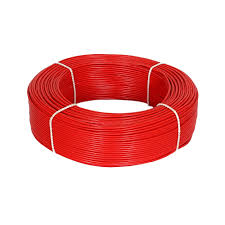
The socket wire of the house — seven full-gauge stranded copper conductors measuring 3.0 mm², PVC insulated to 450/750 V, drawn on the Pilone line in Lahore.
Cable tracks the daily copper rate, so we quote per coil on WhatsApp. Send your circuit list and city — Punjab in 1–2 days, rest of Pakistan in 2–4.
The rest of the house set: 3/.029 single core for lighting, 4mm single core for the AC points, 6mm single core for the earth — all under general wiring.
We draw the copper in Lahore and sell it at the day's rate — no dealer margin, and the line that made the coil answers the message. Send your circuit list and city: Punjab in 1–2 days, rest of Pakistan in 2–4.