
Factory-direct from Lahore · Nationwide delivery in 2–4 days
+92 319 4262451
WhatsApp
About 29 coils — 14 of 1.5 mm², 12 of 2.5 mm² and 3 of 4 mm² — which is roughly 2,520 m of single-core copper, plus about 82 ft of 16 mm² main cable from the meter to the distribution board.
That is a single-storey 7 marla house wired to 60 points on 14 circuits, pulled through conduit, with 15% cut in for wastage. Double storey takes about 53 coils. A coil is 90 m — the length the trade sells house wire in.
A single-storey 7 marla house of about 1,300 sq ft covered area, wired to 60 points on 14 circuits, needs roughly 2,520 m of single-core copper conductor: 1,196 m of 1.5 mm² for lights and fans, 1,042 m of 2.5 mm² for socket, kitchen and pump circuits, 259 m of 4 mm² for three AC points and two geysers, and about 25 m of 6 mm² for the main earth. In 90 m coils that is 14 + 12 + 3 = 29 coils. Those figures carry a 15% wastage margin and assume a centrally placed distribution board, conduit routing and one floor.
The technical world quotes house wiring in metres. Every shop in Pakistan sells it in coils. One standard coil of single-core building wire is 90 m, near enough 100 yards, so the conversion at the counter is metres ÷ 90, rounded up per size.
There is no dedicated 7 marla wiring list published anywhere we could find. Search it and you get 5 marla pages and house-plan drawings. The gap between the two plots is not small: a 7 marla house takes about 8 more coils than a 5 marla and needs a heavier cable from the meter.
Three inputs, multiplied. Change any of them for your own house and the answer moves with you.
60 on a single-storey 7 marla plan: 32 light and fan points, 22 socket points, 3 AC points, 2 geysers, 1 pump. Count yours off the approved layout.
13 m per point: its share of the circuit run back to the DB, plus the ceiling rise and the switch drop. A 1,300 sq ft floor is roughly 30 × 43 ft, so the far corner is a long way from a central board.
2.5 for lighting and fan circuits, where switch legs share neutrals; 3 for socket and appliance circuits, which each carry live, neutral and earth.
Lighting and fans: 32 × 13 × 2.5 = 1,040 m. Sockets and kitchen: 22 × 13 × 3 = 858 m. Pump, on a 16 m run: 1 × 16 × 3 = 48 m, giving 906 m of 2.5 mm². Three ACs and two geysers on 15 m runs: 5 × 15 × 3 = 225 m of 4 mm². Main earth: 22 m. Raw total 2,193 m. Add 15%: 2,193 × 1.15 = 2,522 m. Divide by 90 and round up per size: 29 coils.
Cross-check against the trade rule of 1.5–2 ft of conduit run per sq ft of plot. At 1,575 sq ft that is 720–960 m of runs, and at 2–3 conductors per run, 1,440–2,880 m of conductor. 2,522 m sits inside it. The method itself is on how much cable a house needs.
| Circuit | Size (strand code) | Conductor metres | Coils |
|---|---|---|---|
| Lighting and fan circuits | 1.5 mm² (3/.029) | 1,196 m | 14 |
| Socket, kitchen and pump circuits | 2.5 mm² (7/.029) | 1,042 m | 12 |
| 3 AC points, 2 geyser points | 4 mm² (7/.036) | 259 m | 3 |
| Main earth conductor | 6 mm² (7/.044) | 25 m | cut length |
| Meter to DB main cable | 16 mm² 2 core (7/.064) | 25 m / 82 ft | cut length |
A 7 marla plot is 1,575 sq ft. After setback, stairs and porch you build about 1,300 sq ft per floor — typically three bedrooms, a drawing room, a lounge, a kitchen and two or three bathrooms.
| Room | Light and fan | Socket | Appliance |
|---|---|---|---|
| Bedroom 1 | 5 | 3 | 1 AC |
| Bedroom 2 | 4 | 3 | 1 AC |
| Bedroom 3 | 4 | 3 | 1 AC |
| Drawing room | 5 | 3 | — |
| Lounge | 6 | 4 | — |
| Kitchen | 3 | 4 | — |
| 3 bathrooms | 3 | — | 2 geysers |
| Porch, stairs, outside | 2 | 2 | 1 pump |
| Total | 32 | 22 | 6 |
Coils are only half the planning. The other half is how many ways the board needs, and that is a count you can do exactly rather than guess. Points do not map one-to-one to ways — they group into circuits, and each circuit takes one way.
Three grouping rules cover a house: about 10 light and fan points per lighting circuit; about 8 socket points per socket circuit; and one dedicated way each for anything that draws heavily or must not trip the rest of the house.
| Circuit | Serves | Cable | Breaker | Ways |
|---|---|---|---|---|
| Lighting and fans | 32 points | 1.5 mm² | 6 A | 4 |
| General sockets | 18 points | 2.5 mm² | 16 A | 3 |
| Kitchen | 4 points | 2.5 mm² | 20 A | 1 |
| AC points | 3 points, one way each | 4 mm² | 20 A | 3 |
| Geysers | 2 points, one way each | 4 mm² | 25 A | 2 |
| Water pump | 1 point | 2.5 mm² | 16 A | 1 |
| Circuits used | — | — | — | 14 |
| Spare at 20% | Future AC, a new bathroom, solar | — | — | 3 |
| Board size | 17 ways needed, next stocked size up | — | — | 18 way |
Boards are stocked in 4, 6, 8, 12, 18, 24 and 36 ways, so 17 rounds up to an 18-way. Do not buy the 12-way because the circuits fit: it fits today, and the first thing you add lands on a shared MCB. The spare ways are the cheapest part of the installation and the only part that cannot be added without opening the wall the board sits in.
Three ACs is also the point where a 7 marla house starts pressing on a single-phase connection. Three 1.5 ton units running together are roughly 21–27 A before anything else is switched on. That is still comfortable on a 10 kW connection, but a fourth AC or an instant geyser is the conversation where three-phase starts to make sense.
The upper floor carries about 85% of the ground floor's points — no porch, no main entrance, no pump — and adds a riser from the ground board to a second board upstairs.
| Item | Single storey | Double storey |
|---|---|---|
| Points | 60 | 111 |
| 1.5 mm² coils | 14 | 25 |
| 2.5 mm² coils | 12 | 22 |
| 4 mm² coils | 3 | 6 |
| Total coils | 29 | 53 |
| Conductor metres | 2,522 m | 4,666 m |
| Boards | 1 × 18 way | 1 × 18 way + 1 × 18 way |
| Riser to upper board | — | 16 mm², about 14 m |
The coil list wires the house. It does not feed it. The run from the WAPDA or K-Electric meter to your distribution board is a separate two-core cable, and it is the line missing from almost every plot-size wiring list published.
Assume a 10 kW sanctioned load, typical for a 7 marla domestic connection — read the real figure off your meter card. At 220 V single phase that is 10,000 ÷ 220 = 45.5 A. Over a 25 m (82 ft) run, 10 mm² copper carries 63 A and drops 45.5 × 25 × 4.4 ÷ 1000 = 5.00 V, inside the 11 V that 5% of 220 V allows. So 10 mm² passes. Run 16 mm²: it carries 85 A, drops 3.18 V, and holds when the third AC and the second geyser are both on. The sizing rationale in full is on WAPDA meter cable size; the same run in aluminium is a size up, and is on 16mm 2 core aluminium cable.
Ask for 1.5 mm² at a shop in Pakistan and you will be handed 3/.029. The strand code is the trade's real vocabulary and it is imperial: 3 strands of 0.029 inch. The two systems do not line up exactly, and the gap matters on the first two rows.
| Strand code | True area | Sold as | Usual job |
|---|---|---|---|
| 3/.029 | 1.29 mm² | 1.5 mm² | Lights, fans |
| 7/.029 | 3.0 mm² | 2.5–3 mm² | Sockets, kitchen |
| 7/.036 | 4.6 mm² | 4 mm² | AC, geyser |
| 7/.044 | 6.9 mm² | 6 mm² | Earth, submains |
| 7/.052 | 9.6 mm² | 10 mm² | Meter to DB |
| 7/.064 | 14.5 mm² | 16 mm² | Heavy service run |
3/.029 measures 1.29 mm², under a true 1.5 mm², so keep it on 6 A lighting circuits and off sockets. 7/.029 measures 3.0 mm², over a true 2.5 mm², which is why it is the socket wire here. How to verify a delivered coil against these numbers is set out on the 5 marla wiring page.
| Circuit | Size | Capacity | Voltage drop | Breaker |
|---|---|---|---|---|
| Lighting, fans | 1.5 mm² | 19.5 A | 29 mV/A/m | 6 A |
| Sockets, kitchen, pump | 2.5 mm² | 27 A | 18 mV/A/m | 16 A |
| AC points, geysers | 4 mm² | 36 A | 11 mV/A/m | 20–25 A |
| Main earth | 6 mm² | 46 A | 7.3 mV/A/m | — |
| Meter to DB | 16 mm² | 85 A | 2.8 mV/A/m | 63 A |
Sizing one circuit rather than a whole house? The selection chart is on single-phase cable size, and long runs are settled by the voltage drop calculator.
Published totals for wiring one size of house differ by several times over, and the reason is scope, not the house. One quote is the wire alone; the next adds conduit, boards and accessories; the third adds the electrician. Find out which before you compare two numbers.
| Scope | What is in it | Who supplies it |
|---|---|---|
| A. Wire and cable only | The 29 coils, the 6 mm² earth conductor, the 16 mm² meter-to-DB main cable | Pilone Cables, factory-direct |
| B. A plus fittings | Conduit pipe, back boxes, switches, sockets, the 18-way board and its MCBs, earth electrode | Electrical store |
| C. B plus labour | Chasing walls, laying conduit, pulling wire, terminating, testing, making good the plaster | Your electrician or contractor |
Scope A is the only one we price, and we price it at the day's copper rate because copper is what moves it. Per-point and per-square-foot labour rates sit on cable installation cost. Send the coil list on WhatsApp and scope A comes back as one figure for your city.
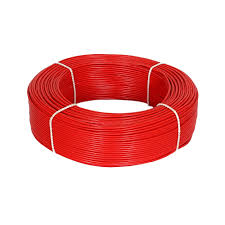
The longest line on a 7 marla list at 14 coils. Stranded copper, PVC insulated, 450/750 V, drawn on the Pilone line in Lahore for lighting and fan circuits.
Prices track the daily copper rate. Send the coil list and your city for today's factory rate on the whole lot.
Also on this list: 7/.029 single core copper cable, 4mm single core copper cable, 6mm single core copper cable for the earth, and 16mm 2 core cable for the meter run.
We draw the copper in Lahore and sell it at the day's rate — no dealer margin. Send the coil list and your city for today's number: Punjab in 1–2 days, rest of Pakistan in 2–4.