
Factory-direct from Lahore · Nationwide delivery in 2–4 days
+92 319 4262451
WhatsApp
Wiring is quoted on one of three bases — per electrical point, per square foot of covered area, or as a material list — and they are not three prices for the same thing. To put a per-square-foot rate beside a per-point rate, multiply it by 20 to 25. The gap between one published total and the next is almost never the house; it is scope — wire only, wire plus fittings and board, or the whole job with labour.
That multiplier is the point density of an ordinary house: about one light, fan, socket or appliance point for every 20–25 sq ft of covered floor. Once two quotes sit on the same basis, everything still between them is scope — whether the wire, the conduit, the board and the plaster repair are inside the rate or bought separately. Pilone Cables is a cable manufacturer, not an installer: we price the material side, at the day's copper rate.
Ask three people what wiring a house costs and you get three answers, because each of them is counting something different. One counts points. One counts floor area. One counts coils of wire. None of the three is wrong and none of them can be set against another until it is converted.
| Basis | What is counted | What the figure normally prices | Who quotes it |
|---|---|---|---|
| Per point | Every light, fan, socket, AC, geyser and pump position | The labour of chasing the wall, laying conduit, pulling conductors and terminating that point | Electrician or contractor |
| Per square foot | Covered area, all floors added | The same labour, averaged across the plan instead of counted point by point | Electrician or contractor |
| Material list | Coils per size, plus cut lengths for the earth and the meter run | The wire and cable itself, delivered to your city | Cable manufacturer or electrical store |
The distance between a per-point quote and a per-square-foot quote is arithmetic, and it closes in one step. The distance between either of them and a material list is scope, and it never closes — they are different purchases, made from different people, on different days of the job.
An ordinary single-storey plan runs about one point for every 20 to 25 square feet of covered area, so a per-square-foot rate multiplied by 20 to 25 gives the equivalent per-point rate, and a per-point rate divided by 20 to 25 gives the equivalent per-square-foot rate. The conversion works in both directions and does not change with the size of the plot, because point density is a property of how a house is laid out rather than of how big it is. What it cannot do is close the gap to a material list: neither rate includes the cable unless the quote says it does.
The density is not a guess. Our own 5 marla point schedule counts 46 points — 24 light and fan, 18 socket, 4 appliance — across about 950 sq ft of covered area on one floor. That is 950 ÷ 46 = 20.7 sq ft behind every point. Plans with more bedrooms and more bathrooms sit nearer 20; open plans with large lounges and long verandas sit nearer 25. Below 20 you are wiring a dense plan and a per-point quote will beat a per-square-foot one; above 25 the reverse.
| Plot | Plot area | Covered, one floor | Points, one floor | Cable list |
|---|---|---|---|---|
| 3 marla | 675 sq ft | 570 sq ft | 23–29 | 3 marla cable list |
| 5 marla | 1,125 sq ft | 950 sq ft | 38–48 | 5 marla cable list |
| 7 marla | 1,575 sq ft | 1,330 sq ft | 53–67 | 7 marla cable list |
| 10 marla | 2,250 sq ft | 1,900 sq ft | 76–95 | 10 marla cable list |
| 1 kanal | 4,500 sq ft | 3,800 sq ft | 152–190 | 1 kanal cable list |
| 2 kanal | 9,000 sq ft | 7,600 sq ft | 304–380 | 2 kanal cable list |
Two cautions on the large plots. A kanal house normally gets a second distribution board, which shortens every final circuit and makes a per-point rate look better against a per-square-foot one than the table suggests. And an upper floor carries roughly 85% of the ground floor's points, not 100% — there is no porch, no main entrance and no pump upstairs — so do not simply double the count for a double storey. A portion or flat is counted the same way, on its own covered area rather than the whole building's.
A house wiring quote can contain eight distinct line items and they come from three different places. Almost no published figure says which of the eight it covers, and that omission — not the house, not the city, not the electrician — is why totals for the same plot differ several times over.
| Line item | What it is | Where it comes from |
|---|---|---|
| Single-core wire, per size | The coils: 1.5 mm² lighting, 2.5 mm² sockets, 4 mm² AC and geyser | Cable manufacturer |
| Meter to DB main cable | A cut length of 2 or 4 core, sized on the sanctioned load | Cable manufacturer |
| Main earthing conductor | Usually 6 mm² from the board to the electrode | Cable manufacturer |
| Conduit, back boxes, junction boxes | The pipe the wire is pulled through, and its fittings | Electrical store |
| Switches, sockets, plates | The accessories at every point | Electrical store |
| Distribution board, MCBs, RCD | The board and its protective devices | Electrical store |
| Earth electrode and its pit | The plate or rod, its pit, salt and charcoal | Electrical store, fitted on site |
| Labour | Chasing, conduit, pulling, terminating, testing, making good | Electrician or contractor |
Ask the question in these words: "Is the wire in your rate, or am I supplying it?" A quote that prices labour alone and a quote that prices the whole electrical package are both honest; they are simply answers to different questions. Put them side by side without asking, and the cheaper one wins an argument it was never in.
Search for what house wiring costs in Pakistan and three figures come back on the same page of results, none of them explaining the others. They are not three estimates of one job. Each prices a different slice of the eight line items above, and set out in that order they stop contradicting each other.
| Scope of the figure | Basis | Published figure | Source |
|---|---|---|---|
| Electrical works for a house, individual lines not itemised | Per square foot of covered area | Rs 50–80 per sq ft | as published by avenirdevelopments.com, read August 2026 |
| Wires and cables only, 5 marla house | Whole-house material total | Rs 4.61 lac | as published by wazirandsons.pk, read August 2026 |
| All electrical works, 5 marla house — material, fittings, board and labour | Whole-house all-in total | Rs 12.79 lac | as published by wazirandsons.pk, read August 2026 |
Put them on one basis and the spread explains itself. A single-storey 5 marla carries about 950 sq ft of covered area, so that per-square-foot band works out at 950 × 50 to 950 × 80 = roughly Rs 47,500 to 76,000 for the house — a labour-order number, and nowhere near either total beside it. The two totals are a scope pair from one publisher: 4.61 lac for the wire and cable alone against 12.79 lac for everything electrical, which leaves 8.18 lac of the larger figure as conduit, accessories, board, earthing and labour rather than cable. Nothing in that spread is the house. A rate is only comparable with a rate that covers the same lines.
The wire quantity barely moves between a new house and a rewire of the same house. The labour moves a great deal, and it moves for reasons that have nothing to do with wiring. In new construction the conduit goes in before the plaster, so pulling wire is a clean pull through empty pipe. In an occupied house the same point means breaking the wall, drawing out the old conductor, laying fresh conduit and then making the plaster good again — three trades where the new build needed one.
This is why a rewire is quoted per point far more often than per square foot: the cost follows the points you actually open up, and half a house rewired is half the points, not half the area. It is also why the sequence matters more than the rate. Wire is ordered at conduit stage, after the pipe is laid and before the plaster — the new house wiring sequence sets out where that falls, and rewiring an old house covers what an existing installation adds to the list.
Of the eight line items above, a cable manufacturer supplies three: the coils, the meter-to-board run and the earthing conductor. That is the part of a cable installation cost that can be quoted precisely, on the same day, against a written list — because it is a count of metres, not an estimate of effort. Copper is most of what a coil costs, so the number tracks the daily copper rate; we draw the wire in Lahore and sell it at that rate with no dealer margin in between.
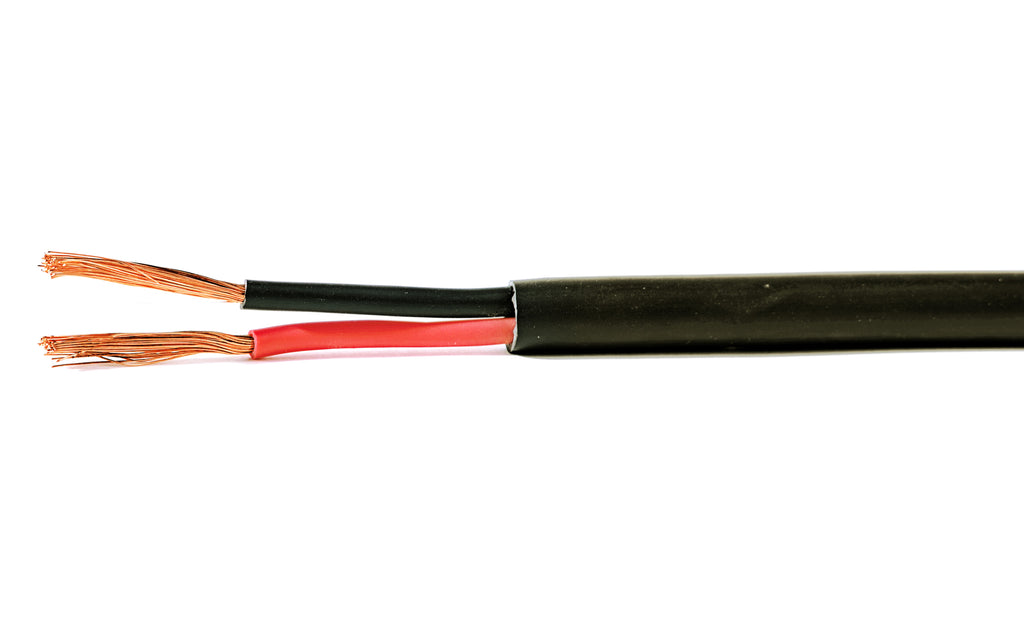
The socket and kitchen wire on almost every house list. Seven stranded copper conductors measuring 3.0 mm², PVC insulated to 450/750 V, drawn on the Pilone line in Lahore.
This is the material line only — no labour, no fittings. Send the coil list per size and your city for today's factory rate on the whole lot.
The rest of a house list: 3/.029 single core copper cable for lighting, 4mm single core copper cable for AC and geyser points, 6mm single core copper cable for the main earth, and 10mm 2 core standard cable or 16mm 2 core cable for the meter run. Every size and its per-metre basis is on the cable price list and cable price per meter.
A rate you cannot multiply is not information. Three numbers turn it into a total, and all three come off your own layout rather than off a price page.
Room by room off the approved plan. It sets the per-point total, the coil list and the number of ways in the board.
Points × average run × conductors, plus margin, on how much wire a house needs.
Which size on which circuit, from the single-phase size chart, and the meter to DB cable as its own line.
We draw the copper in Lahore and sell it at the day's rate — no dealer margin, and no labour in the number. Send the coil list per size and your city: Punjab in 1–2 days, rest of Pakistan in 2–4.