Factory-direct from Lahore · Nationwide delivery in 2–4 days
+92 319 4262451
WhatsApp
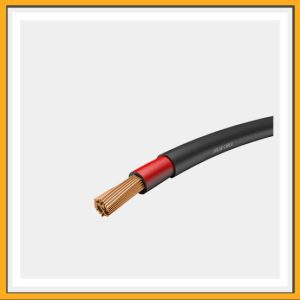
Single-core DC wire for solar systems: 6 mm² of class 5 copper at 84 strands of 0.30 mm, under two PVC layers instead of one. 3.30 Ω/km, about 53 kg of copper per kilometre, 46 A against the two-conductor method C reference. The second jacket buys mechanical protection, not heat rating — it is what survives being pulled through conduit and dragged over a parapet. Drawn on the Pilone line in Lahore.
Prices track the daily copper rate. Bulk and coil pricing on request.
Check the coil before you pay for it
Every coil leaves our factory with a QR code printed on the packaging. Scan it and the factory record for that batch opens: brand, cable size, batch number, year of manufacture and conductor. Compare the batch number on screen with the one printed on your coil — if the two do not match, it did not come from us.
| Property | Value |
|---|---|
| Conductor | Plain annealed copper, class 5 fine stranded |
| Nominal area | 6 mm² × 1 core |
| Strand construction | 84 / 0.30 mm (typical) |
| Max conductor resistance at 20°C | 3.30 Ω/km |
| Current capacity (method C, 2-conductor reference) | 46 A |
| Voltage drop | 7.3 mV/A/m |
| Insulation / sheath | Double PVC, 70°C conductor rating |
| Conductor copper weight | ≈ 53.3 kg/km |
| Reference standards | IEC 60228 (conductors), IEC 60227 (PVC cables) |
6 mm² is the default DC size on Pakistani rooftop jobs — the installer wiring a 3 kW or a 10 kW system buys the same section for the strings and steps up only on the battery side. The choice on this page is not the size, it is the jacket. Double PVC belongs where the cable is protected from the sun but exposed to handling: inside conduit and trunking, down a shaft, along a shaded wall, behind the inverter. Where the run lies open on the roof in June, the 90°C insulation in 6mm XLPE/PVC solar wire is the correct spend, and the 70°C PVC here is not.
Array down to the combiner box or DC isolator, pulled through conduit where the outer jacket takes the abrasion.
Short, high-current links between the bank, the charge controller and the inverter, where the current is large and the volts are few.
Indoor and shaded DC runs between controller, battery and DC loads on tube-well and off-grid installations.
On DC the number that decides the size is usually the voltage drop, not the heat, because the system voltage can be low. Drop is current × route length × 7.3 mV/A/m, divided by 1000. A string carrying 12 A over a 20 m route drops 12 × 20 × 7.3 ÷ 1000 = 1.75 V. On a 400 V string that is 0.4% and nobody notices it. Put the same 1.75 V on a 48 V battery link and it is 3.6%; on a 24 V system, 7.3%. Same cable, same current, three different verdicts — which is why panel strings can be long and battery cables have to be short. Work your own run on the voltage drop calculator and check the size against the 6mm DC cable range.
“Excellent quality copper cables. Fast delivery across Pakistan. Highly recommended for electrical projects.”
“Best cable manufacturer in Lahore. 99.9% pure copper as promised. Very satisfied with the product quality.”
“Good quality cables at competitive prices. Delivery was quick to Karachi. Will order again.”