Factory-direct from Lahore · Nationwide delivery in 2–4 days
+92 319 4262451
WhatsApp
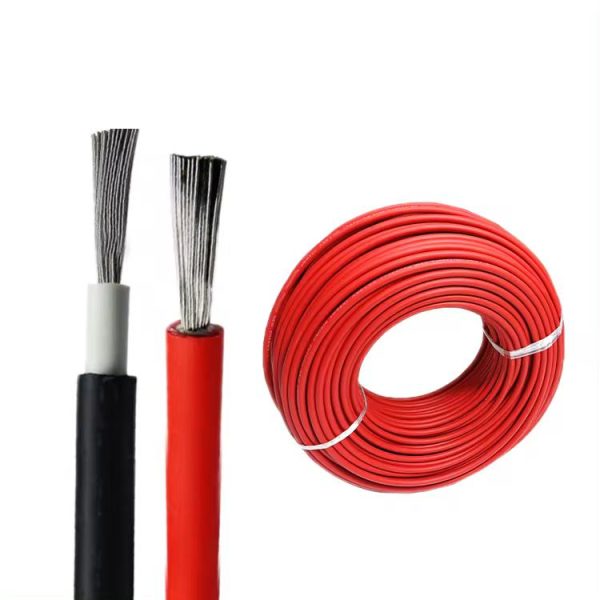
Single-core DC solar cable for runs that live in the sun: 6 mm² of class 5 copper at 84 strands of 0.30 mm, XLPE insulated under a PVC jacket and rated for a 90°C conductor instead of the 70°C a PVC build carries. 3.30 Ω/km, about 53 kg of copper per kilometre, 46 A against the two-conductor method C reference. Drawn on the Pilone line in Lahore.
Prices track the daily copper rate. Bulk and coil pricing on request.
Check the coil before you pay for it
Every coil leaves our factory with a QR code printed on the packaging. Scan it and the factory record for that batch opens: brand, cable size, batch number, year of manufacture and conductor. Compare the batch number on screen with the one printed on your coil — if the two do not match, it did not come from us.
| Property | Value |
|---|---|
| Conductor | Plain annealed copper, class 5 fine stranded |
| Nominal area | 6 mm² × 1 core |
| Strand construction | 84 / 0.30 mm (typical) |
| Max conductor resistance at 20°C | 3.30 Ω/km |
| Current capacity (method C, 2-conductor reference) | 46 A |
| Voltage drop | 7.3 mV/A/m |
| Insulation / sheath | XLPE inner / PVC outer, 90°C conductor rating |
| Conductor copper weight | ≈ 53.3 kg/km |
| Reference standards | IEC 60228 (conductors); solar XLPE cables typically 90°C rated |
This is the cable for the part of a solar job that sits in the open: the module-to-module links, the string run along the rails, the drop from the array down to the inverter. The buyer is the installer, and the question he is actually deciding is not the size — 6 mm² is the standard string section on a 3 kW rooftop and on a 10 kW one — but whether the run needs 90°C insulation. A dark roof in a Lahore June does not sit at shade temperature, and every degree the cable surface runs above ambient comes off the current it can carry. That headroom is the whole difference between this wire and the cheaper 6mm double PVC solar DC wire; the copper inside them is the same.
Module-to-module links and string runs clipped to the rails, in sun and weather from morning to evening.
The long DC run down from the roof to the inverter or charge controller, where part of the route is still exposed.
Row-to-row DC on tube-well and farm arrays, run in trays or clipped along the frames.
Voltage drop is rarely what limits a string at this size. On a string running at 300 V, 10 A over a 35 m roof-to-inverter route drops 10 × 35 × 7.3 ÷ 1000 = 2.6 V, which is 0.85% of 300 V — nothing. Heat is what limits it. The 46 A in the table is a 30 °C ambient figure, and a roof in June is not 30 °C: the tabulated current is multiplied by an ambient correction factor before it means anything on your installation, and a higher-rated insulation is what keeps more of it. We publish the tabulated number and the assumption rather than an invented “real world” figure, because the factor depends on where the cable actually lies. Your installer applies it; the voltage drop calculator handles the length side.
“Excellent quality copper cables. Fast delivery across Pakistan. Highly recommended for electrical projects.”
“Best cable manufacturer in Lahore. 99.9% pure copper as promised. Very satisfied with the product quality.”
“Good quality cables at competitive prices. Delivery was quick to Karachi. Will order again.”