
Factory-direct from Lahore · Nationwide delivery in 2–4 days
+92 319 4262451
WhatsApp
On a site the cable moves. That makes the conductor's construction as much of a decision as its size: class 5 flexible copper for anything that gets recoiled and re-routed, class 2 standard cable for the parts that stay put.
The two are not the same conductor at the same nominal size. Class 5 is built from many fine strands so it survives handling, and it carries up to about 7 percent more resistance than class 2 of the same mm² — 25 mm² is 0.727 Ω/km as class 2 against 0.78 Ω/km as class 5, though the penalty varies by size and disappears at 50 mm². That difference is small on a short tail and it is real on a 90-metre temporary run at the edge of a voltage-drop budget. Both tables are below.
A construction load is unlike a building load in three ways. It is intermittent, so the connected total badly overstates the demand. It is mobile, so the cable is re-routed every few weeks as the work moves up the structure. And it is short-lived but reused, so the same coil is expected to serve the next job. Almost nothing that fails on a site fails because the conductor was too thin.
| Run on the site | Duty | What actually kills it | Construction |
|---|---|---|---|
| Supply to the main site board | Whole site, weeks or months in one place | Vehicles and trench crossings | Fixed class 2, armoured where exposed |
| Site board to sub-boards up the structure | Moves up a floor at a time | Re-termination and rough hauling | Class 5 flexible, cut long |
| Mixer, vibrator, bar bender, cutter | Plugged in and dragged daily | Abrasion on rebar and rubble | Class 5 flexible, sheathed |
| Welding set | Heavy, intermittent draw | Being run while still on the drum | Class 5, fully unwound in use |
| Site cabins, offices, security lighting | Steady, fixed for the job's duration | Standing water at joints and boxes | Fixed class 2, elevated route |
| Tower crane or hoist supply | Heavy motor starts, constant vibration | Terminations working loose | Fixed class 2, properly clamped |
A 25 mm² cable has 25 mm² of copper in it whichever class it is, but the copper is arranged differently and the measured resistance is not identical. Class 2 uses a few thick strands and sits still. Class 5 uses many fine ones so it can be coiled and uncoiled without work-hardening — which is exactly what a site cable does — and pays a small penalty in resistance for it.
| Size | Class 2 strands | Class 2 resistance | Class 5 strands | Class 5 resistance | Difference |
|---|---|---|---|---|---|
| 4 mm² | 7/0.85 | 4.61 Ω/km | 56/0.30 | 4.95 Ω/km | +7.4% |
| 6 mm² | 7/1.04 | 3.08 Ω/km | 84/0.30 | 3.30 Ω/km | +7.1% |
| 10 mm² | 7/1.35 | 1.83 Ω/km | 80/0.40 | 1.91 Ω/km | +4.4% |
| 16 mm² | 7/1.70 | 1.15 Ω/km | 126/0.40 | 1.21 Ω/km | +5.2% |
| 25 mm² | 7/2.14 | 0.727 Ω/km | 196/0.40 | 0.78 Ω/km | +7.3% |
| 35 mm² | 19/1.53 | 0.524 Ω/km | 276/0.40 | 0.554 Ω/km | +5.7% |
| 50 mm² | 19/1.78 | 0.387 Ω/km | 396/0.40 | 0.386 Ω/km | −0.3% |
The last row is worth noticing: at 50 mm² the two classes come out level, and one of them is a hair lower. That is a reminder that this is measured conductor data rather than a rule of thumb, and that the sensible way to use the table is to check the size you are actually buying instead of assuming a fixed penalty. Nothing here changes the current rating — capacity is read against the nominal size, and against the way the cable is installed.
A temporary supply feeding a site distribution board 90 metres away across the plot, drawing 70 A three-phase at 415 V, run on the surface and lifted over the access road.
Capacity. 25 mm² is 96 A with three loaded conductors at 30°C. Take the ambient and grouping factors for a site run as multiplying to 0.80 — yours come from BS 7671, not from this page — and 96 × 0.80 = 76.8 A, which clears 70 A.
Voltage drop, class 2. The three-phase figure for 25 mm² is 1.5 mV/A/m, so 1.5 × 70 × 90 ÷ 1000 = 9.45 V against a 2.5% budget of 10.4 V on 415 V. It passes, with 0.95 V of margin.
Voltage drop, class 5. Now buy the same size as flexible so the run can be recoiled when the board moves. Conductor resistance goes from 0.727 to 0.78 Ω/km, which is 7.3% more, and the drop scales with it — close enough at these sizes, where reactance is a small part of the total. 9.45 × 1.073 = 10.14 V. Still inside 10.4 V, but the margin has fallen from 0.95 V to 0.26 V.
Answer: 25 mm² will do it today, and 35 mm² is the size to buy. A site board does not stay where it was first put. Add twenty metres when the work moves and the class 5 run is over budget; on 35 mm² the same 90 m is 1.1 × 70 × 90 ÷ 1000 = 6.93 V as class 2, or about 7.33 V as class 5, with room for the move. Buying one size up on a temporary run is not waste — the coil goes to the next job. Check your own numbers in the voltage drop calculator, and the full kW to mm² ladder is on 3-phase cable size.
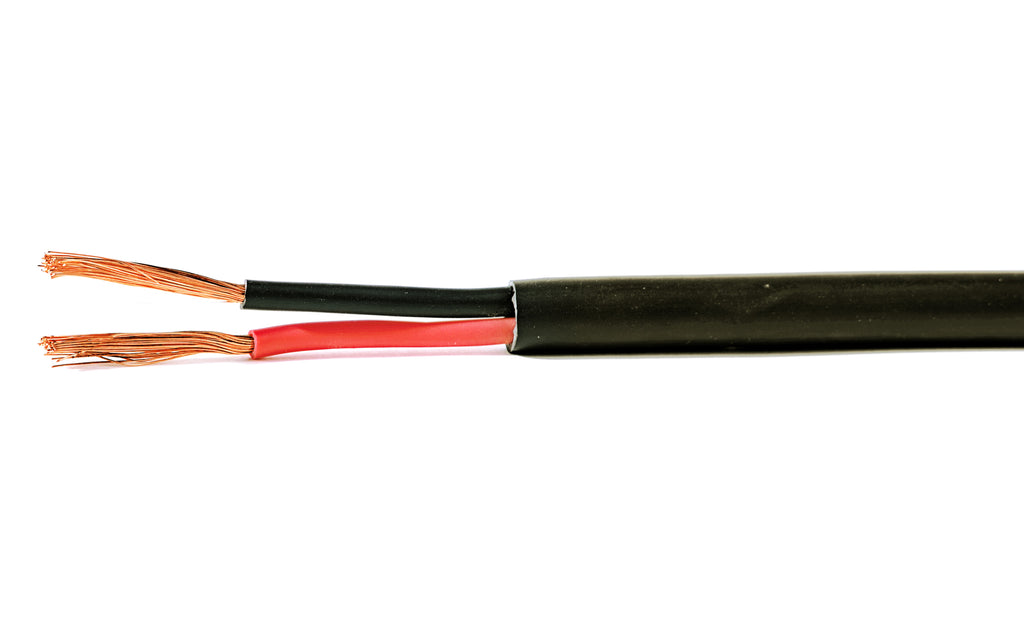
Fine-stranded copper for plant tails, sub-board feeds and anything that gets coiled, dragged and re-terminated as the work moves.
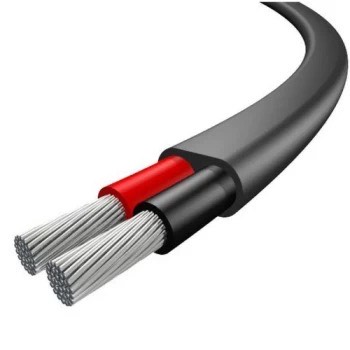
Lower cost per metre where the temporary supply run is long and stays put. The size steps up for the same current; per-size figures on the product page.
The fixed site sizes that leave the Lahore line most often are 25mm 4 core cable and 16mm 4 core cable. Cable is priced off the day's copper rate, so we quote per metre and per coil on WhatsApp rather than publish a figure that goes stale — send the board schedule or a bill of quantities as a photo, with your city: Punjab in 1–2 days, rest of Pakistan in 2–4.
Mark every run as fixed or mobile before you price anything. The fixed runs go on class 2 standard cable; the runs that will be moved go on class 5 flexible, and the two are ordered differently.
The board furthest from the supply sets the size for that circuit, and it is usually the one that gets moved further still. Give us the worst case and the load on it.
Cable is sold by the coil and coil lengths differ between makers, so ask for the coil length with the rate. On a site, a joint in the middle of a run is a fault waiting for the wet season.
Tell us the board loads, the distances, and which runs will be moved during the job. We come back with sizes, the class that suits each run, and the day's factory rate — a bill of quantities gets a line-item answer.