
Factory-direct from Lahore · Nationwide delivery in 2–4 days
+92 319 4262451
WhatsApp
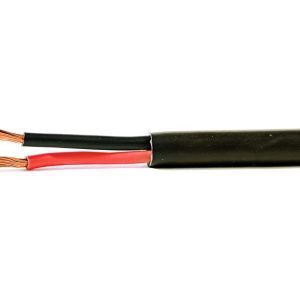
Two 10mm² class 5 cores — live and neutral, no earth inside the sheath — 80 strands of 0.40 mm each, carrying 63 A on two loaded conductors. This is the build generator men and site electricians buy when a heavy single-phase supply has to move and the earth is already made off at the board: a set-to-changeover tail, an inverter tail, a trailing lead feeding a site board. If the earth has to travel with the supply, as it does on a pump or a welding set, that job belongs to 10mm 3 core flexible. 1.91 Ω/km, 4.4 mV/A/m, 300/500 V, about 178 kg of copper per kilometre across the two cores. Drawn on the Pilone line in Lahore.
Prices track the daily copper rate. Bulk and coil pricing on request.
Check the coil before you pay for it
Every coil leaves our factory with a QR code printed on the packaging. Scan it and the factory record for that batch opens: brand, cable size, batch number, year of manufacture and conductor. Compare the batch number on screen with the one printed on your coil — if the two do not match, it did not come from us.
| Property | Value |
|---|---|
| Conductor | Plain annealed copper, class 5 flexible stranded |
| Nominal area | 10 mm² × 2 cores |
| Strand construction | 80/0.40 mm per core (typical) |
| Max conductor resistance at 20°C | 1.91 Ω/km |
| Current capacity (method C, 2 loaded) | 63 A |
| Voltage drop | 4.4 mV/A/m |
| Voltage rating | 300/500 V |
| Insulation / sheath | PVC / PVC, 70°C conductor rating |
| Conductor copper weight | ≈ 178 kg/km (2 × 88.9 kg/km) |
| Reference standards | IEC 60228 (conductors), IEC 60227 (PVC cables) |
Worked example, using the 4.4 mV/A/m in the table. A 40 A generator tail run 15 m from the set to the changeover switch loses 40 × 15 × 4.4 ÷ 1000 = 2.6 V — 1.2% of a 220 V single-phase supply, against the 5% BS 7671 allows on a power circuit. That 5% is 11 V here. Push the same cable to its full 63 A and the 11 V is spent at about 40 m: 11 ÷ (63 × 4.4 ÷ 1000) = 39.7 m. Past that distance the run length picks the size, not the load.
Live and neutral from a solar inverter or UPS across to the changeover switch, on a core set that takes being pulled about every time the battery bank is serviced.
Set to changeover switch or board. 63 A at 220 V covers a set of about 14 kVA.
A heavy lead dragged from the board to where the work is, coiled and dropped daily. The board at the far end takes its earth from its own bar or rod, not from this sheath. For an earthed machine, run 10mm 3 core flexible.
“Excellent quality copper cables. Fast delivery across Pakistan. Highly recommended for electrical projects.”
“Best cable manufacturer in Lahore. 99.9% pure copper as promised. Very satisfied with the product quality.”
“Good quality cables at competitive prices. Delivery was quick to Karachi. Will order again.”