
Factory-direct from Lahore · Nationwide delivery in 2–4 days
+92 319 4262451
WhatsApp
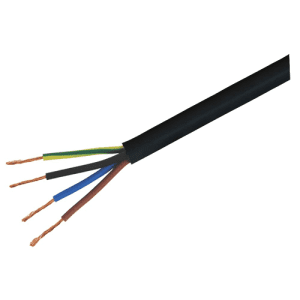
Four 10mm² class 5 cores — three phases and a neutral — for three-phase equipment that does not stay in one place. A generator tail into a changeover panel, a trailing lead to a site board, the tail on a machine that gets shifted between bays. 57 A with three conductors loaded, which is about 39 kVA on a 400 V supply. 80 strands of 0.40 mm per core, 1.91 Ω/km, 4.4 mV/A/m, 300/500 V. Drawn on the Pilone line in Lahore.
Prices track the daily copper rate. Bulk and coil pricing on request.
Check the coil before you pay for it
Every coil leaves our factory with a QR code printed on the packaging. Scan it and the factory record for that batch opens: brand, cable size, batch number, year of manufacture and conductor. Compare the batch number on screen with the one printed on your coil — if the two do not match, it did not come from us.
10mm 4 core flexible cable is quoted at the day's copper rate, per metre.
10 mm² 4 core flexible cable is quoted at the day's copper rate, per metre — send the metres and your city on WhatsApp and today's number comes back. Four cores carry three phases and a neutral, so three conductors are loaded and the cable carries 57 A on BS 7671 reference method C at 30°C, about 39.5 kVA at 400 V. The class 5 conductor — 80 strands of 0.40 mm — is what lets a cable this heavy still be coiled at the end of a job.
A 10mm 4 core flexible cable price is quoted per metre, per foot or per coil depending on who you ask, and the three are not comparable until the unit is stated. Per foot always reads cheapest, because a foot is under a third of a metre. A coil price is meaningless without the coil's length. Put everything on a per-metre footing first, and specify flexible — the standard build in the same size is a different cable at a different rate.
| Quoted as | Length in metres | To get the per-metre rate |
|---|---|---|
| Per metre | 1 m | Nothing to do |
| Per foot | 0.305 m | Multiply the per-foot rate by 3.281 |
| Per yard | 0.914 m | Multiply the per-yard rate by 1.094 |
| Per 90 m coil | 90 m (295 ft) | Divide the coil price by 90 |
| Per 45 m half coil | 45 m (148 ft) | Divide by 45 |
| Per 100 m drum | 100 m (328 ft) | Divide by 100 |
Coil lengths are not standardised here, so get the metre count onto the invoice before you pay. We quote per metre against the length you give us. The price per meter page works through every conversion, and how cable is priced in Pakistan explains what moves the number.
57 A with three conductors loaded, clipped direct at 30°C — about 39.5 kVA on a 400 V supply. The ladder shows what a step of size buys: current, and reach before voltage drop takes over from heat as the thing that picks the size.
| Size | Strands | 2 loaded | 3 loaded | Voltage drop | Copper in a 90 m coil |
|---|---|---|---|---|---|
| 1.5 mm² | 30/0.25 | 19.5 A | 17.5 A | 29 mV/A/m | 4.8 kg |
| 2.5 mm² | 50/0.25 | 27 A | 24 A | 18 mV/A/m | 8.0 kg |
| 4 mm² | 56/0.30 | 36 A | 32 A | 11 mV/A/m | 13 kg |
| 6 mm² | 84/0.30 | 46 A | 41 A | 7.3 mV/A/m | 19 kg |
| 10 mm² | 80/0.40 | 63 A | 57 A | 4.4 mV/A/m | 32 kg |
| 16 mm² | 126/0.40 | 85 A | 76 A | 2.8 mV/A/m | 51 kg |
On a four-core run the neutral is not counted as a loaded conductor for the tabulated rating, which is why a balanced three-phase load sees the same 57 A here as on the three-core build. Where the load is badly unbalanced the neutral carries real current and the assumption stops holding — that is a case for an electrician with a clamp meter, not a table. At full load the 20 V that BS 7671's 5% allows on 400 V is spent at 80 m.
These are clipped-direct figures at 30°C. A flexible cable loaded while still wound on its drum cannot shed heat, and site rules say run it out first for exactly that reason. Conduit, bundling and high ambient each take another bite, handled with BS 7671 correction factors. Work yours out with the cable size calculator and the voltage drop calculator, then have a licensed electrician confirm it.
| Property | Value |
|---|---|
| Conductor | Plain annealed copper, class 5 flexible stranded |
| Nominal area | 10 mm² × 4 cores |
| Strand construction | 80/0.40 mm per core (typical) |
| Max conductor resistance at 20°C | 1.91 Ω/km |
| Current capacity (method C, 3 loaded) | 57 A |
| Voltage drop | 4.4 mV/A/m |
| Voltage rating | 300/500 V |
| Insulation / sheath | PVC / PVC, 70°C conductor rating |
| Conductor copper weight | ≈ 356 kg/km (4 × 88.9 kg/km) |
| Reference standards | IEC 60228 (conductors), IEC 60227 (PVC cables) |
Worked example, using the 4.4 mV/A/m in the table. A 45 A three-phase machine on a 25 m trailing lead loses 45 × 25 × 4.4 ÷ 1000 = 5.0 V — 1.2% of 400 V, well inside the 5% BS 7671 allows on a power circuit, which is 20 V here. At the cable's full 57 A that 20 V budget lasts to about 80 m: 20 ÷ (57 × 4.4 ÷ 1000) = 79.7 m. A three-phase lead buys roughly twice the distance a single-phase one does on the same conductor, because the budget is 5% of 400 V rather than 5% of 220 V.
Same copper, same 10 mm², different stranding. Class 5 divides the area into 80 strands of 0.40 mm; class 2 uses 7 strands of 1.35 mm. Thin strands move against each other as the cable bends, so the conductor tolerates coiling and uncoiling; a thick-stranded class 2 core flexed repeatedly will fatigue and fail inside an undamaged sheath.
| Property | Class 5 (flexible) | Class 2 (standard) |
|---|---|---|
| Strands | 80/0.40 | 7/1.35 |
| Max resistance | 1.91 ohm/km | 1.83 ohm/km |
| Current capacity | 57 A / 63 A | 57 A / 63 A |
| Bends repeatedly | Yes | No |
| Typical use | Site boards, generator tails | Fixed wiring, trays, conduit |
The class 5 build's marginally higher resistance is allowed by the standard and does not change the rating. Pay for flexible only when the cable will move; for a fixed run, 10mm 4 core standard cable is the same copper for less.
Set to changeover panel, three phases and a neutral in one sheath. 57 A covers a set of about 39 kVA at 400 V.
Compressors, welding plant and mixers that get moved between bays and need the neutral as well as the three phases.
Feeding a temporary board on a construction site, on a lead that is run out and re-coiled every day.
Core count follows the circuit, not the load. Two core is line and neutral with a separate earth. Three core is line, neutral and earth, or three phases with no neutral. Four core is three phases plus a neutral, which is what a mixed single-phase load downstream needs. Same 10 mm² conductor in all three.
| Cores | What runs in it | Loaded | Current capacity |
|---|---|---|---|
| 2 core | Line and neutral, earth run separately | 2 | 63 A |
| 3 core | Line, neutral and earth — or three phases, no neutral | 2 or 3 | 63 A / 57 A |
| 4 core | Three phases plus neutral | 3 | 57 A |
The same size in the other builds: 10mm 2 core flexible cable and 10mm 3 core flexible cable. One step up is 16mm 4 core flexible cable at 76 A, which is the largest flexible build we make; one step down, 6mm 4 core flexible cable at 41 A.
Three checks you can run on any seller's cable, ours included, with a weighing scale, a tape and a vernier.
Conductor mass = area × cores × 8.89 kg/km per mm². For 10 mm² 4 core that is 10 × 4 × 8.89 = 356 kg/km, so a 90 m coil holds about 32 kg of copper before insulation and sheath.
A class 5 core at this size is about 80 strands of 0.40 mm. Cut the end square and count. Far fewer, thicker strands means a class 2 conductor being sold as flexible.
Get the metre count in writing before you pay, then check it with a measuring wheel. A short coil is the quietest way a per-coil price stops being the price you calculated.
“Excellent quality copper cables. Fast delivery across Pakistan. Highly recommended for electrical projects.”
“Best cable manufacturer in Lahore. 99.9% pure copper as promised. Very satisfied with the product quality.”
“Good quality cables at competitive prices. Delivery was quick to Karachi. Will order again.”