
Factory-direct from Lahore · Nationwide delivery in 2–4 days
+92 319 4262451
WhatsApp
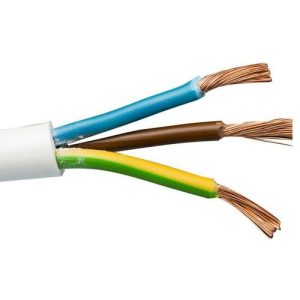
Three 16 mm² class 5 conductors, 126 strands of 0.40 mm each, PVC insulated and sheathed to 450/750 V. Tabulated at 76 A with three loaded conductors on method C at 30°C, and 85 A when only two are loaded — the single-phase case, line and neutral working with the third core as earth, which is about 18.7 kW at 220 V. Site electricians buy it as the feed to a portable distribution board; workshops buy it as the earthed tail from a changeover switch to heavy equipment. The trade orders this size by the code 7/.064.
Prices track the daily copper rate. Coil and bulk pricing on request.
Check the coil before you pay for it
Every coil leaves our factory with a QR code printed on the packaging. Scan it and the factory record for that batch opens: brand, cable size, batch number, year of manufacture and conductor. Compare the batch number on screen with the one printed on your coil — if the two do not match, it did not come from us.
16mm 3 core flexible cable is quoted at the day's copper rate, per metre.
16 mm² 3 core flexible cable is quoted at the day's copper rate, per metre — send the length in metres and your city on WhatsApp and today's number comes back. Two ratings apply and the circuit decides which. Line, neutral and earth loads two conductors and the cable carries 85 A on BS 7671 reference method C at 30°C, about 18.7 kVA at 220 V. Three phases with no neutral loads all three and the figure is 76 A, about 52.6 kVA at 400 V. The class 5 conductor — 126 strands of 0.40 mm rather than the 7 thick strands of the fixed-wiring build — is what lets it be coiled and moved without work-hardening.
The question behind most searches for a 16mm 3 core cable price in Pakistan is not really the rate, it is which unit the rate is in. One shop quotes per foot, which always sounds cheaper because a foot is under a third of a metre. One quotes a coil without saying how long the coil is. Put every quote on a per-metre footing first, and say “flexible” out loud — the standard build in the same size is a different cable at a different price.
| Quoted as | Length in metres | To get the per-metre rate |
|---|---|---|
| Per metre | 1 m | Nothing to do |
| Per foot | 0.305 m | Multiply the per-foot rate by 3.281 |
| Per yard | 0.914 m | Multiply the per-yard rate by 1.094 |
| Per 90 m coil | 90 m (295 ft) | Divide the coil price by 90 |
| Per 45 m half coil | 45 m (148 ft) | Divide by 45 |
| Per 100 m drum | 100 m (328 ft) | Divide by 100 |
A coil is a container, not a quantity, and coil lengths are not standardised here. Get the metre count written on the invoice before you pay. We quote per metre against the length you give us. The price per meter page works through every conversion, and how cable is priced in Pakistan explains why the figure moves week to week.
85 A with two conductors loaded, 76 A with three. On the site boards and generator tails this cable usually feeds, the third core is the earth and the number that applies is 85 A — about 18.7 kVA at 220 V (85 × 220 ÷ 1000). Where all three cores carry a phase, use 76 A, about 52.6 kVA at 400 V (1.732 × 400 × 76 ÷ 1000).
| Size | Strands (class 5) | 2 loaded | 3 loaded | Voltage drop | Copper in a 90 m coil |
|---|---|---|---|---|---|
| 4 mm² | 56/0.30 | 36 A | 32 A | 11 mV/A/m | 9.6 kg |
| 6 mm² | 84/0.30 | 46 A | 41 A | 7.3 mV/A/m | 14 kg |
| 10 mm² | 80/0.40 | 63 A | 57 A | 4.4 mV/A/m | 24 kg |
| 16 mm² | 126/0.40 | 85 A | 76 A | 2.8 mV/A/m | 38 kg |
Heat sets one limit and run length the other. A 70 A single-phase board 25 m from the supply drops 70 × 25 × 2.8 ÷ 1000 = 4.9 V, which is 2.2% of 220 V and inside the 11 V that BS 7671's 5% allows. Load the same cable to its full 85 A and the 11 V is gone at 11 ÷ (85 × 2.8 ÷ 1000) = 46 m. On a trailing lead that gets extended job after job, that distance arrives sooner than people expect.
Both figures assume the cable is clipped direct in open air at 30°C. Coiled on a drum it is worse, not better: a cable carrying current while wound on its reel cannot shed heat, which is why site rules say run it out before you load it. Pull it through conduit, bundle it, or work under a Lahore roof in June and derate again. Work yours out with the cable size calculator and the voltage drop calculator, then have a licensed electrician confirm it.
| Property | Value |
|---|---|
| Conductor | Plain annealed copper, class 5 flexible stranded |
| Nominal area | 16 mm² × 3 cores |
| Strand construction | 126 / 0.40 mm per core (typical) |
| Max conductor resistance at 20°C | 1.21 Ω/km |
| Current capacity (method C, 3 loaded) | 76 A |
| Voltage drop | 2.8 mV/A/m |
| Voltage rating | 450/750 V |
| Insulation / sheath | PVC / PVC, 70°C conductor rating |
| Conductor copper weight | ≈ 426.6 kg/km (3 × 142.2 kg/km per core) |
| Reference standards | IEC 60228 (conductors), IEC 60227 (PVC cables) |
Check the run length against the load before you buy the coil. A site distribution board pulling 60 A over a 30 m flexible feed drops 60 × 30 × 2.8 ÷ 1000 = 5.04 V — 2.3% of 220 V, inside the 5% BS 7671 allows on a power circuit, which is 11 V here. At the cable's full 76 A the same 11 V is reached at 11 000 ÷ (76 × 2.8) = 52 m. Beyond that the run length sets the size, not the load.
Flexible and standard are the same copper and the same 16 mm². What differs is how that area is divided. Class 5 splits it into 126 strands of 0.40 mm; class 2 uses 7 strands of 1.70 mm. Thin strands slide past each other when the cable bends, so the conductor survives being coiled and uncoiled; thick strands do not, and a class 2 core repeatedly flexed will eventually break inside an intact sheath.
| Property | Class 5 (flexible) | Class 2 (standard) |
|---|---|---|
| Strands | 126/0.40 | 7/1.70 |
| Max resistance | 1.21 ohm/km | 1.15 ohm/km |
| Current capacity | 76 A / 85 A | 76 A / 85 A |
| Bends repeatedly | Yes | No |
| Typical use | Trailing leads, portable boards | Fixed wiring, trays, conduit |
The slightly higher resistance of the class 5 build is in the standard and is not a defect: more strands means more surface and a fractionally longer path. It does not change the current capacity. Pay for the flexible build when the cable will actually move — for a run clipped to a wall that will never be touched again, 16mm 3 core standard cable is the same copper for less money.
Line, neutral and earth to a site board or temporary supply point, on a cable that can be coiled and carried to the next job.
Socket and machine circuits above roughly 60 A, where the protective conductor has to travel inside the same sheath.
The tail between a single-phase genset, its changeover switch and the load, with the earth carried through the run.
Who buys this size: site contractors, event and rental crews, and workshops running heavy single-phase equipment. The circuit is a 220 V feed with its own earth — in almost every job this cable goes into, the third core is the protective conductor and not a second phase. Where all three cores are loaded, as on three phases with no neutral, the rating drops from 85 A to 76 A, which is why both figures are printed above. For a run that will never move, 16mm 3 core standard cable is the same copper in the cheaper class 2 build. For three phases plus a neutral, take 16mm 4 core flexible cable.
Core count follows the circuit, not the load. Two core is line and neutral with the earth taken separately. Three core is line, neutral and earth — or three phases without a neutral. Four core is three phases plus a neutral. The conductor is the same 16 mm² in every build; what changes is how many conductors are loaded.
| Cores | What runs in it | Loaded | Current capacity |
|---|---|---|---|
| 2 core | Line and neutral, earth run separately | 2 | 85 A |
| 3 core | Line, neutral and earth — or three phases, no neutral | 2 or 3 | 85 A / 76 A |
| 4 core | Three phases plus neutral | 3 | 76 A |
The same size in the other builds: 16mm 2 core flexible cable and 16mm 4 core flexible cable. One step down in the same three-core flexible build is 10mm 3 core flexible cable at 57 A on three loaded conductors. 16 mm² is the largest flexible build we make — above it the fixed class 2 family takes over, starting at 25mm 3 core standard cable.
“Full gauge” is a claim on a lot of listings and it rarely arrives with a test you can run. Here are three you can run on any seller's cable, ours included. They need a weighing scale, a tape and a vernier.
Conductor mass = area × cores × 8.89 kg/km per mm². For 16 mm² 3 core that is 16 × 3 × 8.89 = 427 kg/km, so a 90 m coil holds about 38 kg of copper before insulation and sheath.
A class 5 core at this size is about 126 strands of 0.40 mm. Count them on a squarely cut end. A flexible cable built on far fewer, thicker strands is a class 2 conductor being sold as flexible.
Get the metre count in writing before you pay, then check it with a measuring wheel. A short coil is the quietest way a per-coil price stops being the price you calculated.
“Excellent quality copper cables. Fast delivery across Pakistan. Highly recommended for electrical projects.”
“Best cable manufacturer in Lahore. 99.9% pure copper as promised. Very satisfied with the product quality.”
“Good quality cables at competitive prices. Delivery was quick to Karachi. Will order again.”